Seminar
| Parent Program: | -- |
|---|---|
| Location: | SLMath: Eisenbud Auditorium, Online/Virtual |
From the Space Sciences Laboratory at the University of California, Berkeley:
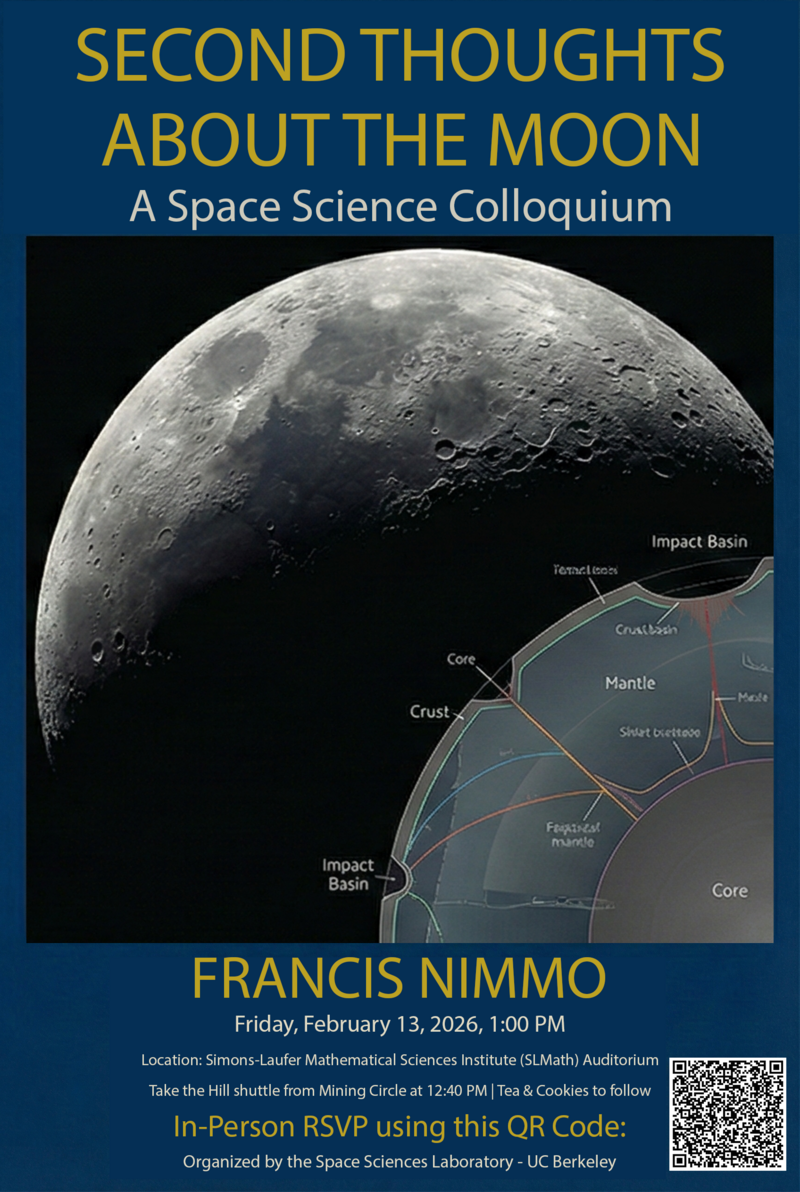
We are thrilled to invite you all to a special colloquium featuring Francis Nimmo, Professor of Earth and Planetary Sciences at UC Santa Cruz, as he kicks off our new premier seminar series this year. SLMath members and visitors are welcome to join this event - RSVP below.
Event Details
-
Date: Friday, February 13, 2026
-
Time: 1:00 PM – 2:00 PM
-
In-Person Location: Simons Laufer Mathematical Sciences Institute (SLMath) Eisenbud Auditorium
-
In-Person RSVP: If you plan to attend in person, please fill out the RSVP form here: https://docs.google.com/forms/d/e/1FAIpQLSdOKq6pPDyjthQ_WIRdaJtPEMEmJMkySP06mx7jOGrKLcpJJQ/viewform
-
Virtual Participation: Join via Zoom
-
Link: https://berkeley.zoom.us/j/92310248808
-
Meeting ID: 923 1024 8808
-
-
Shuttle: Take the Hill shuttle at 12:40 PM from Mining Circle.
-
Networking (In-Person): Tea and cookies to follow at 2:00 PM on the SSL Patio.
Talk Title: Second thoughts about the Moon
Abstract: Some lunar theories developed in the immediate aftermath of the Apollo missions are getting a little threadbare. In this talk, I'll discuss three issues that are being re-addressed: how the Moon formed; when it formed; and how asymmetric it is. I'll also pay attention to how predictions might be tested with upcoming or active lunar missions.
About the Speaker: Francis Nimmo's interests are the interiors and evolution of solid solar system bodies. He received his BA in 1993 and PhD in 1996, both from Cambridge University. He joined the faculty at UC Santa Cruz in 2005 and received the Macelwane medal and Urey prize in 2007. He has served on the GRAIL, Cassini, New Horizons, and InSight missions and is currently a member of four teams on the Europa Clipper mission. He was elected to the National Academy of Sciences in 2020 and the Royal Society in 2024.
This colloquium is open to the wider Berkeley community. SSL particularly welcomes colleagues from Astronomy, Physics, and Earth & Planetary Science (EPS) to join this inaugural event.