

Summer Graduate School
| Parent Program: | -- |
|---|---|
| Location: | Columbia University |
Show List of Lecturers
- Matthias Christandl (University of Copenhagen)
- Jeroen Zuiddam (University of Amsterdam)
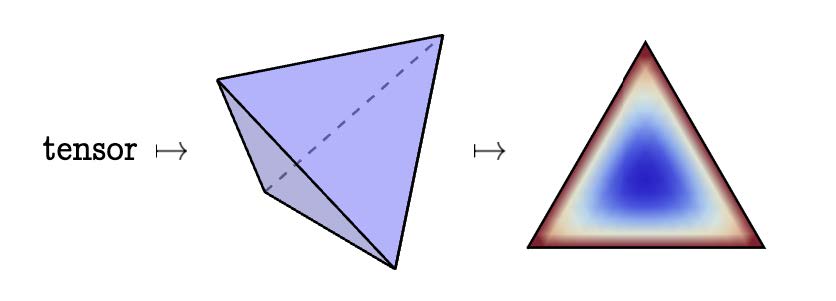
Tensors play a central role in various areas of mathematics, physics and computer science: from constructing fast matrix multiplication algorithms in algebraic complexity theory to the study of entanglement in quantum information. While matrices (order-two tensors) are very well understood, tensors have a much more intricate structure, and much about them is still unknown, despite much interest.
In this lecture series we will discuss foundations and recent advances in the theory of tensors and their applications across computer science and physics. Professor Zuiddam's lectures will present Strassen’s pioneering perspective on tensors and algebraic complexity theory developed in Strassen’s quest to understand the complexity of matrix multiplication. Along the way we will see various applications, various notions of tensor rank, and old and new methods and results.
Professor Christandl's lectures will focus on quantum information theory; he will discuss the relation of tensors to multiparticle entanglement, to tensor networks used in the description of many-body quantum states, as well as the quantum and classical computational complexity of representation-theoretic coefficients arising in the study of the tensor. We note that the topic also connects closely to that of the quantum marginal problem, a foundational problem in the field of quantum information theory.
School Structure
Through ten focused lectures, participants will gain an integrated view of tensors as a unifying concept across complexity theory, representation theory, and quantum information.
Each day has two 1-hour lectures (one in the morning and one in the early afternoon). There will also be exercise and review sessions led by the teaching assistants after each lecture (1 hour in the morning and 1 hour in the afternoon).
Prerequisites
We highly recommend having taken an advanced undergraduate course in algebra, such as MATH GU4041 offered at Columbia University. An introductory algebra textbook such as T. Judson’s Abstract Algebra: Theory and Applications would be more than sufficient to cover the algebra background needed. Familiarity with basic representation theory, e.g., that of the symmetric group, would be helpful, though not required (we recommend Bruce Sagan’s The Symmetric Group: Representations, Combinatorial Algorithms, and Symmetric Functions as a reference).
An optional pre-reading assignment before the summer school would be to read the first two lectures of Michael Walter’s course on symmetry and quantum information.
Application Procedure
SLMath is only able to support a limited number of students to attend this school. Therefore, it is likely that only one student per institution will be funded by SLMath.
For eligibility and how to apply, see the Summer Graduate Schools homepage.
Venue
The summer school will take place at Columbia University in New York.
tensors
complexity theory
quantum information
algebraic algorithms