

Summer Graduate School
| Parent Program: | -- |
|---|---|
| Location: | SLMath: Eisenbud Auditorium, Atrium |
Show List of Lecturers
- Seraphina Eun Bi Lee (Harvard University)
- Matthew Stover (Temple University)
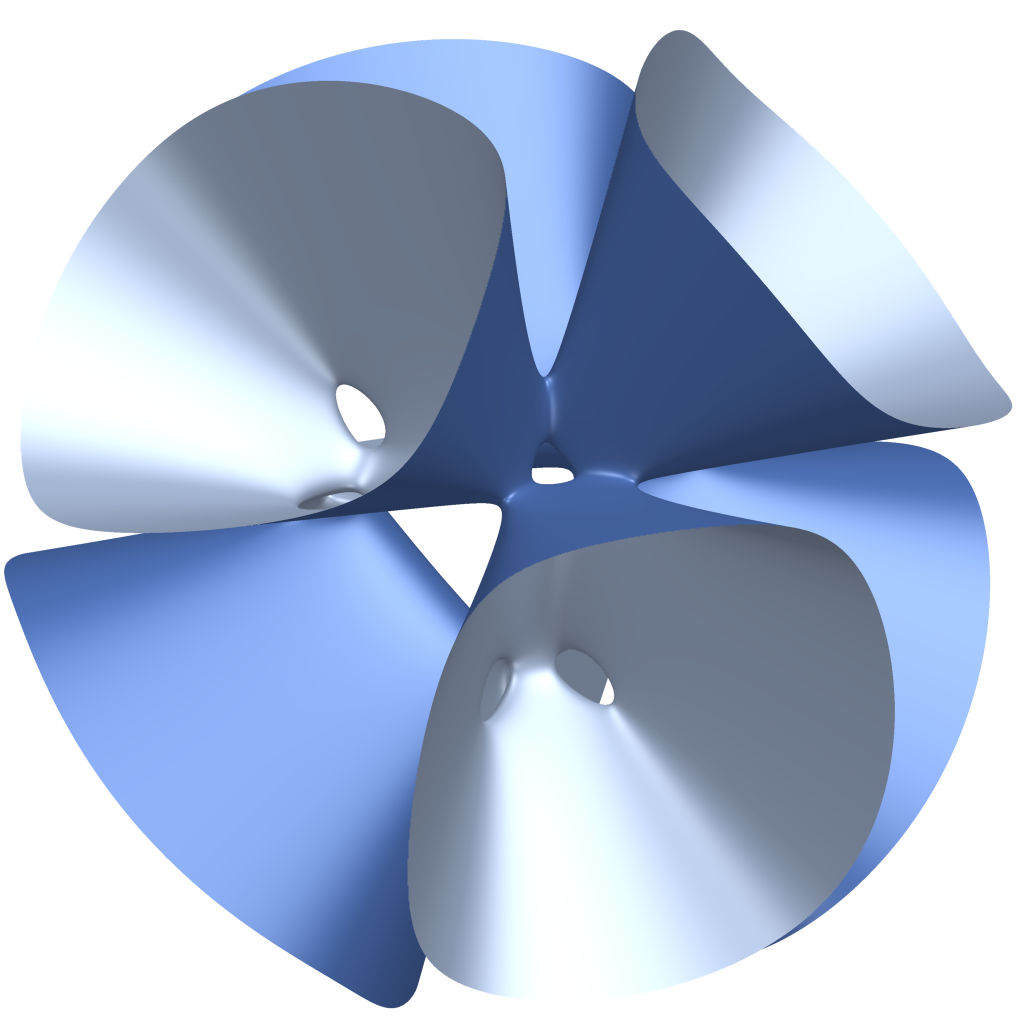
The study of complex projective surfaces is yet to attain the level of realization and widespread prevalence as that of curves. The classification of surfaces is far from complete, and many basic problems remain open. This is particularly pronounced in geometric topology, where understanding of algebraic curves (i.e., Riemann surfaces) is essential knowledge but, for just one example, applications of surface theory to studying the geometric topology of four-dimensional manifolds are very limited at the present moment. One reason for this gap is the much higher bar of entry found in standard texts on surfaces, whereas the study of algebraic curves is standard introductory graduate material.
The purpose of this summer school is to close the background gap and connect young researchers with different backgrounds that are, perhaps unbeknownst to themselves, well-poised to fruitfully collaborate on important problems at the interface of geometric topology and surface geometry. Despite the seemingly high bar of entry one encounters in the first pages of books on algebraic surfaces, the premise of this summer school is that it is far easier to develop a sufficient working knowledge of the subject and begin learning deep results and techniques. Consequently, this summer school is designed to be accessible to any graduate student that has completed basic introductory graduate courses.
School Structure
Week 1: Bootcamp: Each day of the bootcamp will consist of two 60 minute lectures, morning and afternoon, one 60-minute morning collaborative problem session, and an open-ended late-afternoon collaborative problem session.
Week 2: Mini-courses: The second week of the summer school will be dedicated to two mini-courses, along with problem sessions of similar structure and scope as the first week.
Prerequisites
Standard graduate courses in algebra (e.g., Dummitt & Foote: Chapters 1-5, 7, 9, 11, 13-14), differential topology (e.g., Guilleman & Pollack: Chapters 1-4), algebraic topology (e.g., Hatcher - Chapters 0-3), and complex analysis (e.g., Ahlfors: Chapters 1-6).
Specifically, participants should have basic working knowledge of smooth manifolds, basics on Riemann surfaces and holomorphic mappings, fundamental groups, homology and cohomology, and differential forms. Some facility with basic algebraic geometry will be helpful but not required. There is no implicit Riemannian geometry expectation.
Recommended Readings: Chapters 1 and 2 of Algebraic Curves and Riemann Surfaces by Miranda.
Application Procedure
For eligibility and how to apply, see the Summer Graduate Schools homepage.
Complex surfaces
geometric topology
algebraic surfaces
4-manifolds