

-
Workshop 2018 Blackwell-Tapia Conference and Award Banquet
The NSF Mathematical Sciences Institutes Diversity Committee hosts the 2018 Blackwell-Tapia Conference and Awards Ceremony. This is the ninth conference since 2000, held every other year, with the location rotating among NSF Mathematics Institutes. The conference and prize honors David Blackwell, the first African-American member of the National Academy of Science, and Richard Tapia, winner of the National Medal of Science in 2010, two seminal figures who inspired a generation of African-American, Native American and Latino/Latina students to pursue careers in mathematics. The Blackwell-Tapia Prize recognizes a mathematician who has contributed significantly to research in his or her area of expertise, and who has served as a role model for mathematical scientists and students from underrepresented minority groups, or has contributed in other significant ways to addressing the problem of underrepresentation of minorities in math.
The 2018 recipient of the Blackwell-Tapia Prize is Dr. Ronald E. Mickens, the Distinguished Fuller E. Callaway Professor in the Department of Physics at Clark Atlanta University.
The conference will include scientific talks, poster presentations, panel discussions, ample opportunities for networking, and the awarding of the Blackwell-Tapia Prize. Participants are invited from all career stages and will represent institutions of all sizes across the country, including Puerto Rico.
Updated on May 08, 2018 12:46 PM PDT -
Workshop 2018 Modern Math Workshop
Organizers: Hélène Barcelo (MSRI / Simons Laufer Mathematical Sciences Institute (SLMath)), LEAD Elvan Ceyhan (SAMSI - Statistical and Applied Mathematical Sciences Institute), Leslie McClure (SAMSI - Statistical and Applied Mathematical Sciences Institute), Christian Ratsch (Institute of Pure and Applied Mathematics (IPAM)), Ulrica Wilson (Institute for Computational and Experimental Research in Mathematics (ICERM))The Mathematical Sciences Diversity Initiative holds a Modern Math Workshop (MMW) prior to the SACNAS National Conference each year. The 2018 MMW will be hosted by SAMSI at the Henry B. Gonzalez Convention Center, San Antonio, Texas on October 10th and 11th, 2018. This workshop is intended to encourage undergraduates, graduate students and recent PhDs from underrepresented minority groups to pursue careers in the mathematical sciences and build research and mentoring networks. The Modern Math Workshop is a pre-conference event at the SACNAS National Conference. The MMW includes a keynote lecture, mini-courses, research talks, a question and answer session and a reception.
Updated on Mar 15, 2018 12:33 PM PDT -
Summer Graduate School From Symplectic Geometry to Chaos
Organizers: Marcel Guardia (Polytechnical University of Cataluña (Barcelona) ), vadim kaloshin (University of Maryland), Leonid Polterovich (Tel Aviv University)The purpose of the summer school is to introduce graduate students to state-of-the-art methods and results in Hamiltonian systems and symplectic geometry. We focus on recent developments on the study of chaotic motion in Hamiltonian systems and its applications to models in Celestial Mechanics.
Updated on Jul 31, 2018 12:12 PM PDT -
Summer Graduate School Representations of High Dimensional Data
Organizers: Blake Hunter (Microsoft), Deanna Needell (University of California, Los Angeles)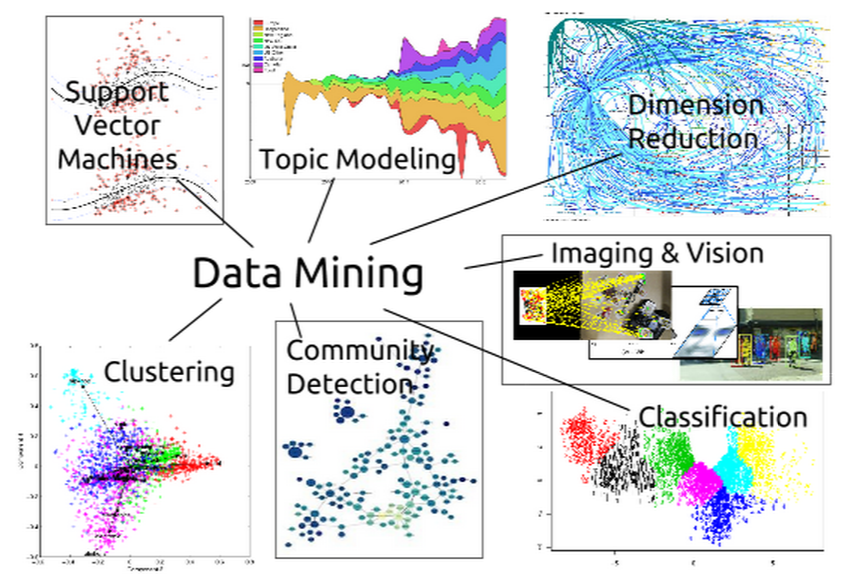 In today's world, data is exploding at a faster rate than computer architectures can handle. This summer school will introduce students to modern and innovative mathematical techniques that address this phenomenon. Hands-on topics will include data mining, compression, classification, topic modeling, large-scale stochastic optimization, and more.Updated on Jul 19, 2018 11:45 AM PDT
-
Summer Graduate School IAS/PCMI 2018: Harmonic Analysis
Organizers: Carlos Kenig (University of Chicago), Fanghua Lin (New York University, Courant Institute), Svitlana Mayboroda (University of Minnesota, Twin Cities), Tatiana Toro (MSRI / Simons Laufer Mathematical Sciences Institute (SLMath); University of Washington)Harmonic analysis is a central field of mathematics with a number of applications to geometry, partial differential equations, probability, and number theory, as well as physics, biology, and engineering. The Graduate Summer School will feature mini-courses in geometric measure theory, homogenization, localization, free boundary problems, and partial differential equations as they apply to questions in or draw techniques from harmonic analysis. The goal of the program is to bring together students and researchers at all levels interested in these areas to share exciting recent developments in these subjects, stimulate further interactions, and inspire the new generation to pursue research in harmonic analysis and its applications.
Updated on Jun 20, 2018 12:17 PM PDT -
Summer Graduate School H-principle
Organizers: Emmy Murphy (Princeton University), Takashi Tsuboi (RIKEN Interdisciplinary Theoretical and Mathematical Sciences Program)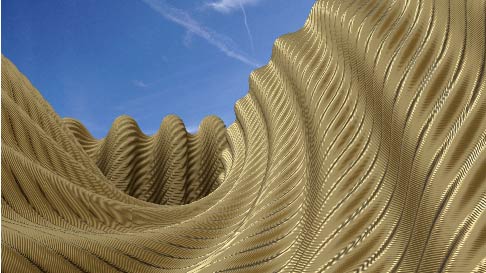 The image of a large sphere isometrically embedded into a small space through a C^1 embedding. (Attributions: E. Bartzos, V. Borrelli, R. Denis, F. Lazarus, D. Rohmer, B. Thibert)
This two week summer school will introduce graduate students to the theory of h-principles. After building up the theory from basic smooth topology, we will focus on more recent developments of the theory, particularly applications to symplectic and contact geometry, and foliation theory.
Updated on Jun 20, 2018 12:17 PM PDT -
Summer Graduate School Derived Categories
Organizers: Nicolas Addington (University of Oregon), LEAD Alexander Polishchuk (University of Oregon)The goal of the school is to give an introduction to basic techniques for working with derived categories, with an emphasis on the derived categories of coherent sheaves on algebraic varieties. A particular goal will be to understand Orlov’s equivalence relating the derived category of a projective hypersurface with matrix factorizations of the corresponding polynomial.Updated on Jul 05, 2018 09:05 AM PDT -
Summer Graduate School Mathematical Analysis of Behavior
Organizers: Ann Hermundstad (Janelia Research Campus, HHMI), Vivek Jayaraman (Janelia Research Campus, HHMI), Eva Kanso (University of Southern California), L. Mahadevan (Harvard University)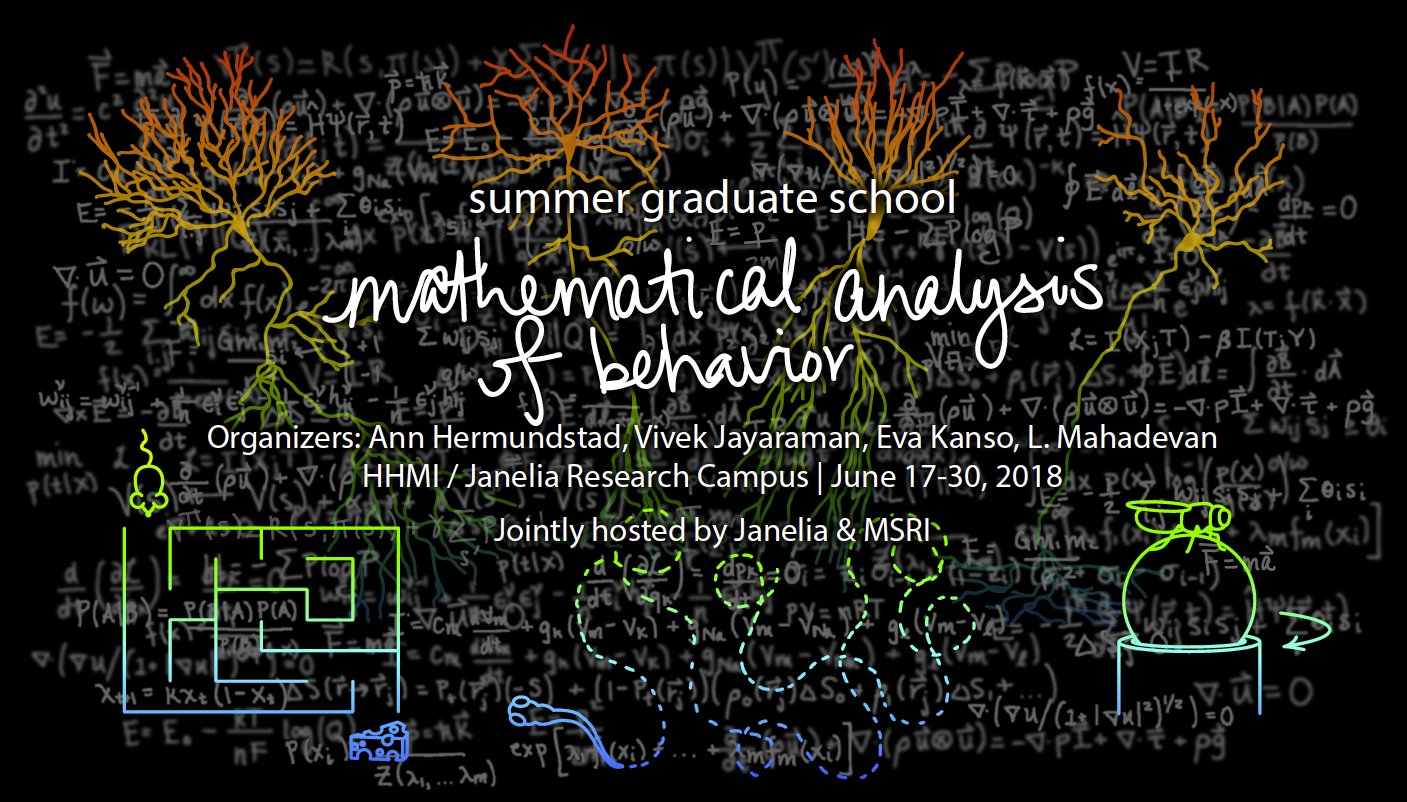
Explore Outstanding Phenomena in Animal Behavior
Jointly hosted by Janelia and the Mathematical Sciences Research Institute (MSRI), this program will bring together 15-20 advanced PhD students with complementary expertise who are interested in working at the interface of mathematics and biology. Emphasis will be placed on linking behavior to neural dynamics and exploring the coupling between these processes and the natural sensory environment of the organism. The aim is to educate a new type of global scientist that will work collaboratively in tackling complex problems in cellular, circuit and behavioral biology by combining experimental and computational techniques with rigorous mathematics and physics.
Updated on Jun 20, 2018 12:16 PM PDT -
MSRI-UP MSRI-UP 2018: The Mathematics of Data Science
Organizers: Federico Ardila (School of Mathematical Sciences, Queen Mary, University of London), Duane Cooper (Morehouse College), LEAD Maria Mercedes Franco, Rebecca Garcia (Colorado College), David Uminsky (University of Chicago), Suzanne Weekes (SIAM - Society of Industrial and Applied Mathematics)The MSRI-UP summer program is designed to serve a diverse group of undergraduate students who would like to conduct research in the mathematical sciences.
In 2018, MSRI-UP will focus on the core role of (linear) algebra in current research and application areas of Data Science ranging from unsupervised learning, clustering and networks, to algebraic signal processing and feature extraction, to the central role linear algebra plays in deep machine learning. The research program will be led by Dr. David Uminsky, Associate Professor of Mathematics and Statistics at the University of San Francisco.
Updated on Sep 14, 2023 04:04 AM PDT -
Summer Graduate School Séminaire de Mathématiques Supérieures 2018: Derived Geometry and Higher Categorical Structures in Geometry and Physics
Organizers: Anton Alekseev (Université de Genève), Ruxandra Moraru (University of Waterloo), Chenchang Zhu (Universität Göttingen)Higher categorical structures and homotopy methods have made significant influence on geometry in recent years. This summer school is aimed at transferring these ideas and fundamental technical tools to the next generation of mathematicians.
The summer school will focus on the following four topics: higher categorical structures in geometry, derived geometry, factorization algebras, and their application in physics. There will be eight to ten mini courses on these topics, including mini courses led by Chirs Brav, Kevin Costello, Jacob Lurie, and Ezra Getzler. The prerequisites will be kept at a minimum, however, a introductory courses in differential geometry, algebraic topology and abstract algebra are recommended.Updated on Jun 20, 2018 12:16 PM PDT -
Summer Graduate School The ∂-Problem in the Twenty-First Century
Organizers: Debraj Chakrabarti (Central Michigan University), Jeffery McNeal (Ohio State University)This Summer Graduate School will introduce students to the modern theory of the inhomogeneous Cauchy-Riemann equation, the fundamental partial differential equation of Complex Analysis. This theory uses powerful tools of partial differential equations, differential geometry and functional analysis to obtain a refined understanding of holomorphic functions on complex manifolds. Besides students planning to work in complex analysis, this course will be valuable to those planning to study partial differential equations, complex differential and algebraic geometry, and operator theory. The exposition will be self-contained and the prerequisites will be kept at a minimum
Updated on Jun 21, 2018 01:13 PM PDT -
Workshop The 2018 Infinite Possibilities Conference
Organizers: Alejandra Alvarado (U.S. Navy), Hélène Barcelo (MSRI / Simons Laufer Mathematical Sciences Institute (SLMath)), Rebecca Garcia (Colorado College), Katharine Gurski (Howard University), LEAD Lily Khadjavi (Loyola Marymount University), Candice Price (Smith College), Kimberly Sellers (Georgetown University), Talitha Washington (Clark Atlanta University; Atlanta University Center Consortium), Kimberly Weems (North Carolina Central University), Ulrica Wilson (Institute for Computational and Experimental Research in Mathematics (ICERM))
The Infinite Possibilities Conference (IPC) is a national conference that is designed to promote, educate, encourage and support women of color interested in mathematics and statistics, as a step towards addressing the underrepresentation of African-Americans, Latinas, Native Americans, and Pacific Islanders in these fields.
IPC aims to:
- fulfill a need for role models and community-building
- provide greater access to information and resources for success in graduate school and beyond
- raise awareness of factors that can support or impede underrepresented women in the mathematical sciences
A unique gathering, the conference brings together participants from across the country, at all stages of education and career, for mentoring and mathematics.
Updated on May 18, 2018 12:18 PM PDT -
Workshop Latinx in the Mathematical Sciences Conference 2018
Organizers: Federico Ardila (School of Mathematical Sciences, Queen Mary, University of London), Ricardo Cortez (Tulane University), Tatiana Toro (MSRI / Simons Laufer Mathematical Sciences Institute (SLMath); University of Washington), Mariel Vazquez (University of California, Davis)On March 8-10, 2018, IPAM will host a conference showcasing the achievements of Latinx in the mathematical sciences. The goal of the conference is to encourage Latinx to pursue careers in the mathematical sciences, to promote the advancement of Latinx currently in the discipline, to showcase research being conducted by Latinx at the forefront of their fields, and, finally, to build a community around shared academic interests. The conference will be held on the UCLA campus in Los Angeles, CA. It will begin at noon on Thursday, March 8.
This conference is sponsored by the Mathematical Sciences Institutes Diversity Initiative, with funding from the National Science Foundation Division of Mathematical Sciences.
Updated on Oct 23, 2017 04:53 PM PDT -
Workshop Critical Issues in Mathematics Education 2018: Access to mathematics by opening doors for students currently excluded from mathematics
Organizers: Aditya Adiredja (University of Arizona), LEAD Julia Aguirre (University of Washington - Tacoma), Kate Belin (Fannie Lou Hamer Freedom High School), LEAD Ricardo Cortez (Tulane University), Michael Driskill (Math for America ), Nicole Joseph (Vanderbilt University), Katherine Stevenson (California State University, Northridge), Francis Su (Harvey Mudd College), Maria del Rosario ZavalaOur mathematics education system is inequitable. It operates in ways that leave a significant proportion of students with negative mathematics experiences and inadequate mathematical preparation. The problem is historical and systemic, and the students most disaffected by the current system are overwhelmingly Black and Latino, Indigenous, poor, women, immigrant or first generation college students. If our mathematics community is to sustainably grow and thrive, mathematics education at all levels must be transformed.
This workshop focuses on students for whom we do not yet successfully ensure access to and advancement in mathematics. Sessions will share relevant programmatic efforts and innovative research that have been shown to maintain or increase students’ engagement and interests in mathematics across k-12, undergraduate and graduate education. The sessions will focus particularly on reproducible efforts that affirm those students’ identities and their diverse intellectual resources and lived experiences. These efforts at various levels of mathematics education will highlight ways in which meaningful experiences in mathematics can disrupt ongoing systemic oppression. Participants will leave with conceptual and practical ways to open up and elevate mathematics education where all students thrive.
Updated on Jul 03, 2018 09:03 AM PDT -
Workshop Modern Math Workshop 2017
Organizers: Hélène Barcelo (MSRI / Simons Laufer Mathematical Sciences Institute (SLMath)), Leslie McClure (SAMSI - Statistical and Applied Mathematical Sciences Institute), Christian Ratsch (Institute of Pure and Applied Mathematics (IPAM)), Ulrica Wilson (Institute for Computational and Experimental Research in Mathematics (ICERM))As part of the Mathematical Sciences Collaborative Diversity Initiatives, nine mathematics institutes are pleased to offer their annual SACNAS pre-conference event, the 2017 Modern Math Workshop (MMW). The Modern Math Workshop is intended to encourage minority undergraduates to pursue careers in the mathematical sciences and to assist undergraduates, graduate students and recent PhDs in building their research networks. The Modern Math Workshop is part of the SACNAS National Conference; the workshop and the conference take place in the Salt Palace Convention Center in Salt Lake City, Utah. The MMW starts at 1:00 pm on Wednesday, October 18 with registration beginning at noon.
Updated on Oct 12, 2017 02:36 PM PDT -
Summer Graduate School Automorphic Forms and the Langlands Program
Organizers: LEAD Kevin Buzzard (Imperial College, London)The summer school will be an introduction to the more algebraic aspects of the theory of automorphic forms and representations. One of the goals will be to understand the statements of the main conjectures in the Langlands programme. Another will be to gain a good working understanding of the fundamental definitions in the theory, such as principal series representations, the Satake isomorphism, and of course automorphic forms and representations for groups such as GL_n and its inner forms.
Updated on Aug 04, 2017 11:02 AM PDT -
Summer Graduate School Nonlinear dispersive PDE, quantum many particle systems and the world between
Organizers: Natasa Pavlovic (University of Texas, Austin), Gigliola Staffilani (Massachusetts Institute of Technology), Nikolaos Tzirakis (University of Illinois at Urbana-Champaign)The purpose of the summer school is to introduce graduate students to the recent developments in the area of dispersive partial differential equations (PDE), which have received a great deal of attention from mathematicians, in part due to ubiquitous applications to nonlinear optics, water wave theory and plasma physics.
Recently remarkable progress has been made in understanding existence and uniqueness of solutions to nonlinear Schrodinger (NLS) and KdV equations, and properties of those solutions. We will outline the basic tools that were developed to address these questions. Also we will present some of recent results on derivation of NLS equations from quantum many particle systems and will discuss how methods developed to study the NLS can be relevant in the context of the derivation of this nonlinear equation.
Updated on Sep 12, 2017 02:02 PM PDT -
Summer Graduate School Positivity Questions in Geometric Combinatorics
Organizers: Eran Nevo (The Hebrew University of Jerusalem), Raman Sanyal (Johann Wolfgang Goethe-Universität Frankfurt)McMullen’s g-Conjecture from 1970 is a shining example of mathematical foresight that combined all results available at that time to conjure a complete characterization of face numbers of convex simple/simplicial polytopes. The key statement in its verification is that certain combinatorial numbers associated to geometric (or topological) objects are non-negative. The aim of this workshop is to introduce graduate students to selected contemporary topics in geometric combinatorics with an emphasis on positivity questions. It is fascinating that the dual notions of simple and simplicial polytopes lead to different but equally powerful algebraic frameworks to treat such questions. A key feature of the lectures will be the simultaneous development of these algebraic frameworks from complementary perspectives: combinatorial-topological and convex-geometric. General concepts (such as Lefschetz elements, Hodge–Riemann–Minkowski inequalities) will be developed side-by-side, and analogies will be drawn to concepts in algebraic geometry, Fourier analysis, rigidity theory and measure theory. This allows for entry points for students with varying backgrounds. The courses will be supplemented with guest lectures highlighting further connections to other fields.
Updated on Jul 21, 2017 10:13 AM PDT -
Summer Graduate School Séminaire de Mathématiques Supérieures 2017: Contemporary Dynamical Systems
Organizers: Sylvain Crovisier (Université de Paris VI (Pierre et Marie Curie)-Université de Paris XI (Paris-Sud)), LEAD Konstantin Khanin (University of Toronto), Andres Navas (University of Santiago de Chile), Christiane Rousseau (Université de Montréal), Marcelo Viana (Institute of Pure and Applied Mathematics (IMPA)), Amie Wilkinson (University of Chicago)The theory of dynamical systems has witnessed very significant developments in the last decades, including the work of two 2014 Fields medalists, Artur Avila and Maryam Mirzakhani. The school will concentrate on the recent significant developments in the field of dynamical systems and present some of the present main streams of research. Two central themes will be those of partial hyperbolicity on one side, and rigidity, group actions and renormalization on the other side. Other themes will include homogeneous dynamics and geometry and dynamics on infinitely flat surfaces (both providing connections to the work of Maryam Mirzakhani), topological dynamics, thermodynamical formalism, singularities and bifurcations in analytic dynamical systems.
Updated on May 06, 2017 01:18 AM PDT -
Summer Graduate School Soergel Bimodules
Organizers: LEAD Ben Elias (University of Oregon), Geordie Williamson (University of Sydney)We will give an introduction to categorical representation theory, focusing on the example of Soergel bimodules, which is a categorification of the Iwahori-Hecke algebra. We will give a comprehensive introduction to the "tool box" of modern (higher) representation theory: diagrammatics, homotopy categories, categorical diagonalization, module categories, Drinfeld center, algebraic Hodge theory.
Updated on Jul 10, 2017 01:18 PM PDT
|
|
Past Educational Events |
