

-
Workshop [Moved Online] Critical Issues in Mathematics Education 2020: Today’s Mathematics, Social Justice, and Implications for Schools
Organizers: Meredith Broussard (New York Unviersity), Victor Donnay (Bryn Mawr College), Courtney Ginsberg (Math for America), Luis Leyva (Vanderbilt University), Candice Price (Smith College), Chris Rasmussen (San Diego State University), LEAD Katherine Stevenson (California State University, Northridge), William Tate (Washington University in St. Louis)Due to the COVID-19 virus outbreak, the Critical Issues in Mathematics Education 2020 workshop was held online. The full workshop description and list of talks can be found HERE.
Friday 4/17: 12pm PST (3pm eastern time)12:00 - 1:00 Some unintended consequences of active learning
Sage Forbes-Gray, Sunset Park High School, Brooklyn, NY, Mfa Master Teacher
Sharon Collins - New Heights Academy Charter School, NYC, MfA Master Teacher;
Kate Belin - Fannie Lou High School, NYC, MfA Master Teacher;Moderator: Courtney Ginsberg, MfA
Host: Katherine Stevenson, CSUNUpdated on May 12, 2020 08:41 AM PDT -
Workshop [Moved Online] Critical Issues in Mathematics Education 2020: Today’s Mathematics, Social Justice, and Implications for Schools
Organizers: Meredith Broussard (New York Unviersity), Victor Donnay (Bryn Mawr College), Courtney Ginsberg (Math for America), Luis Leyva (Vanderbilt University), Candice Price (Smith College), Chris Rasmussen (San Diego State University), LEAD Katherine Stevenson (California State University, Northridge), William Tate (Washington University in St. Louis)Due to the COVID-19 virus outbreak, the Critical Issues in Mathematics Education 2020 workshop was held online. The full workshop description and list of talks can be found HERE.
Friday 4/10: 12pm PST (3pm eastern time)
12:00 - 1:00 Estrella Johnson, Some unintended consequences of active learning
Updated on May 12, 2020 08:40 AM PDT -
Workshop {Moved Online] Critical Issues in Mathematics Education 2020: Today’s Mathematics, Social Justice, and Implications for Schools
Organizers: Meredith Broussard (New York Unviersity), Victor Donnay (Bryn Mawr College), Courtney Ginsberg (Math for America), Luis Leyva (Vanderbilt University), Candice Price (Smith College), Chris Rasmussen (San Diego State University), LEAD Katherine Stevenson (California State University, Northridge), William Tate (Washington University in St. Louis)Due to the COVID-19 virus outbreak, the Critical Issues in Mathematics Education 2020 workshop was held online. The full workshop description and list of talks can be found HERE.
Friday 3/27: Starting at 12pm PST (3pm eastern time)
12:00p - 1:00p
Nicol Turner Lee, Brookings Inst., Center for Tech Innov. - Unconscious Bias
Saber Khan, Processing Foundation, leader of #EthicalCS - Identity & EthicsUpdated on May 12, 2020 08:40 AM PDT -
Workshop [Moved Online] Critical Issues in Mathematics Education 2020: Today’s Mathematics, Social Justice, and Implications for Schools
Organizers: Meredith Broussard (New York Unviersity), Victor Donnay (Bryn Mawr College), Courtney Ginsberg (Math for America), Luis Leyva (Vanderbilt University), Candice Price (Smith College), Chris Rasmussen (San Diego State University), LEAD Katherine Stevenson (California State University, Northridge), William Tate (Washington University in St. Louis)Due to the COVID-19 virus outbreak, the Critical Issues in Mathematics Education 2020 workshop was held online. The full workshop description and list of talks can be found HERE.
Friday 3/20: Starting at 12pm PST (3pm eastern time)12:00p - 12:45p Lisa Goldberg, Hot Hands: What Data Science Can (and Can't) Tell Us About Basketball Trends
12:45p - 1:00p Discussion with Lisa and Kate on: What Bayes tells us about our ability to reason about randomnessUpdated on May 12, 2020 08:37 AM PDT -
Workshop [Moved Online] Critical Issues in Mathematics Education 2020: Today’s Mathematics, Social Justice, and Implications for Schools
Organizers: Meredith Broussard (New York Unviersity), Victor Donnay (Bryn Mawr College), Courtney Ginsberg (Math for America), Luis Leyva (Vanderbilt University), Candice Price (Smith College), Chris Rasmussen (San Diego State University), LEAD Katherine Stevenson (California State University, Northridge), William Tate (Washington University in St. Louis)Due to the COVID-19 virus outbreak, the Critical Issues in Mathematics Education 2020 workshop was held online. The full workshop description and list of talks can be found HERE.
On March 12 and March 13, portions of the Critical Issues in Mathematics Education 2020: Today’s Mathematics, Social Justice, and Implications for Schools workshop will be streamed online via Zoom. Only the talks below will are scheduled at this time. Further talks may be scheduled at a later date, and you will be notified when we know more.
Please see the schedule below, as well as links to the two sessions.
Thursday 3/12: Starting at 9am PST (noon eastern time)
9:00 - 9:10 Welcoming remarks
9:10 - 9:15 Introduction to CIME 2020 plan and speaker David Daley
9:15 - 9:55 David Daley, Why Your Vote Doesn't Count
9:55 - 10:00 Kate Stevenson, introduction of activity
10:00-10:30 Mathical Book Prize Announcement
Friday 3/13: Starting at 9am PST (noon eastern time)
9:00 - 9:05 Introduction of speaker Wesley Pegden
9:05 - 9:45 Wesley Pegden, Bringing Mathematics to the Courtroom
9:45 - 10:00 Q&A
A formal Notice of Change letter is available here, which can be shared with your institution, funding agency, and others.
Updated on May 28, 2020 08:57 AM PDT -
Workshop Symposium in Honor of Julia Robinson’s 100th Birthday
Organizers: Hélène Barcelo (MSRI / Simons Laufer Mathematical Sciences Institute (SLMath)), Thomas Scanlon (University of California, Berkeley), Carol Wood (Wesleyan University)MSRI will host a Symposium on the occasion of Julia Robinson’s 100th birthday on Monday, December 9, 2019 at MSRI. Julia Robinson (1919-1985) was an internationally renowned logician of the twentieth century. She was a trailblazer in mathematics as well as in many other ways: she was the first woman president of the American Mathematical Society, and the first woman mathematician elected to membership in the National Academy of Sciences.
Participating speakers in this day-long celebration of her work and of current mathematics insprired by her research include: Martin Davis, Kirsten Eisentrager, Yuri Matiyasevich, and Lou van den Dries. Following the symposium, Lenore Blum will give a public lecture at UC Berkeley.
Updated on Nov 22, 2019 03:54 PM PST -
Workshop Modern Math Workshop 2019
Organizers: Sudipta Dasmohapatra (Duke University ), Christian Ratsch (Institute of Pure and Applied Mathematics (IPAM)), Michael Singer (North Carolina State University), Ulrica Wilson (Institute for Computational and Experimental Research in Mathematics (ICERM))
As part of the Mathematical Sciences Collaborative Diversity Initiatives, six mathematics institutes are pleased to host their annual SACNAS pre-conference event, the 2019 Modern Math Workshop (MMW). The Modern Math Workshop is intended to encourage minority undergraduates to pursue careers in the mathematical sciences and to assist undergraduates, graduate students and recent PhDs in building their research networks.
Updated on Dec 18, 2019 02:42 PM PST -
Summer Graduate School H-Principle (INdAM, Cortona, Italy)
Organizers: LEAD Emmy Murphy (Princeton University), Takashi Tsuboi (RIKEN Interdisciplinary Theoretical and Mathematical Sciences Program)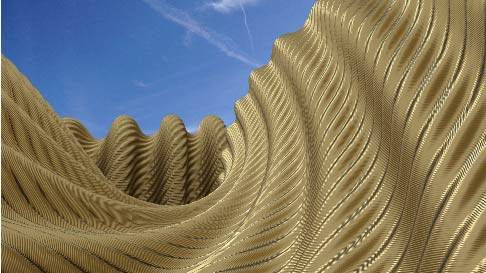 The image of a large sphere isometrically embedded into a small space through a C^1 embedding. (Attributions: E. Bartzos, V. Borrelli, R. Denis, F. Lazarus, D. Rohmer, B. Thibert)
This two week summer school will introduce graduate students to the theory of h-principles. After building up the theory from basic smooth topology, we will focus on more recent developments of the theory, particularly applications to symplectic and contact geometry, fluid dynamics, and foliation theory.
Updated on Aug 08, 2019 09:31 AM PDT -
Summer Graduate School Mathematics of Machine Learning
Organizers: Sebastien Bubeck (Microsoft Research), Anna Karlin (University of Washington), Adith Swaminathan (Microsoft Research)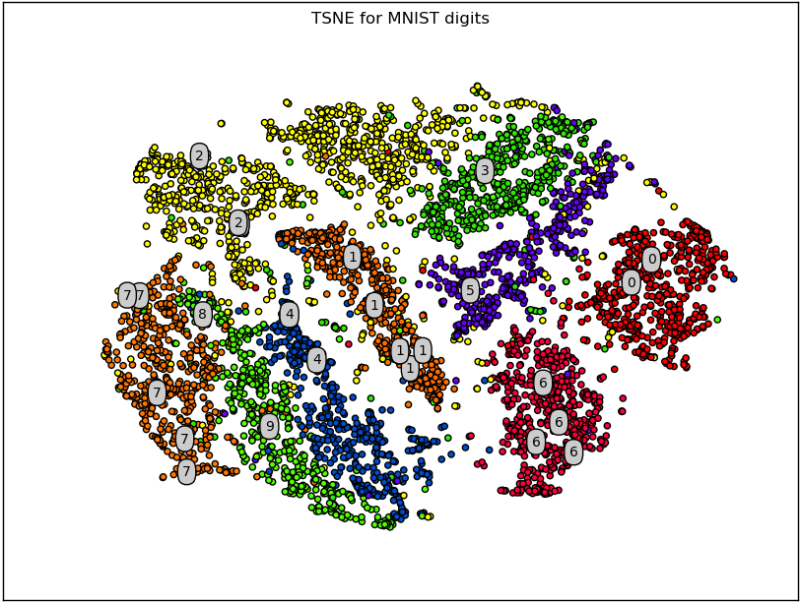 Popular visualization of the MNIST dataset
Learning theory is a rich field at the intersection of statistics, probability, computer science, and optimization. Over the last decades the statistical learning approach has been successfully applied to many problems of great interest, such as bioinformatics, computer vision, speech processing, robotics, and information retrieval. These impressive successes relied crucially on the mathematical foundation of statistical learning.
Recently, deep neural networks have demonstrated stunning empirical results across many applications like vision, natural language processing, and reinforcement learning. The field is now booming with new mathematical problems, and in particular, the challenge of providing theoretical foundations for deep learning techniques is still largely open. On the other hand, learning theory already has a rich history, with many beautiful connections to various areas of mathematics (e.g., probability theory, high dimensional geometry, game theory). The purpose of the summer school is to introduce graduate students (and advanced undergraduates) to these foundational results, as well as to expose them to the new and exciting modern challenges that arise in deep learning and reinforcement learning.
Updated on Aug 01, 2019 10:00 AM PDT -
Summer Graduate School Toric Varieties (National Center for Theoretical Sciences, Taipei, Taiwan)
Organizers: David Cox (Amherst College), Henry Schenck (Auburn University)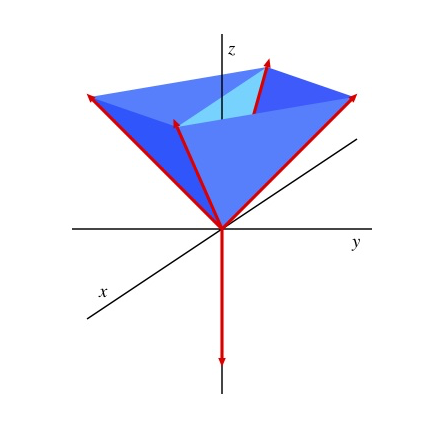 This simplicial fan in 3-dimensional space
Toric varieties are algebraic varieties defined by combinatorial data, and there is a wonderful interplay between algebra, combinatorics and geometry involved in their study. Many of the key concepts of abstract algebraic geometry (for example, constructing a variety by gluing affine pieces) have very concrete interpretations in the toric case, making toric varieties an ideal tool for introducing students to abstruse concepts.
Updated on Jul 14, 2020 04:08 PM PDT -
Summer Graduate School Recent topics on well-posedness and stability of incompressible fluid and related topics
Organizers: LEAD Yoshikazu Giga (University of Tokyo), Maria Schonbek (University of California, Santa Cruz), Tsuyoshi Yoneda (Hitotsubashi University)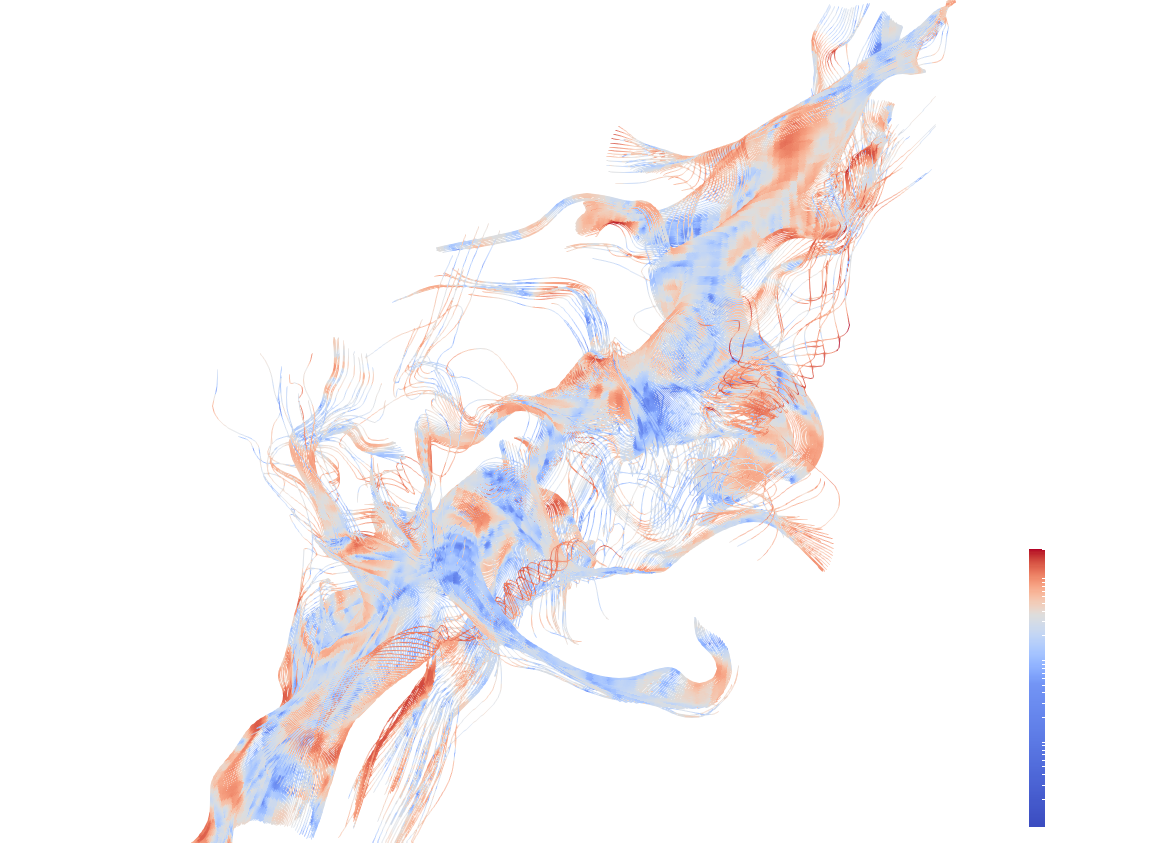 Fluid-flow stream function color-coded by vorticity in 3D flat torus calculated by K. Nakai (The University of Tokyo)
The purpose of the workshop is to introduce graduate students to fundamental results on the Navier-Stokes and the Euler equations, with special emphasis on the solvability of its initial value problem with rough initial data as well as the large time behavior of a solution. These topics have long research history. However, recent studies clarify the problems from a broad point of view, not only from analysis but also from detailed studies of orbit of the flow.
Updated on Aug 19, 2019 04:17 PM PDT -
Summer Graduate School Polynomial Method
Organizers: Adam Sheffer (Bernard M. Baruch College, CUNY), LEAD Joshua Zahl (University of British Columbia)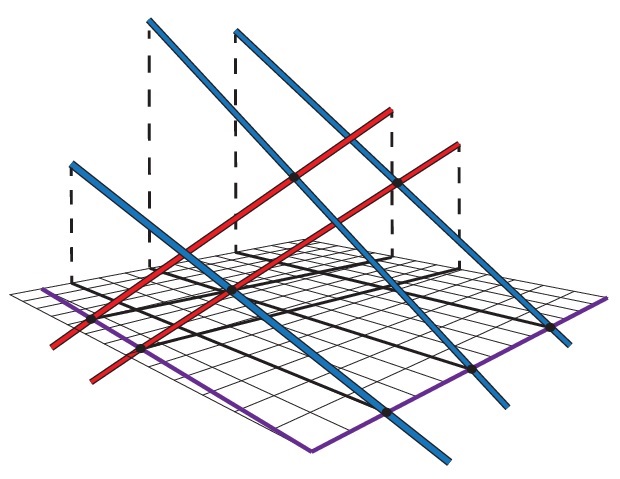 from distinct distances in the plane to line incidences in R^3
In the past eight years, a number of longstanding open problems in combinatorics were resolved using a new set of algebraic techniques. In this summer school, we will discuss these new techniques as well as some exciting recent developments.
Updated on Oct 20, 2023 04:16 PM PDT -
Summer Graduate School Geometric Group Theory
Organizers: LEAD Rita Jiménez Rolland (Instituto de Matematicás, UNAM-Oaxaca), LEAD Pierre Py (Universidad Nacional Autónoma de México)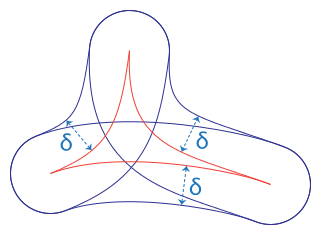 Rips's δ-thin triangle condition for Gromov hyperbolicity of metric spaces (Stomatapoll)
Geometric group theory studies discrete groups by understanding the connections between algebraic properties of these groups and topological and geometric properties of the spaces on which they act. The aim of this summer school is to introduce graduate students to specific central topics and recent developments in geometric group theory. The school will also include students presentations to give the participants an opportunity to practice their speaking skills in mathematics. Finally, we hope that this meeting will help connect Latin American students with their American and Canadian counterparts in an environment that encourages discussion and collaboration.
Updated on Jul 03, 2019 11:35 AM PDT -
Summer Graduate School Séminaire de Mathématiques Supérieures 2019: Current trends in Symplectic Topology
Organizers: Octav Cornea (Université de Montréal), Yakov Eliashberg (Stanford University), Michael Hutchings (University of California, Berkeley), Egor Shelukhin (Université de Montréal)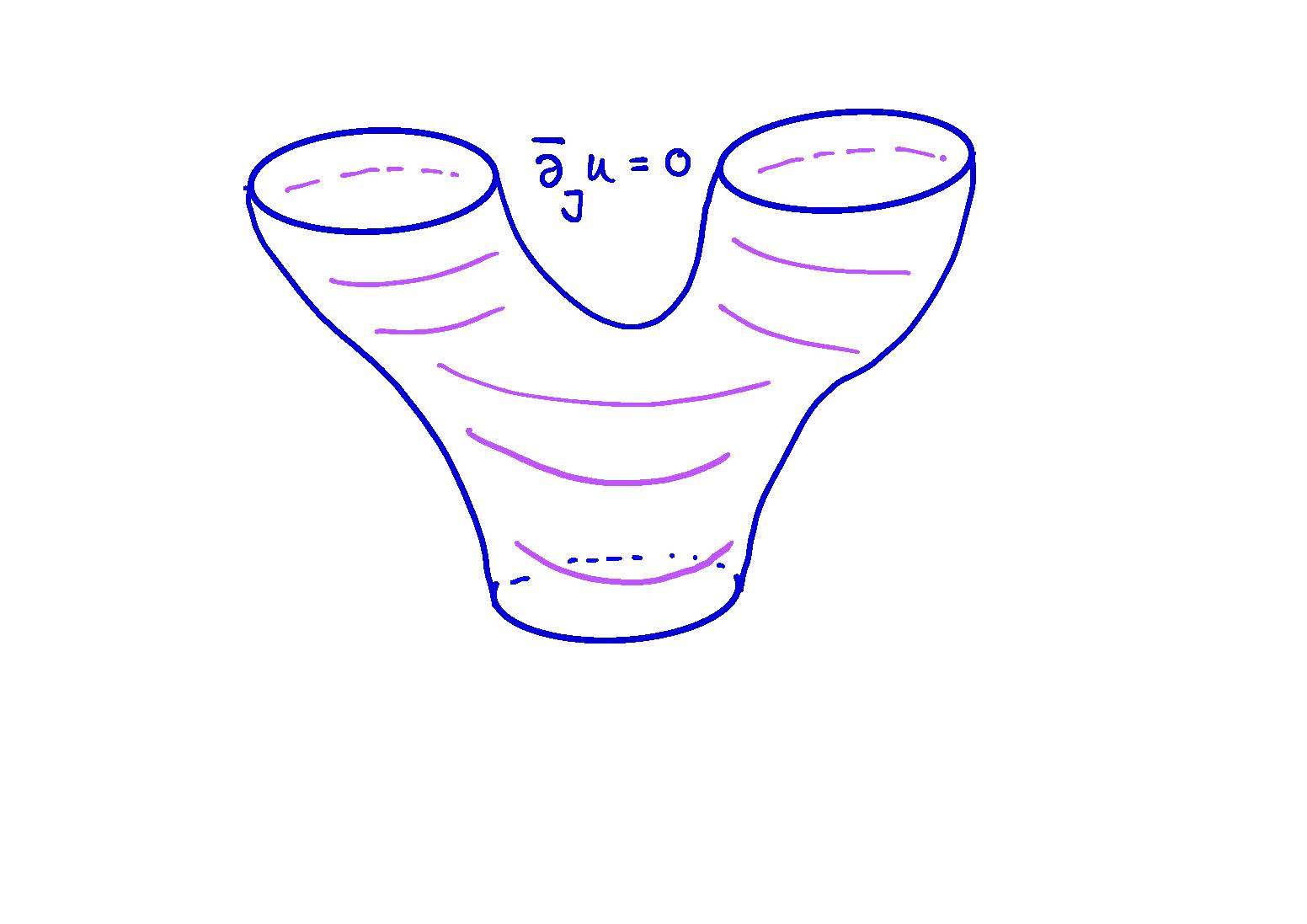 A Holomorphic Curve
Symplectic topology is a fast developing branch of geometry that has seen phenomenal growth in the last twenty years. This two weeks long summer school, organized in the setting of the Séminaire de Mathématiques Supérieures, intends to survey some of the key directions of development in the subject today thus covering: advances in homological mirror symmetry; applications to hamiltonian dynamics; persistent homology phenomena; implications of flexibility and the dichotomy flexibility/rigidity; legendrian contact homology; embedded contact homology and four-dimensional holomorphic techniques and others. With the collaboration of many of the top researchers in the field today, the school intends to serve as an introduction and guideline to students and young researchers who are interested in accessing this diverse subject.
Updated on Dec 10, 2018 04:21 PM PST -
Summer Graduate School Representation stability
Organizers: Thomas Church (Stanford University), LEAD Andrew Snowden (University of Michigan), Jenny Wilson (University of Michigan)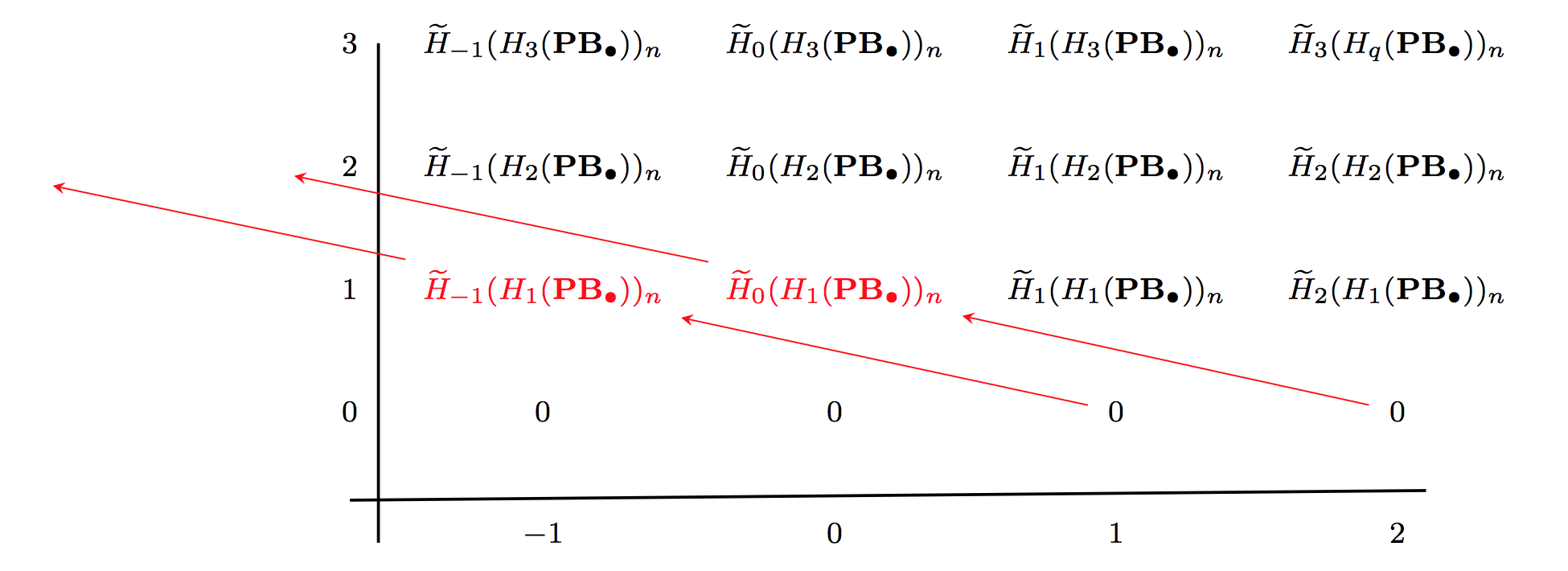 An illustration of an adaptation of Quillen's classical homological stability spectral sequence argument
This summer school will give an introduction to representation stability, the study of algebraic structural properties and stability phenomena exhibited by sequences of representations of finite or classical groups -- including sequences arising in connection to hyperplane arrangements, configuration spaces, mapping class groups, arithmetic groups, classical representation theory, Deligne categories, and twisted commutative algebras. Representation stability incorporates tools from commutative algebra, category theory, representation theory, algebraic combinatorics, algebraic geometry, and algebraic topology. This workshop will assume minimal prerequisites, and students in varied disciplines are encouraged to apply.
Updated on Jul 03, 2019 03:47 PM PDT -
MSRI-UP MSRI-UP 2019: Combinatorics and Discrete Mathematics
Organizers: Federico Ardila (School of Mathematical Sciences, Queen Mary, University of London), Duane Cooper (Morehouse College), Maria Mercedes Franco, LEAD Rebecca Garcia (Colorado College), Pamela Harris (University of Wisconsin-Milwaukee), Suzanne Weekes (SIAM - Society of Industrial and Applied Mathematics)The MSRI-UP summer program is designed to serve a diverse group of undergraduate students who would like to conduct research in the mathematical sciences.
In 2019, MSRI-Up will focus on the application of combinatorial arguments and techniques to enumerate, examine, and investigate the existence of discrete mathematical structures with certain properties. The areas of interest for these applications encompass a wide range of mathematical fields and will include algebra, number theory, and graph theory, through weight multiplicity computations, the study of vector partition functions, and graph domination problems, respectively. The research program will be led by Dr. Pamela E. Harris, Assistant Professor of Mathematics at Williams College.
Updated on Oct 20, 2023 04:19 PM PDT -
Workshop Improving the Preparation of Graduate Students to Teach Undergraduate Mathematics
Organizers: Jack Bookman (Duke University), Shandy Hauk (San Francisco State University), LEAD Dave Kung (St. Mary's College of Maryland), LEAD Natasha Speer (University of Maine; University of Maine)Is your department interested in helping graduate students learn to teach? Perhaps your department is considering starting a teaching-focused professional development program. Or maybe your department has a program but is interested in updating and enhancing it.
Many departments now offer pre-semester orientations, semester-long seminars, and other opportunities for graduate students who are new to teaching so they will be well-equipped to provide high-quality instruction to undergraduates. The purpose of this workshop is to support faculty from departments that are considering starting a teaching-focused professional development program or, for departments that have a program, to learn ways to improve it.
Updated on Mar 04, 2019 04:57 PM PST -
Summer Graduate School Random and arithmetic structures in topology
Organizers: LEAD Alexander Furman (University of Illinois at Chicago), Tsachik Gelander (Weizmann Institute of Science) The study of locally symmetric manifolds, such as closed hyperbolic manifolds, involves geometry of the corresponding symmetric space, topology of towers of its finite covers, and number-theoretic aspects that are relevant to possible constructions.The workshop will provide an introduction to these and closely related topics such as lattices, invariant random subgroups, and homological methods.Updated on Oct 20, 2023 04:22 PM PDT
-
Summer Graduate School Commutative Algebra and its Interaction with Algebraic Geometry
Organizers: Craig Huneke (University of Virginia), Sonja Mapes (University of Notre Dame), Juan Migliore (University of Notre Dame), LEAD Claudia Polini (University of Notre Dame), Claudiu Raicu (University of Notre Dame)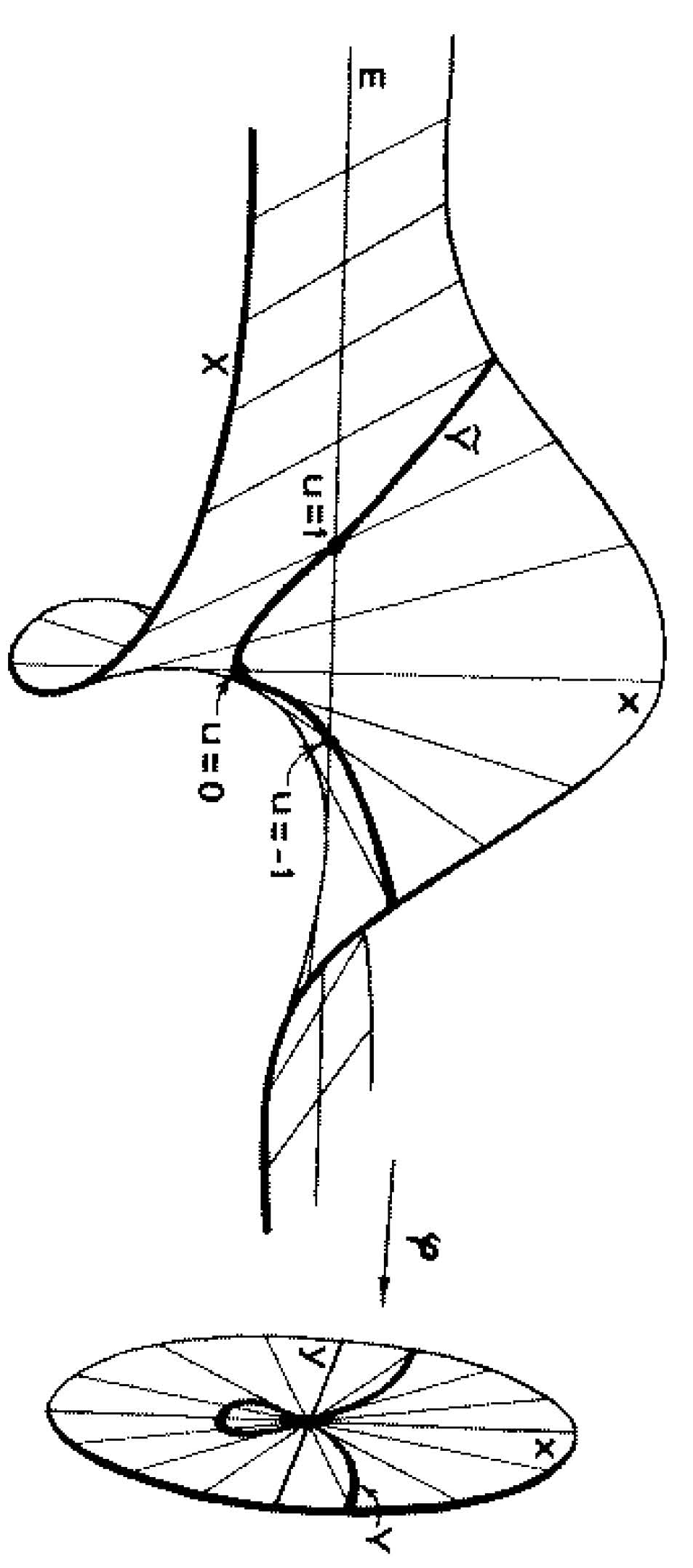 The figure represents a blow-up. The so called blow-up algebras or Rees rings are the algebraic realizations of such blow-ups.
Linkage is a method for classifying ideals in local rings. Residual intersections is a generalization of linkage to the case where the two `linked' ideals need not have the same codimension. Residual intersections are ubiquitous: they play an important role in the study of blowups, branch and multiple point loci, secant varieties, and Gauss images; they appear naturally in intersection theory; and they have close connections with integral closures of ideals.
Commutative algebraists have long used the Frobenius or p-th power map to study commutative rings containing a finite fi eld. The theory of tight closure and test ideals has widespread applications to the study of symbolic powers and to Briancon-Skoda type theorems for equi-characteristic rings.
Numerical conditions for the integral dependence of ideals and modules have a wealth of applications, not the least of which is in equisingularity theory. There is a long history of generalized criteria for integral dependence of ideals and modules based on variants of the Hilbert-Samuel and the Buchsbaum-Rim multiplicity that still require some remnants of finite length assumptions.
The Rees ring and the special fiber ring of an ideal arise in the process of blowing up a variety along a subvariety. Rees rings and special fiber rings also describe, respectively, the graphs and the images of rational maps between projective spaces. A difficult open problem in commutative algebra, algebraic geometry, elimination theory, and geometric modeling is to determine explicitly the equations defining graphs and images of rational maps.
The school will consist of the following four courses with exercise sessions plus a Macaulay2 workshop
- Linkage and residual intersections
- Characteristic p methods and applications
- Blowup algebras
- Multiplicity theory
Updated on May 29, 2019 09:11 AM PDT -
Workshop Critical Issues in Mathematics Education 2019: Mathematical Modeling in K-16: Community and Cultural Contexts
Organizers: Julia Aguirre (University of Washington - Tacoma), LEAD Cynthia Anhalt (University of Arizona), Staffas Broussard (The Algebra Project), Ricardo Cortez (Tulane University), Michael Driskill (Math for America ), Sol Garfunkel (Consortium for Mathematics and Its Applications (COMAP)), Genetha Gray (Salesforce), Maria Hernandez (North Carolina School of Science and Mathematics), LEAD Rachel Levy (American Mathematical Society), Javier Rojo (Oregon State)Mathematical Modeling (MM) now has increased visibility in the education system and in the public domain. It appears as a content standard for high school mathematics and a mathematical practice standard across the K-12 curriculum (Common Core Standards; and other states’ standards in mathematics education). Job opportunities are increasing in business, industry and government for those trained in the mathematical sciences. Quantitative reasoning is foundational for civic engagement and decision-making for addressing complex social, economic, and technological issues. Therefore, we must take action to support and sustain a significant increase in the teaching and learning of mathematical modeling from Kindergarten through Graduate School.
Mathematical modeling is an iterative process by which mathematical concepts and structures are used to analyze or gain qualitative and quantitative understanding of real world situations. Through modeling students can make genuine mathematical choices and decisions that take into consideration relevant contexts and experiences.
Mathematical modeling can be a vehicle to accomplish multiple pedagogical and mathematical goals. Modeling can be used to introduce new material, solidify student understanding of previously learned concepts, connectthe world to the classroom, make concrete the usefulness (maybe even the advantages) of being mathematically proficient, and provide a rich context to promote awareness of issues of equity, socio-political injustices, and cultural relevance in mathematics.
A critical issue in math education is that although mathematical modeling is part of the K-12 curriculum, the great majority of teachers have little experience with mathematical modeling as learners of mathematics or in their teacher preparation. In some cases, mathematics teacher educators have limited experience with mathematical modeling while being largely responsible for preparing future teachers.
Currently, the knowledge in teaching and learning MM is underdeveloped and underexplored. Very few MM resources seem to reach the K-16 classrooms. Collective efforts to build a cohesive curriculum in MM and exploration of effective teaching practices based on research are necessary to make mathematical modeling accessible to teacher educators, teachers and students.
At the undergraduate level, mathematical modeling has traditionally been reserved for university courses for students in STEM majors beyond their sophomore year. Many of these courses introduce models but limit the students’ experience to using models that were developed by others rather than giving students the opportunity to generate their own models as is common in everyday life, in modeling competitions and in industry.
The CIME workshop on MM will bring together mathematicians, teacher educators, K-12 teachers, faculty and people in STEM disciplines. As partners we can address ways to realize mathematical modeling in the K-12 classrooms, teacher preparation, and lower and upper division coursework at universities. The content and pedagogy associated with teaching mathematical modeling needs special attention due to the nature of modeling as a process and as a body of content knowledge.
Updated on Jul 12, 2024 07:53 PM PDT
|
|
Past Educational Events |