

-
Seminar Five Minute Talks
Updated on Jan 28, 2025 03:02 PM PST -
Seminar Meet the Staff Tea
Created on Jan 23, 2025 10:42 AM PST -
Seminar Five Minute Talks
Updated on Jan 28, 2025 03:01 PM PST -
Seminar Chancellor Professor Course: Interdisciplinary Topics in Mathematics: Theory of Combinatorial Limits
Updated on Jan 17, 2025 02:01 PM PST -
Seminar Five Minute Talks
Updated on Jan 28, 2025 02:59 PM PST -
Seminar Five Minute Talks
Updated on Jan 28, 2025 02:55 PM PST -
Seminar Chancellor Professor Course: Interdisciplinary Topics in Mathematics: Theory of Combinatorial Limits
Updated on Jan 17, 2025 02:01 PM PST -
Seminar Chancellor Professor Course: Interdisciplinary Topics in Mathematics: Theory of Combinatorial Limits
Updated on Jan 17, 2025 02:01 PM PST -
Workshop Introductory Workshop: Probability and Statistics of Discrete Structures
Organizers: Louigi Addario-Berry (McGill University), LEAD Shankar Bhamidi (University of North Carolina), Christina Goldschmidt (University of Oxford), Dana Randall (Georgia Institute of Technology), Perla Sousi (University of Cambridge), Remco van der Hofstad (Technische Universiteit Eindhoven) Visualization of a network constructed using simple probabilistic rules, showing the emergence of hubs and other macroscopic network phenomenon. From https://graph-tool.skewed.de
Networks, graph driven algorithms, and dynamics on graphs such as epidemics, random walks and centrality measures all play a major role, both in our daily lives as well as many scientific and engineering disciplines. This introductory workshop will bring together experts and junior researchers in combinatorics, probability, and statistics to share a broad vision of major challenges and objectives, with a primary focus on models of random graphs and their limits, network inference, dynamic processes on networks and algorithms and optimization on random structures.
Updated on Jan 30, 2025 10:45 AM PST -
Seminar Chancellor Professor Course: Interdisciplinary Topics in Mathematics: Theory of Combinatorial Limits
Updated on Jan 17, 2025 02:01 PM PST -
Workshop Connections Workshop: Probability and Statistics of Discrete Structures
Organizers: Christina Goldschmidt (University of Oxford), Po-Ling Loh (University of Cambridge), Kavita Ramanan (Brown University), Dana Randall (Georgia Institute of Technology), LEAD Nike Sun (Massachusetts Institute of Technology) AI-generated interpretation of a random network
This two-day workshop will bring together researchers from discrete mathematics, probability theory, theoretical computer science, and statistics to explore topics at their interface. The focus will be on probability and statistics of random discrete structures, as well as their applications, including in computer science and physical systems. The workshop will celebrate academic and gender diversity, bringing together mathematicians at junior and senior levels of their careers from mathematics, physics, and computer science. This workshop is open to all mathematicians.
Updated on Jan 28, 2025 12:16 PM PST -
Program Extremal Combinatorics
Organizers: LEAD David Conlon (California Institute of Technology), LEAD Jacob Fox (Stanford University), Penny Haxell (University of Waterloo), János Pach (Alfréd Rényi Institute of Mathematics), Maya Stein (Universidad de Chile), Andrew Suk (University of California, San Diego)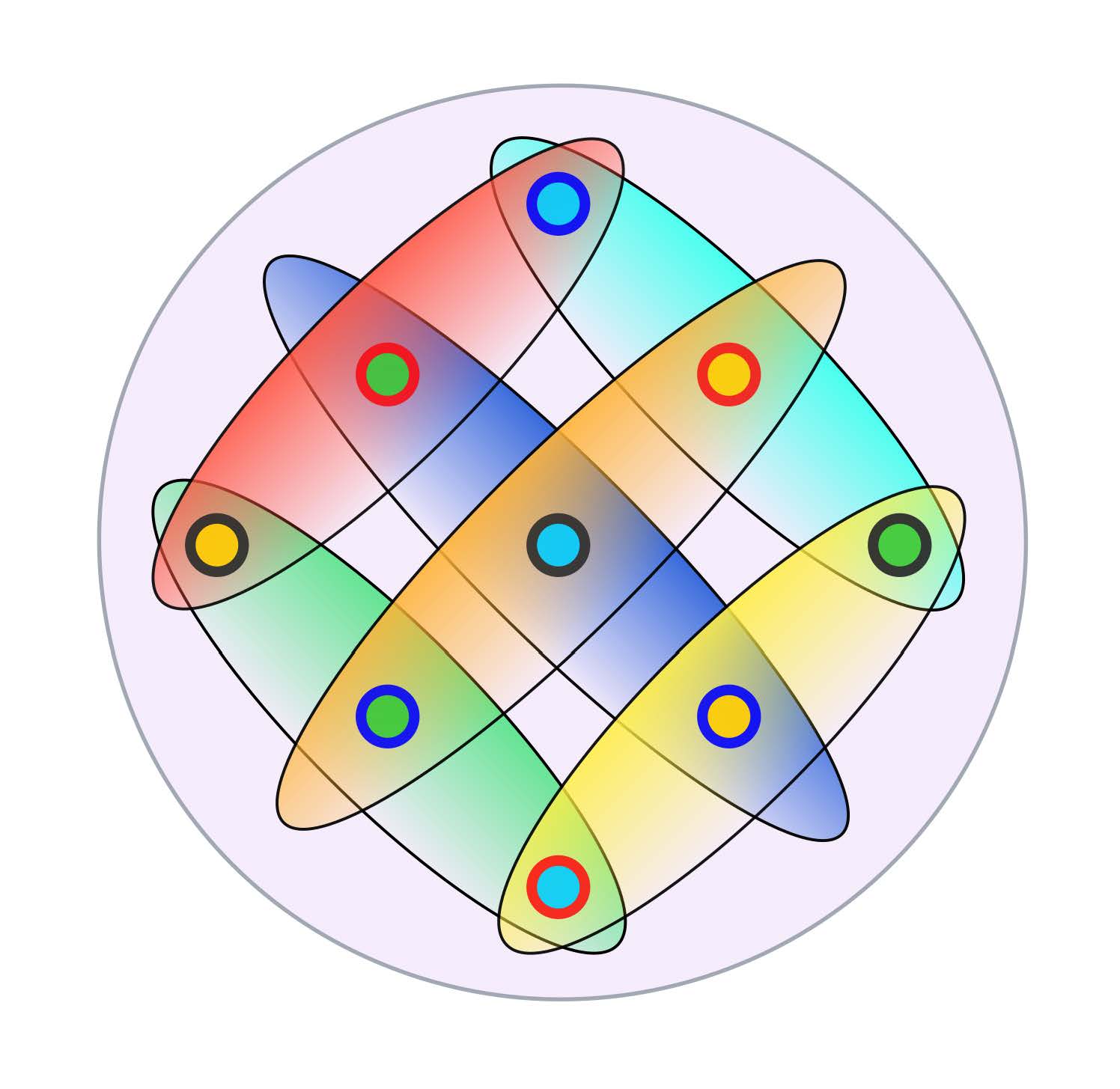
Extremal combinatorics concerns itself with problems about how large or small a finite collection of objects can be while satisfying certain conditions. Questions of this type arise naturally across mathematics, so this area has close connections and interactions with a broad array of other fields, including number theory, group theory, model theory, probability, statistical physics, optimization, and theoretical computer science.
Updated on Dec 16, 2024 03:09 PM PST -
Program Probability and Statistics of Discrete Structures
Organizers: Louigi Addario-Berry (McGill University), Christina Goldschmidt (University of Oxford), Po-Ling Loh (University of Cambridge), Gábor Lugosi (Pompeu Fabra University), Dana Randall (Georgia Institute of Technology), LEAD Remco van der Hofstad (Technische Universiteit Eindhoven)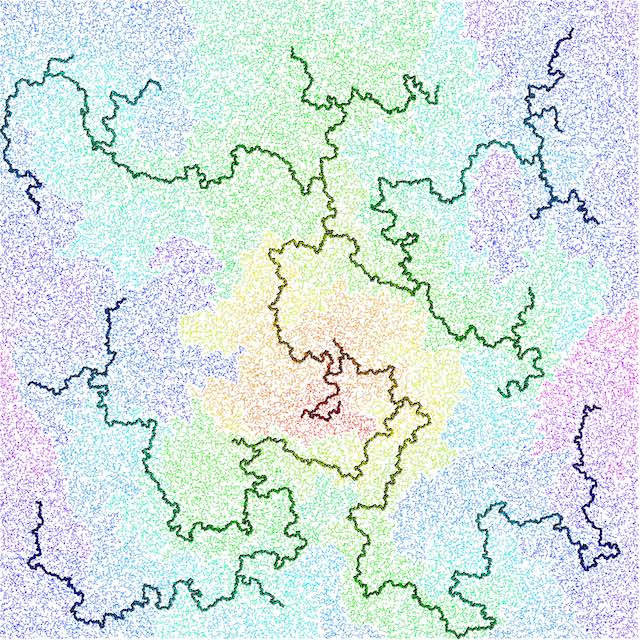 The minimum spanning tree of 100,000 uniformly random points. Colors encode graph distance from the root, which is red. Black points are those whose removal would disconnect at least 5% of the points from the rest.
This program is devoted to the study of the probabilistic and statistical properties of such networks. Central tools include graphon theory for dense graphs, local weak convergence for sparse graphs, and scaling limits for the critical behavior of graphs or stochastic processes on them. The program is aimed at pure and applied mathematicians interested in network problems.
Updated on Dec 19, 2024 09:02 AM PST -
Seminar Chancellor Professor Course: Interdisciplinary Topics in Mathematics: Theory of Combinatorial Limits
Updated on Jan 17, 2025 02:01 PM PST -
Seminar Flows Seminar: "Long time behavior of Ricci flow on some complex surfaces"
Updated on Dec 11, 2024 11:08 AM PST -
Seminar GSA Seminar: "ALG Ricci Flat K\”ahler 3-folds with Schwartz Decay"
Updated on Dec 10, 2024 01:07 PM PST -
Seminar Lunch Problem Session
Updated on Dec 13, 2024 12:20 PM PST -
Seminar Professional Development Workshop: "Large-scale problems and challenges in mathematical publishing"
Updated on Dec 12, 2024 04:26 PM PST -
Seminar Flows Seminar: "Joyce conjectures for Lagrangian mean curvature flow of surfaces"
Updated on Dec 05, 2024 01:01 PM PST -
Seminar GSA Seminar: "Degeneration of conic Kähler-Einstein metrics"
Updated on Dec 03, 2024 09:04 AM PST
|
|
Past Scientific Events |