

-
MAY-UP Mathematically Advancing Young Undergraduates Program (MAY-UP) 2024
Organizers: Lakeshia Jones (Clark Atlanta University), Shelby Wilson (Johns Hopkins University Applied Physics Lab)Updated on May 15, 2024 09:47 AM PDT -
Workshop A Celebration for Women in Mathematics (2024) - May 12 Initiative
Organizers: Ini Adinya (University of Ibadan), Nasrin Altafi (Queen's University), Maria-Grazia Ascenzi (University of California Los Angeles), Shanna Dobson, Malena Espanol (Arizona State University), Eleonore Faber (University of Leeds), Anna Fino (Florida International University), Adi Glucksam (Northwestern University), Eloísa Grifo (University of Nebraska), Céleste Hogan (Texas Tech University), Ellen Kirkman (Wake Forest University), Kuei-Nuan Lin (Pennsylvania State University), Liangbing Luo (Lehigh University), LEAD Ornella Mattei (San Francisco State University), Claudia Miller (Syracuse University), Julia Plavnik (Indiana University, Bloomington), Claudia Polini (University of Notre Dame), Hema Srinivasan (University of Missouri), Špela Špenko (Université Libre de Bruxelles) "May 12 Initiative" Annual Workshop
The Simons Laufer Mathematical Sciences Institute (SLMath) celebrates the "May 12 Initiative" with a panel discussion and social event open to all on the topic "Being a Woman in Mathematics". This is a hybrid event taking place on Zoom and in person at SLMath. This event is free and open to worldwide participation.
If you plan to participate online, please connect using this LINK.
Updated on May 03, 2024 01:11 PM PDT -
Workshop Critical Issues in Mathematics Education 2024: Bringing Innovation to Scale: Teaching-Focused Faculty as Change Agents
Organizers: Debra Carney (Colorado School of Mines), Dave Kung (St. Mary's College of Maryland), P. Gavin LaRose (University of Michigan), Mary Pilgrim (San Diego State University), Chris Rasmussen (San Diego State University), Natasha Speer (University of Maine; University of Maine), Cristina Villalobos (University of Texas Rio Grande Valley)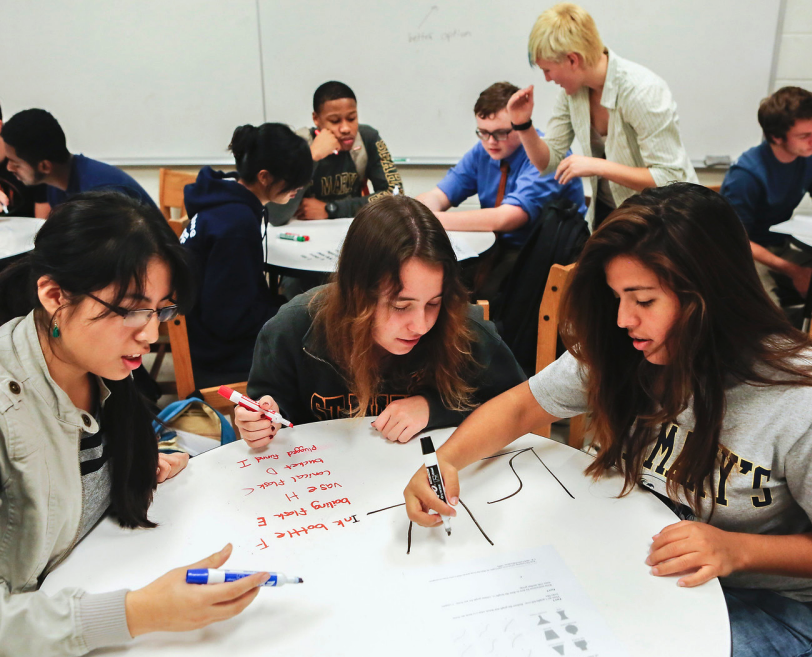
The undergraduate mathematics education system remains a huge barrier to college completion and to equity in higher education. The problem in entry level mathematics courses is not a lack of innovation. Numerous projects and institutions have created, piloted, and occasionally replicated effective reform efforts that overcame particular challenges, like the need to improve pedagogical practices or attend to gender equity. The biggest barrier to systemic reform – implementing many of these research-backed innovations at scale – is a structural one, particularly at large research-focused institutions. This workshop will bring together a group of stakeholders to explore a new avenue for change, the rise of teaching-focused faculty at research-intensive institutions who increasingly influence introductory coursework. By creating a network that connects these faculty across institutions, change at scale across 50, 100, or even more institutions becomes possible – on issues ranging from pedagogy to equity to curricular innovation. Creating such structures would also allow for bringing future innovations to scale much more quickly than is currently possible.
Updated on Apr 19, 2024 06:56 AM PDT -
Workshop Hot Topics: MIP* = RE and the Connes’ Embedding Problem
Organizers: Michael Chapman (New York University, Courant Institute), Anand Natarajan (Massachusetts Institute of Technology), William Slofstra (University of Waterloo), John Wright (University of Texas, Austin), Henry Yuen (Columbia University)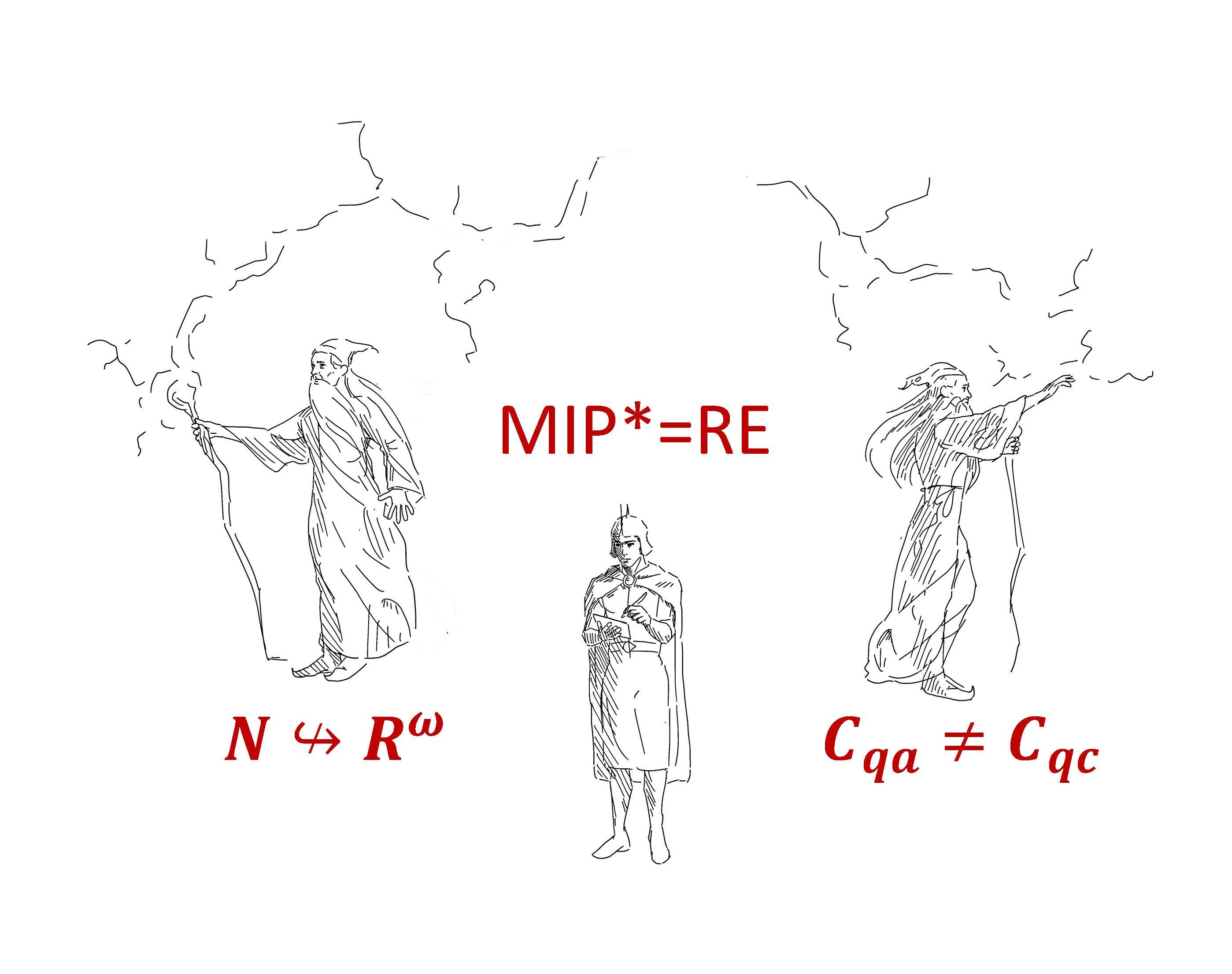 Drawing by Tina Zhang.
This workshop is about the recent MIP*=RE result from quantum computational complexity, and the resulting resolution of the Connes embedding problem from the theory of von Neumann algebras. MIP*=RE connects the disparate areas of computational complexity theory, quantum information, operator algebras, and approximate representation theory. The aim of this workshop is to bridge this divide, by giving an in-depth exposition of the techniques used in the proof of MIP*=RE, and highlighting perspectives on the MIP*=RE result from operator algebras and approximate representation theory. In particular, this workshop will highlight connections with group stability, something that has not been covered in previous workshops. In addition to increasing understanding of the MIP*=RE proof, we hope that this will open up further applications of the ideas behind MIP*=RE in operator algebras.
Updated on Oct 25, 2023 11:46 AM PDT -
Summer Graduate School Foundations and Frontiers of Probabilistic Proofs (Zürich, Switzerland)
Organizers: Alessandro Chiesa (École Polytechnique Fédérale de Lausanne (EPFL))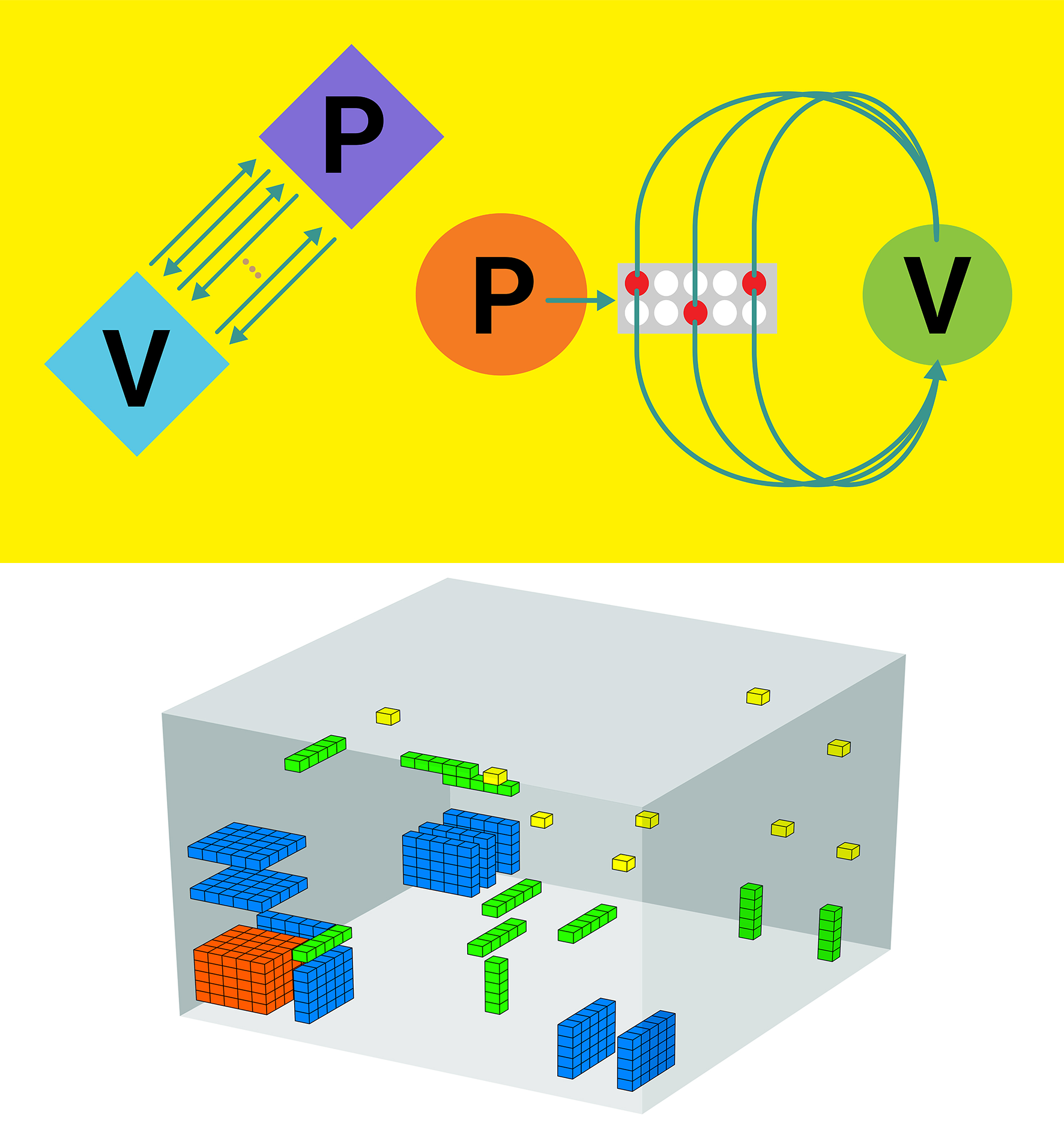 Several executions of a 3-dimensional sumcheck protocol with a random order of directions (thanks to Dev Ojha for creating the diagram)
Proofs are at the foundations of mathematics. Viewed through the lens of theoretical computer science, verifying the correctness of a mathematical proof is a fundamental computational task. Indeed, the P versus NP problem, which deals precisely with the complexity of proof verification, is one of the most important open problems in all of mathematics.
The complexity-theoretic study of proof verification has led to exciting reenvisionings of mathematical proofs. For example, probabilistically checkable proofs (PCPs) admit local-to-global structure that allows verifying a proof by reading only a minuscule portion of it. As another example, interactive proofs allow for verification via a conversation between a prover and a verifier, instead of the traditional static sequence of logical statements. The study of such proof systems has drawn upon deep mathematical tools to derive numerous applications to the theory of computation and beyond.
In recent years, such probabilistic proofs received much attention due to a new motivation, delegation of computation, which is the emphasis of this summer school. This paradigm admits ultra-fast protocols that allow one party to check the correctness of the computation performed by another, untrusted, party. These protocols have even been realized within recently-deployed technology, for example, as part of cryptographic constructions known as succinct non-interactive arguments of knowledge (SNARKs).
This summer school will provide an introduction to the field of probabilistic proofs and the beautiful mathematics behind it, as well as prepare students for conducting cutting-edge research in this area.
Updated on Oct 20, 2023 01:17 PM PDT -
Summer Graduate School Mathematics of Big Data: Sketching and (Multi-) Linear Algebra (IBM Almaden)
Organizers: Kenneth Clarkson (IBM Research Division), Lior Horesh (IBM Thomas J. Watson Research Center), Misha Kilmer (Tufts University), Tamara Kolda (MathSci.ai), Shashanka Ubaru (IBM Thomas J. Watson Research Center)
This summer school will introduce graduate students to sketching-based approaches to computational linear and multi-linear algebra. Sketching here refers to a set of techniques for compressing a matrix, to one with fewer rows, or columns, or entries, usually via various kinds of random linear maps. We will discuss matrix computations, tensor algebras, and such sketching techniques, together with their applications and analysis.
Updated on Nov 03, 2022 11:59 AM PDT -
Summer Graduate School Concentration Inequalities and Localization Techniques in High Dimensional Probability and Geometry (SLMath)
Organizers: Max Fathi (Université Paris Cité), Dan Mikulincer (Massachusetts Institute of Technology)The goal of the summer school is for the students to first become familiar with the concept of concentration of measure in different settings (Euclidean, Riemannian and discrete), and the main open problems surrounding it. The students will later become familiar with the proof techniques that involve the different types of localization and obtain expertise on the ways to apply the localization techniques. After attending the graduate school, the students are expected to have the necessary background that would give them a chance to both conduct research around open problems in concentration of measure, find new applications to existing localization techniques and perhaps also develop new localization techniques.
Updated on Oct 20, 2023 09:42 AM PDT -
Summer Graduate School Introduction to Derived Algebraic Geometry (UC Berkeley)
Organizers: Benjamin Antieau (Northwestern University), Dima Arinkin (University of Wisconsin-Madison)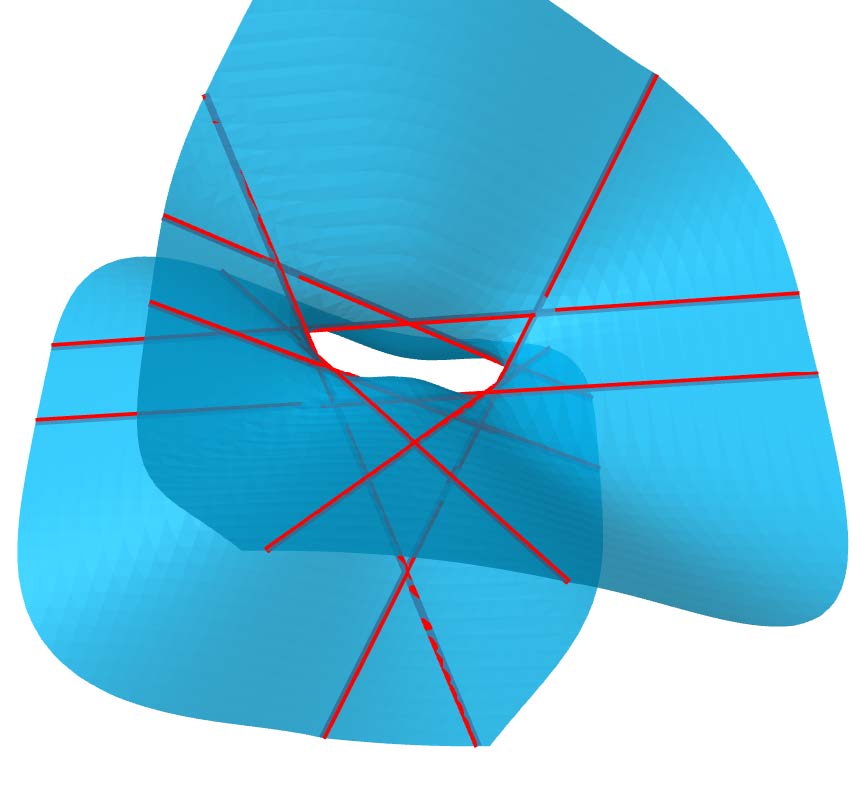 Schur quartic x 4−xy3 = z 4−zu3 and several of the 64 lines that it contains
Derived algebraic geometry is an ‘update’ of algebraic geometry using ‘derived’ (roughly speaking, homological) techniques. This requires recasting the very foundations of the field: rings have to be replaced by differential graded algebras (or other forms of derived rings), categories by higher categories, and so on. The result is a powerful set of new tools, useful both within algebraic geometry and in related areas. The school serves as an introduction to these techniques, focusing on their applications.
The school is built around two related courses on geometric (‘derived spaces’) and categorical (‘derived categories’) aspects of the theory. Our goal is to explain the key ideas and concepts, while trying to keep technicalities to a minimum.
Updated on Jun 28, 2023 04:05 PM PDT -
Summer Graduate School Machine Learning (UC San Diego)
Organizers: Ery Arias-Castro (University of California, San Diego), Mikhail Belkin (University of California, San Diego), Yusu Wang (University of California, San Diego), Lily Weng (University of California, San Diego)The overarching goal of this summer school is to expose the students both to modern forms of unsupervised learning — in the form of geometrical and topological data analysis — and to supervised learning — in the form of (deep) neural networks applied to regression/classification problems. The organizers have opted for a lighter exposure to a broader range of topics. Using the metaphor of a meal, we are offering 2 + 2 samplers — geometry and topology for data analysis + theoretical and practical deep learning — rather than 1 + 1 main dishes. The main goal, thus, is to inspire the students to learn more about one or several of the topics covered in the school.
The expected learning outcomes for students attending the school are the following:
1. An introduction to how concepts and tools from geometry and topology can be leveraged to perform data analysis in situations where the data are not labeled.
2. An introduction to recent and ongoing theoretical and methodological/practical developments in the use of neural networks for data analysis (deep learning).
Updated on Aug 29, 2023 11:59 AM PDT -
Summer Graduate School Topics in Geometric Flows and Minimal Surfaces (St. Mary's College)
Organizers: Ailana Fraser (University of British Columbia), Lan-Hsuan Huang (University of Connecticut), Catherine Searle (Wichita State University), Lu Wang (Yale University)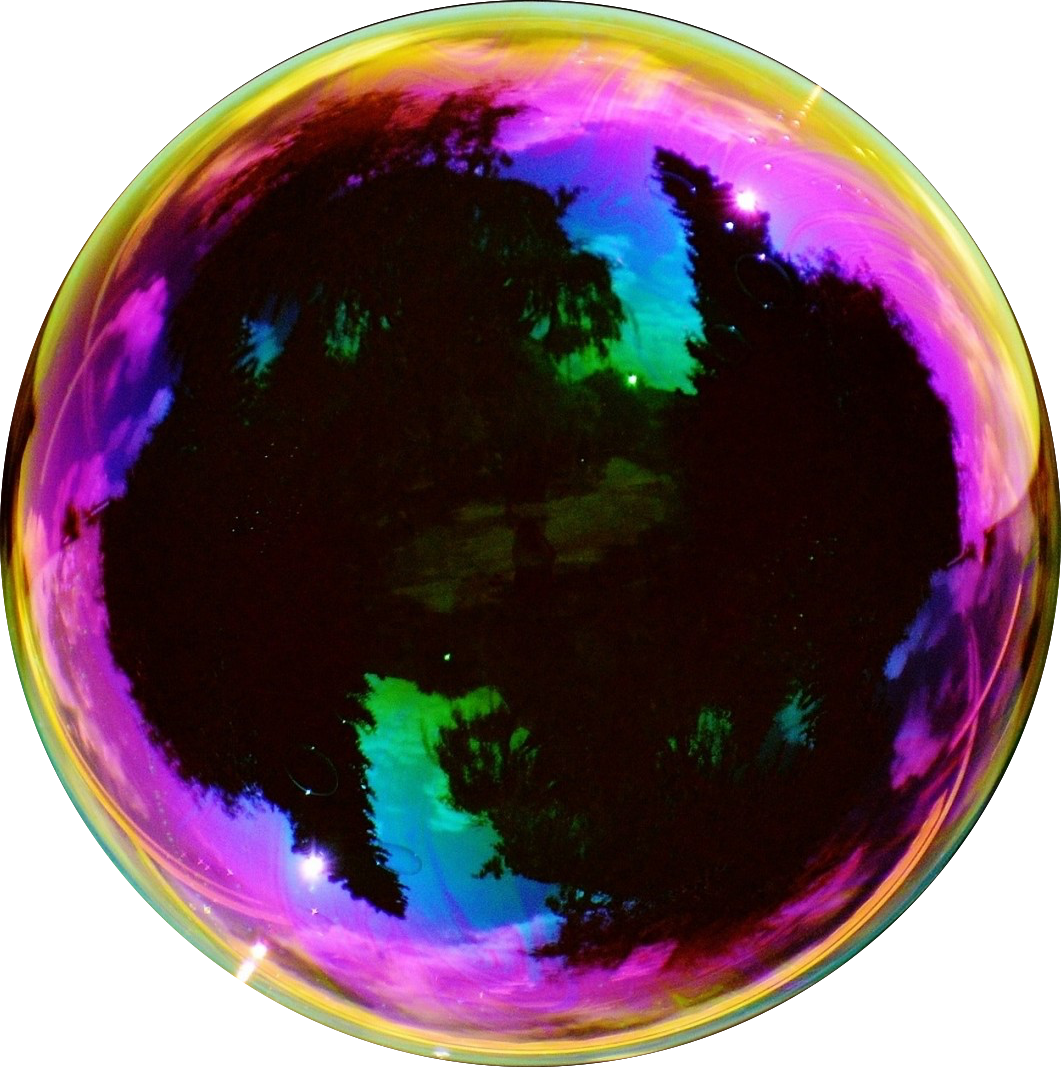 Soap bubble: equilibrium solution of the rescaled mean curvature flow and constant curvature surface.
This graduate summer school will introduce students to two important and inter-related fields of differential geometry: geometric flows and minimal surfaces.
Geometric flows have had far reaching influences on numerous branches of mathematics and other scientific disciplines. An outstanding example is the completion of Hamilton’s Ricci flow program by Perelman, leading to the resolution of the Poincare conjecture and Thurston’s geometrization conjecture for 3-manifolds. In this part of the summer school, students will be guided through basic topics and ideas in the study of geometric flows.
Since Penrose used variations of volume to formulate and study black holes in general relativity (in his Nobel prize-winning work), the intriguing connections between minimal surfaces and general relativity have been a strong driving force for the modern developments of both research areas. This part of the summer school will introduce students to the basic theory of minimal submanifolds and its applications in Riemannian geometry and general relativity.
The curriculum of this program will be accessible and will have a broad appeal to graduate students from a variety of mathematical areas, introducing some of the latest developments in each area and the remaining open problems therein, while simultaneously emphasizing their synergy.
Updated on Jun 29, 2023 10:56 AM PDT -
Summer Graduate School Mathematics and Computer Science of Market and Mechanism Design (SLMath)
Organizers: Yannai Gonczarowski (Harvard University), Irene Lo (Stanford University), Ran Shorrer (Pennsylvania State University), LEAD Inbal Talgam-Cohen (Technion---Israel Institute of Technology)
This school is associated with an upcoming research program at MSRI under the same title. The goal of the school is to equip students unfamiliar with these topics with the mathematical and theoretical computer science toolbox that forms the foundation of market and mechanism design.
Updated on Jun 28, 2023 01:19 PM PDT -
Summer Graduate School Séminaire de Mathématiques Supérieures 2023: Periodic and Ergodic Spectral Problems (Montréal, Canada)
Organizers: Alexander Elgart (Virginia Polytechnic Institute and State University), Vojkan Jaksic (McGill University), Svetlana Jitomirskaya (University of California, Irvine), Ilya Kachkovskiy (Michigan State University), Jean Lagacé (King's College London), Leonid Parnovski (University College London)This two week school will focus on spectral theory of periodic, almost-periodic, and random operators. The main aim of this school is to teach the students who work in one of these areas, methods used in parallel problems, explain the similarities between all these areas and show them the `big picture'.
Updated on Apr 06, 2023 06:24 PM PDT -
Summer Graduate School Algebraic Methods for Biochemical Reaction Networks (Leipzig, Germany)
Organizers: Timo de Wolff (TU Braunschweig), LEAD Alicia Dickenstein (University of Buenos Aires), Elisenda Feliu (University of Copenhagen)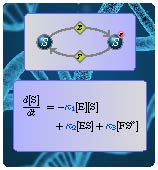 A basic enzymatic mechanism
The aim of the course is to learn how tools from algebraic geometry (in particular, from computational and real algebraic geometry) can be used to analyze standard models in molecular biology. Particularly, these models are key ingredients in the development of Systems and Synthetic biology, two active research areas focusing on understanding, modifying, and implementing the design principles of living systems.
We will focus on the mathematical aspects of the methods, and exemplify and apply the theory to real networks, thereby introducing the participants to relevant problems and mechanisms in molecular biology. As a counterpart, however, the participants will also see how this field has in the past challenged current methods, mainly in the realm of real algebraic geometry, and has given rise to new general and purely theoretical results on polynomial equations. We will end our lectures with an overview of open questions in both fields.
Updated on Jun 15, 2023 08:39 AM PDT -
MSRI-UP MSRI-UP 2023: Topological Data Analysis
Organizers: Federico Ardila (School of Mathematical Sciences, Queen Mary, University of London), LEAD Maria Mercedes Franco, Rebecca Garcia (Colorado College), Jose Perea (Northeastern University), Candice Price (Smith College), Robin Wilson (Loyola Marymount University)The MSRI-UP summer program is designed to serve a diverse group of undergraduate students who would like to conduct research in the mathematical sciences.
In 2023, MSRI-UP will focus on Topological Data Analysis. The research program will be led by Dr. Jose Perea, Associate Professor in the Department of Mathematics and the Khoury College of Computer Sciences at Northeastern University.
Updated on Jun 04, 2024 09:01 AM PDT -
Summer Graduate School Formalization of Mathematics (SLMath)
Organizers: Jeremy Avigad (Institute for Computer-Aided Reasoning in Mathematics (ICARM); Carnegie Mellon University), Heather Macbeth (Imperial College, London), Patrick Massot (Université Paris-Saclay)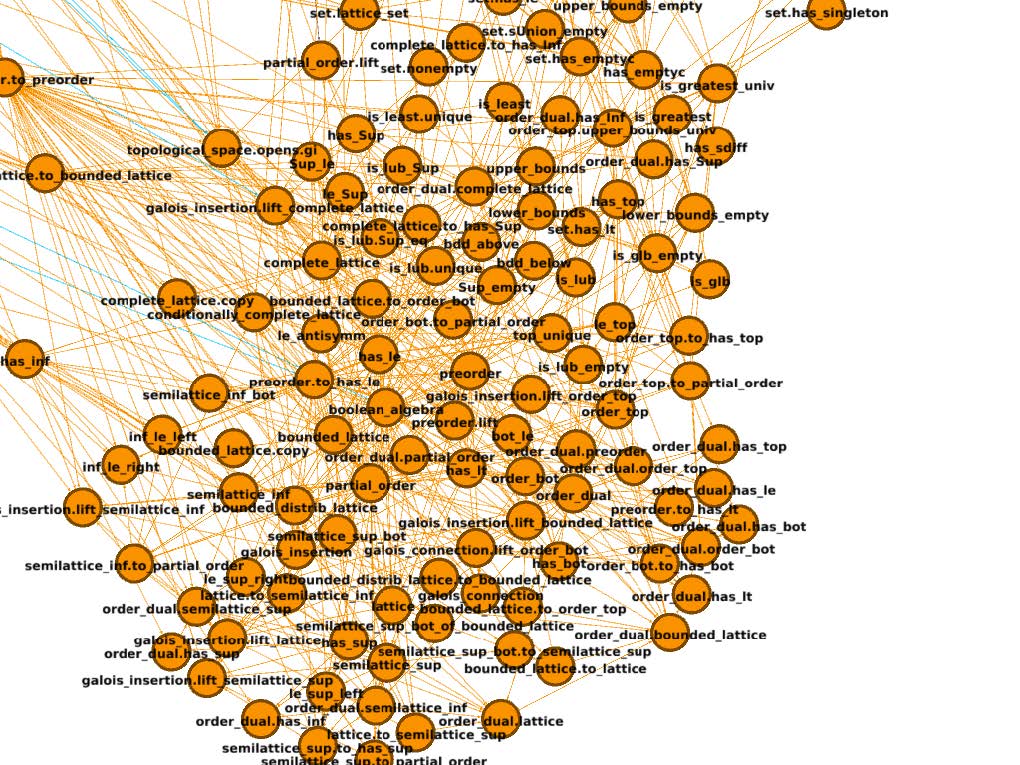 Some basic concepts in mathlib and the dependencies between them
Computational proof assistants now make it possible to develop global, digital mathematical libraries with theorems that are fully checked by computer. This summer school will introduce students to the new technology and the ideas behind it, and will encourage them to think about the goals and benefits of formalized mathematics. Students will learn to use the Lean interactive proof assistant, and by the end of the session they will be in a position to formalize mathematics on their own, join the Lean community, and contribute to its mathematical library.
Updated on Oct 20, 2023 10:07 AM PDT -
Summer Graduate School Commutative Algebra and its Interaction with Algebraic Geometry (Notre Dame)
Organizers: Steven Dale Cutkosky (University of Missouri), LEAD Claudia Polini (University of Notre Dame), Claudiu Raicu (University of Notre Dame), Steven Sam (University of California, San Diego), Kevin Tucker (University of Illinois, Chicago)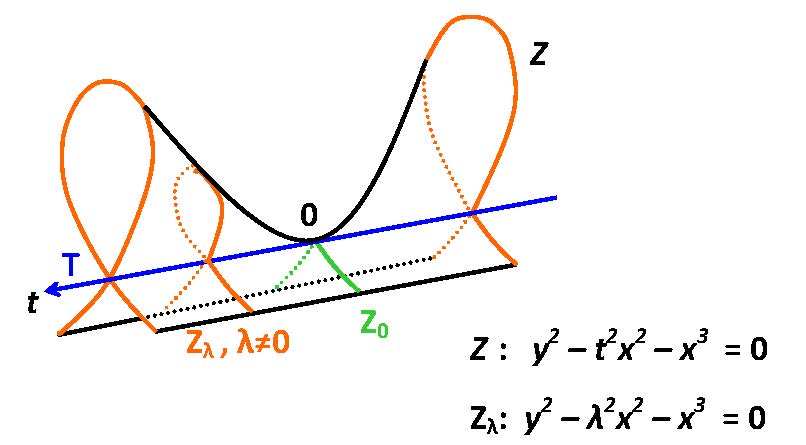
Commutative Algebra has seen an extraordinary development in the last few years. Long standing conjectures have been proven and new connections to different areas of mathematics have been built.This summer graduate school will consist of three mini-courses (5 lectures each) on fundamental topics in commutative algebra that are not covered in the standard courses. Each course will be accompanied by problem sessions focused on research. Five general colloquium-style lectures will be given by invited scholars who will also attend the school and help with afternoon research activities.
Updated on Mar 20, 2023 01:33 PM PDT -
MAY-UP Mathematically Advancing Young Undergraduates Program (MAY-UP) [2023 Pilot Program]
Organizers: Duane Cooper (Morehouse College), Shelby Wilson (Johns Hopkins University Applied Physics Lab)2023 Pilot Program: The goal of MAY-UP is to provide students with a glimpse into Linear Algebra; and the ways in which this topic may arise both theoretically and computationally in their future studies. Material will include an introduction to matrices as well as basic matrix operations. We will also provide students with introductory programming skills in Python, including development environment setup and matrix manipulations via code.
Updated on May 06, 2024 04:22 AM PDT -
Workshop May 12, a Celebration for Women in Mathematics (2023)
Organizers: Ini Adinya (University of Ibadan), Masha Albrecht (Berkeley High School), Romina Arroyo (Universidad Nacional de Cordoba), Maria-Grazia Ascenzi (University of California Los Angeles), Mirela Ciperiani (University of Texas, Austin), Donatella Danielli (Arizona State University), Shanna Dobson, Malena Espanol (Arizona State University), Olubunmi Fadipe-Joseph (University of Ilorin), Anna Fino (Florida International University), Natalia Garcia-Fritz (Pontificia Universidad Católica de Chile), Adi Glucksam (Northwestern University), Céleste Hogan (Texas Tech University), Kuei-Nuan Lin (Pennsylvania State University), Zheng Liu (University of California, Santa Barbara), Liangbing Luo (Lehigh University), LEAD Ornella Mattei (San Francisco State University), Julia Plavnik (Indiana University, Bloomington), Palina Salanevich (Universiteit Utrecht), Ramdorai Sujatha (University of British Columbia)The Simons Laufer Mathematical Sciences Institute (SLMath), formerly MSRI, celebrates May 12 with a panel discussion and social event open to all on the topic "Pathways in Mathematics". This is a hybrid event taking place on Zoom and in person at SLMath and satellite institutions.
Updated on May 17, 2023 02:43 PM PDT -
Workshop MSRI / SLMath 40th Anniversary Symposium
Organizers: Hélène Barcelo (MSRI / Simons Laufer Mathematical Sciences Institute (SLMath)), Charles Fefferman (Princeton University), Dan Freed (Harvard University), Kristin Lauter (Facebook AI Research (FAIR) North America at Meta), Dusa McDuff (Barnard College), Andrei Okounkov (University of California, Berkeley), Tatiana Toro (MSRI / Simons Laufer Mathematical Sciences Institute (SLMath); University of Washington)
In 2022-23, SLMath (formerly MSRI) celebrates 40 years of serving the mathematical sciences community through our topic-focused programs and workshops, and the general public via our national and global outreach initiatives. Director Tatiana Toro and Deputy Director Hélène Barcelo invite the community to join us for a symposium to reflect upon these four decades of extraordinary activity. This celebration will feature special guest speakers, panel discussions and an evening reception.
Updated on Sep 14, 2023 05:24 PM PDT -
Workshop Critical Issues in Mathematics Education 2023: Mentoring for Equity
Organizers: Pamela Harris (University of Wisconsin-Milwaukee), Abbe Herzig (Sarah Lawrence College), LEAD Aris Winger (Georgia Gwinnett College), Michael Young (Carnegie Mellon University)The workshop Critical Issues in Mathematics Education: Mentoring for Equity aims to reach a broad audience of faculty and students in postsecondary mathematical sciences. Participants will learn about the evidence base for effective mentoring, with a focus on culturally responsive mentoring that supports all students and faculty along their mathematical paths. The workshop includes a combination of discussion of research evidence, review and adaptation of practical tools, and explicit training in effective mentoring, including how to bring these tools back to participants’ home institutions. The workshop intertwines objectives of increasing participants’ knowledge of the scholarship on effective mentoring, and engages participants in interactive activities to develop tangible skills as mentors and as mentor-trainers. Participants should come with a growth mindset, prepared to reflect on their experiences as mentors and mentees, and actively contribute to activities that build skills for implementing best mentoring practices. This workshop will cultivate local and national mentoring communities that bring effective tools and strategies to mentoring, so that mentees can persist and thrive in research, teaching, education, and throughout their education and careers. One focus will be on addressing the individual mentoring needs of all faculty and students, including those who have been historically-marginalized in mathematics education and careers.
Updated on Jun 28, 2024 06:07 AM PDT
|
|
Past Educational Events |