

-
Workshop Modern Math Workshop 2022
Organizers: Hélène Barcelo (MSRI / Simons Laufer Mathematical Sciences Institute (SLMath)), Philip Hammer (Institute for Mathematical and Statistical Innovation), Christian Ratsch (Institute of Pure and Applied Mathematics (IPAM)), Ulrica Wilson (Institute for Computational and Experimental Research in Mathematics (ICERM))ALL FUNDING FOR THIS WORKSHOP HAS BEEN ALLOCATED
As part of the Mathematical Sciences Collaborative Diversity Initiatives, the six NSF-funded U.S. mathematics institutes will host their annual SACNAS pre-conference event, the 2022 Modern Math Workshop (MMW). The Modern Math Workshop encourages undergraduates from underrepresented groups to pursue careers in the mathematical sciences, and builds research and networking opportunities among undergraduates, graduate students and recent PhDs.
Updated on Nov 29, 2022 08:49 AM PST -
Summer Graduate School Tropical Geometry
Organizers: Renzo Cavalieri (Colorado State University), Hannah Markwig (Eberhard-Karls-Universität Tübingen), Dhruv Ranganathan (University of Cambridge)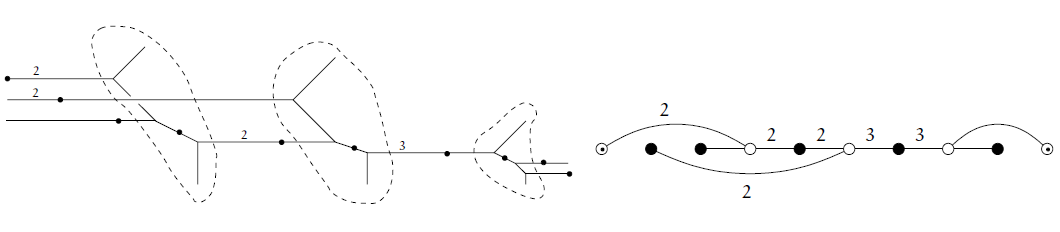 A tropical stable map and the corresponding floor diagram
Enumerative geometry and the theory of moduli spaces of curves are two cornerstones of modern algebraic geometry; the two subjects have had a significant influence on each other. In the last 15 years, discrete and combinatorial methods, systematized within tropical geometry, have begun to provide new avenues of access into these two subjects. The goal of this summer school is to give students crash courses in tropical and logarithmic geometry, with a particular focus on the applications in enumerative geometry and moduli theory. The school will consist of three courses of seven lectures each:
- Enumeration of tropical curves/ by Hannah Markwig
- Curve counting in tropical and algebraic geometry by Renzo Cavalieri
- Logarithmic geometry and stable map/s by Dhruv Ranganathan
Updated on Aug 12, 2022 03:03 PM PDT -
Summer Graduate School Sums of Squares Method in Geometry, Combinatorics and Optimization (BIRS)
Organizers: LEAD Grigoriy Blekherman (Georgia Institute of Technology), Annie Raymond (University of Massachusetts Amherst), Cynthia Vinzant (University of Washington)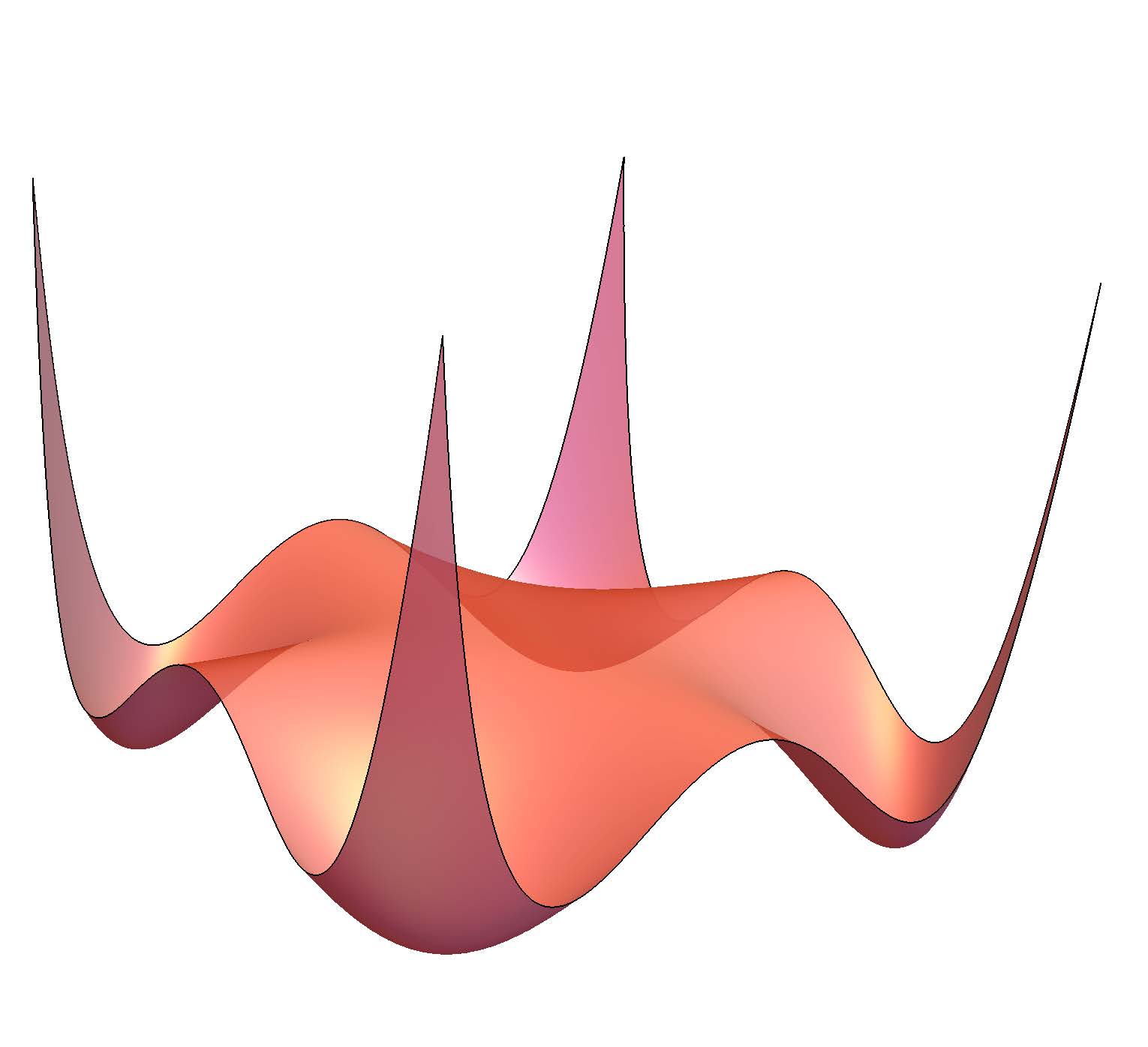 Graph of the Motzkin polynomial, which is nonnegative but not a sum of squares.
The study of nonnegative polynomials and sums of squares is a classical area of real algebraic geometry dating back to Hilbert’s 17th problem. It also has rich connections to real analysis via duality and moment problems. In the last 15 years, sums of squares relaxations have found a wide array of applications from very applied areas (e.g., robotics, computer vision, and machine learning) to theoretical applications (e.g., extremal combinatorics, theoretical computer science). Also, an intimate connection between sums of squares and classical algebraic geometry has been found. Work in this area requires a blend of ideas and techniques from algebraic geometry, convex geometry and representation theory. After an introduction to nonnegative polynomials, sums of squares and semidefinite optimization, we will focus on the following three topics:
- Sums of squares on real varieties (sets defined by real polynomial equations) and connections with classical algebraic geometry.
- Sums of squares method for proving graph density inequalities in extremal combinatorics. Here addition and multiplication take place in the gluing algebra of partially labelled graphs.
- Sums of squares relaxations for convex hulls of real varieties and theta-bodies with applications in optimization.
The summer school will give a self-contained introduction aimed at beginning graduate students, and introduce participants to the latest developments. In addition to attending the lectures, students will meet in intensive problem and discussion sessions that will explore and extend the topics developed in the lectures.
Updated on Apr 07, 2022 02:41 PM PDT -
Summer Graduate School Topological Methods for the Discrete Mathematician
Organizers: Pavle Blagojevic, Florian Frick (Carnegie Mellon University), Shira Zerbib (Iowa State University)
Recently, progress in the field of topological methods in discrete mathematics has been rapid and has generated a lot of activity with the resolution of major open problems, the emergence of new lines of inquiry, and the development of new tools. These exciting new developments have not been digested into a textbook treatment. The two main goals of this school are to:
- Provide graduate students with a thorough introduction to novel topological techniques and to a handful of their applications in the fields of combinatorics and discrete geometry with short glimpses into mathematical mechanics and algorithm complexity.
- Expose students to current research, and guide them in research on open problems in discrete mathematics using modern topological tools.
The summer school will lead participants from appealing, simple-to-state problems at confluence of combinatorics, geometry, and topology to sophisticated topological methods that are required for their resolution. In recent years topological methods have found numerous novel applications in mathematics and beyond, such as in data science, machine learning, economics, the social sciences, and biology. The problems we will discuss are particularly well-suited to rapidly put students in a position to approach related research questions.
Updated on Feb 14, 2023 01:39 PM PST -
Summer Graduate School Mathematics of Machine Learning (INdAM and Courant Institute)
Organizers: Sebastien Bubeck (Microsoft Research)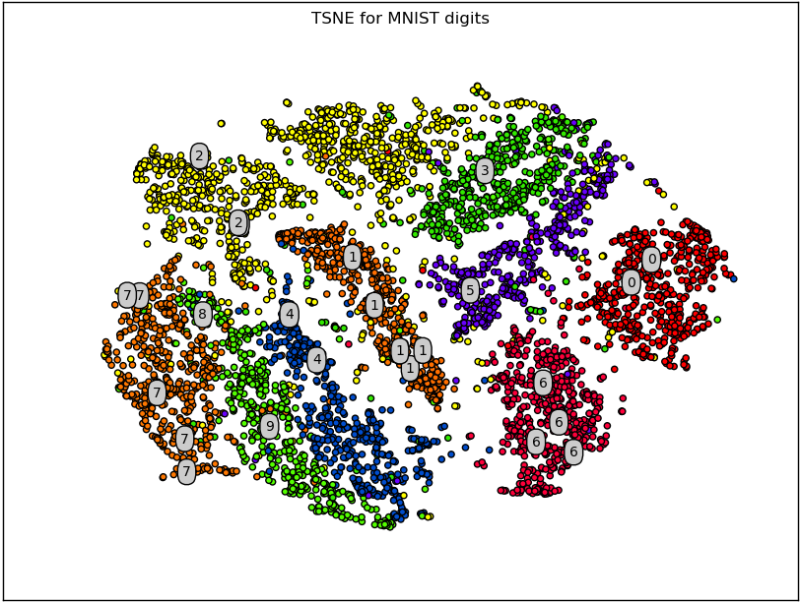 Popular visualization of the MNIST dataset
This school is offered in partnership with Istituto Nazionale di Alta Matematica (INdAM) and the Courant Institute of Mathematical Sciences.
Learning theory is a rich field at the intersection of statistics, probability, computer science, and optimization. Over the last decades the statistical learning approach has been successfully applied to many problems of great interest, such as bioinformatics, computer vision, speech processing, robotics, and information retrieval. These impressive successes relied crucially on the mathematical foundation of statistical learning.
Recently, deep neural networks have demonstrated stunning empirical results across many applications like vision, natural language processing, and reinforcement learning. The field is now booming with new mathematical problems, and in particular, the challenge of providing theoretical foundations for deep learning techniques is still largely open. On the other hand, learning theory already has a rich history, with many beautiful connections to various areas of mathematics (e.g., probability theory, high dimensional geometry, game theory). The purpose of the summer school is to introduce graduate students (and advanced undergraduates) to these foundational results, as well as to expose them to the new and exciting modern challenges that arise in deep learning and reinforcement learning.
Updated on Aug 12, 2022 11:42 AM PDT -
Summer Graduate School MSRI-NCTS Joint Summer School: Recent Topics in Well Posedness
Organizers: Jungkai Chen (National Taiwan University), Mimi Dai (University of Illinois at Chicago), Yoshikazu Giga (University of Tokyo), Tsuyoshi Yoneda (Hitotsubashi University)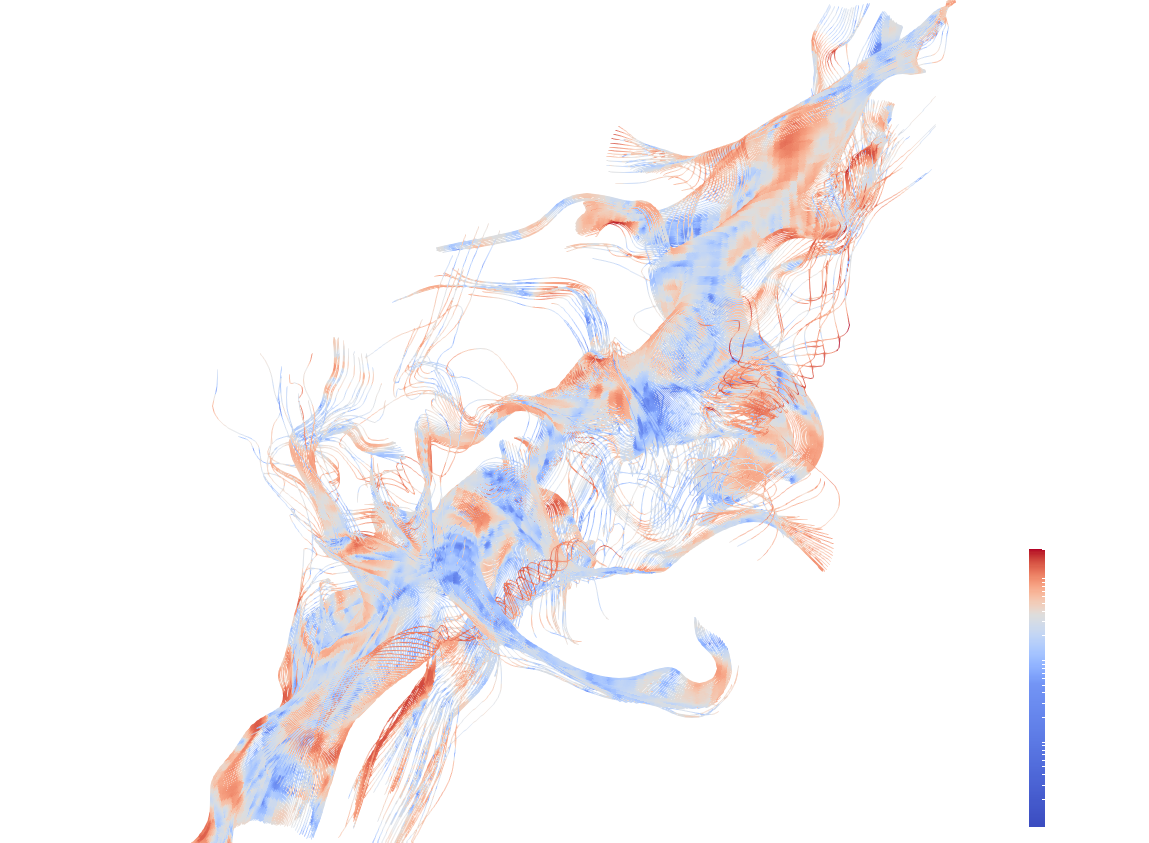 Fluid-flow stream function color-coded by vorticity in 3D flat torus calculated by K. Nakai (The University of Tokyo)
This school is offered in partnership with the National Center for Theoretical Sciences.
The purpose of the workshop is to introduce graduate students to fundamental results on the Navier-Stokes and the Euler equations, with special emphasis on the solvability of its initial value problem with rough initial data as well as the large time behavior of a solution. These topics have long research history. However, recent studies clarify the problems from a broad point of view, not only from analysis but also from detailed studies of orbit of the flow.
Updated on Aug 12, 2022 11:40 AM PDT -
Summer Graduate School 2022 Joint PCMI School: Number Theory Informed by Computation
Organizers: Jennifer Balakrishnan (Boston University), Rafe Mazzeo (Stanford University), Bjorn Poonen (Massachusetts Institute of Technology), Akshay Venkatesh (Institute for Advanced Study)The PCMI graduate summer school program in 2022 will consist of a sequence of 11 minicourses. The lecturers and topics for these minicourses are listed below. Each minicourse is accompanied by a problem session. The topics are arranged so that there is good material and opportunities for learning both for less experienced students as well as more advanced students. Beyond their attendance in these minicourse sessions, all graduate participants will be able to take part in the substantial other benefits of a PCMI session. This includes the opportunity to interact with the researchers in residence and take part in the research seminar component of PCMI. Many graduate students also interact in significant ways with the undergraduate cohort,,the undergraduate faculty cohort, and may also participate in the many pedagogically focused activities which form part of the K-12 Teacher Leadership Program and the Workshop for Equity in Mathematics Education. PCMI includes numerous cross-program activities to help members from all these groups interact with one another.
Updated on Feb 02, 2022 03:52 PM PST -
Summer Graduate School Séminaire de Mathématiques Supérieures 2022: Floer Homotopy Theory
Organizers: Kristen Hendricks (Rutgers University), Ailsa Keating (University of Cambridge), Robert Lipshitz, Liam Watson (University of British Columbia), Ben Williams (University of British Columbia)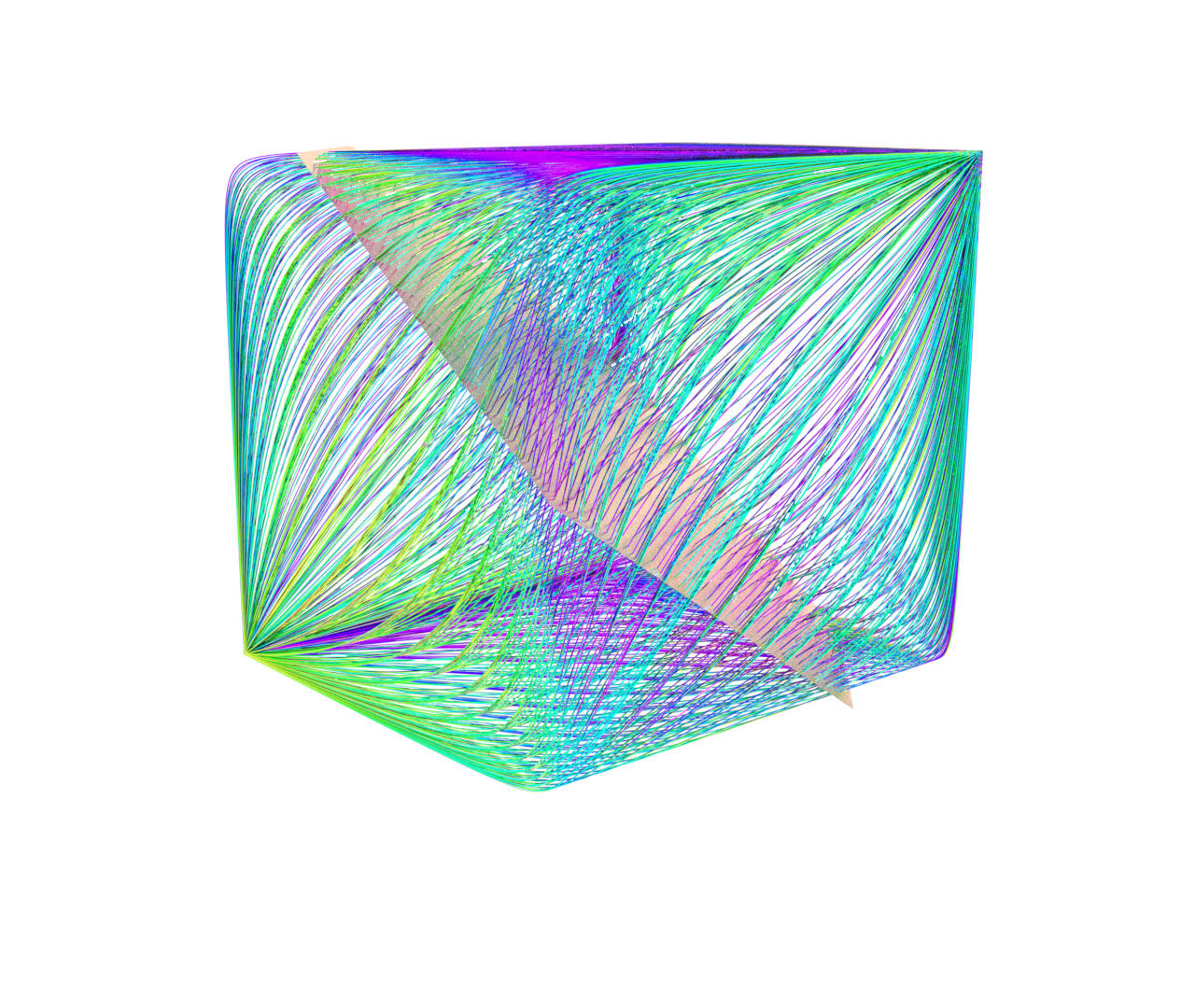 Image by Prof. Robert Lipshitz
The idea of stable homotopy refinements of Floer homology was first introduced by Cohen, Jones, and Segal in a 1994 paper, but it was only in the last decade that this idea became a key tool in low-dimensional and symplectic topology. The two crowning achievements of these techniques so far are Manolescu's use of his Pin(2)-equivariant Seiberg--Witten Floer homotopy type to resolve the Triangulation Conjecture and Abouzaid-Blumberg's use of Floer homotopy theory and Morava K-theory to prove the general Arnol'd Conjecture in finite characteristic. During this period, a range of related techniques, included under the umbrella of Floer homotopy theory, have also led to important advances, including involutive Heegaard Floer homology, Smith theory for Lagrangian intersections, homotopy coherence, and further connections between string topology and Floer theory. These in turn have sparked developments in algebraic topology, ranging from developments on Lie algebras in derived algebraic geometry to new computations of equivariant Mahowald invariants to new results on topological Hochschild homology.
The goal of the summer school is to provide participants the tools in symplectic geometry and stable homotopy theory required to work on Floer homotopy theory. Students will come away with a basic understanding of some of the key techniques, questions, and challenges in both of these fields. The summer school may be particularly valuable for participants with a solid understanding of one of the two fields who want to learn more about the other and the connections between them.Updated on May 27, 2022 09:41 AM PDT -
Summer Graduate School Metric Geometry and Geometric Analysis (Oxford, United Kingdom)
Organizers: LEAD Cornelia Drutu (University of Oxford), Panos Papazoglou (University of Oxford)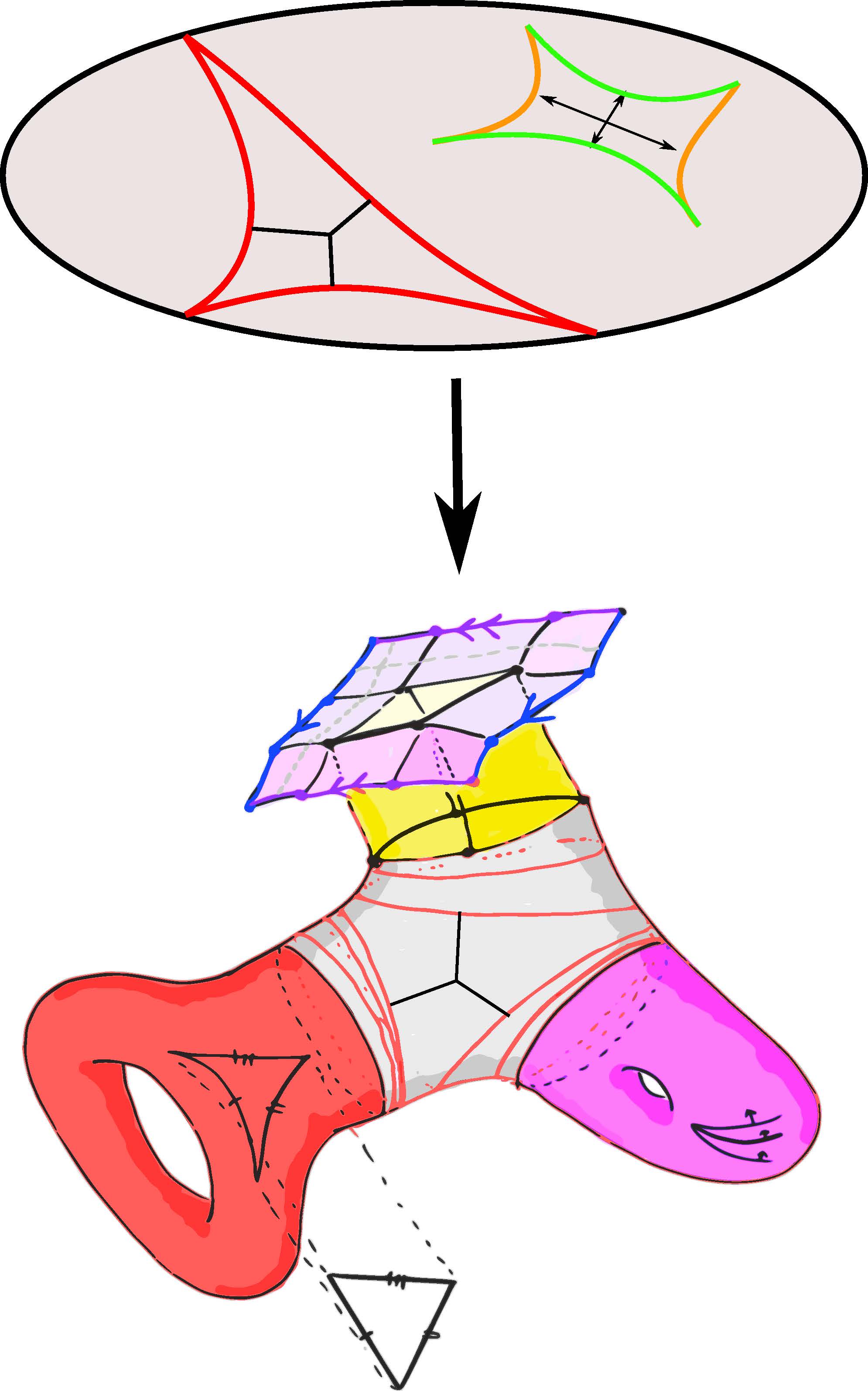 Several geometric ideas in the context of a surface: hyperbolic metric, CAT(0) inequality, Gromov hyperbolicity/coarse median geometry, nonpositively-curved square tiling, Besikovitch inequality. (Picture by M. Hagen and A. Sisto.)
The purpose of the summer school is to introduce graduate students to key mainstream directions in the recent development of geometry, which sprang from Riemannian Geometry in an attempt to use its methods in various contexts of non-smooth geometry. This concerns recent developments in metric generalizations of the theory of nonpositively curved spaces and discretizations of methods in geometry, geometric measure theory and global analysis. The metric geometry perspective gave rise to new results and problems in Riemannian Geometry as well.
All these themes are intertwined and have developed either together or greatly influencing one another. The summer school will introduce some of the latest developments and the remaining open problems in these very modern areas, and will emphasize their synergy.
Updated on Feb 14, 2022 12:29 PM PST -
Summer Graduate School Random Graphs
Organizers: Louigi Addario-Berry (McGill University), Remco van der Hofstad (Technische Universiteit Eindhoven)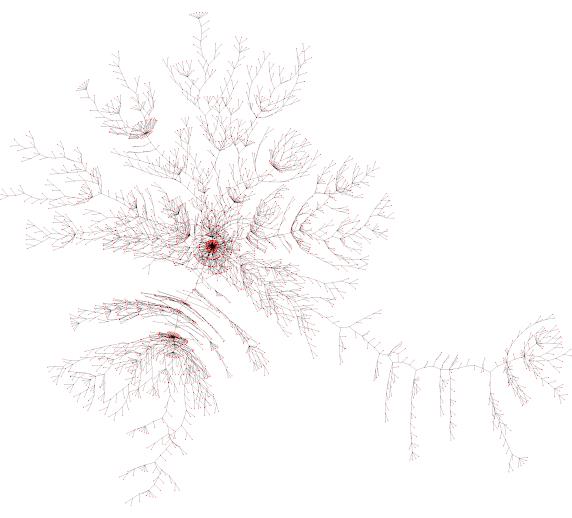 by DeDelphin Sénizergues
The topic of random graphs is at the forefront of applied probability, and it is one of the central topics in multidisciplinary science where mathematical ideas are used to model and understand the real world. At the same time, random graphs pose challenging mathematical problems that have attracted the attention from probabilists and combinatorialists since the 1960, with the pioneering work of Erdös and Rényi. Around the turn of the millennium, very large data sets started to become available, and several applied disciplines started to realize that many real-world networks, even though they are from various different origins, share many fascinating features. In particular, many of such networks are small worlds, meaning that graph distances in them are typically quite small, and they are scalefree, in the sense that there are enormous differences in the number of connections that their elements make. In particular, such networks are quite different from the classical random graph models, such as proposed by Erdös and Rényi.
Updated on Jul 14, 2022 09:37 AM PDT -
Summer Graduate School Algebraic Theory of Differential and Difference Equations, Model Theory and their Applications
Organizers: LEAD Alexey Ovchinnikov (Queens College, CUNY), Anand Pillay (University of Notre Dame), Thomas Scanlon (University of California, Berkeley)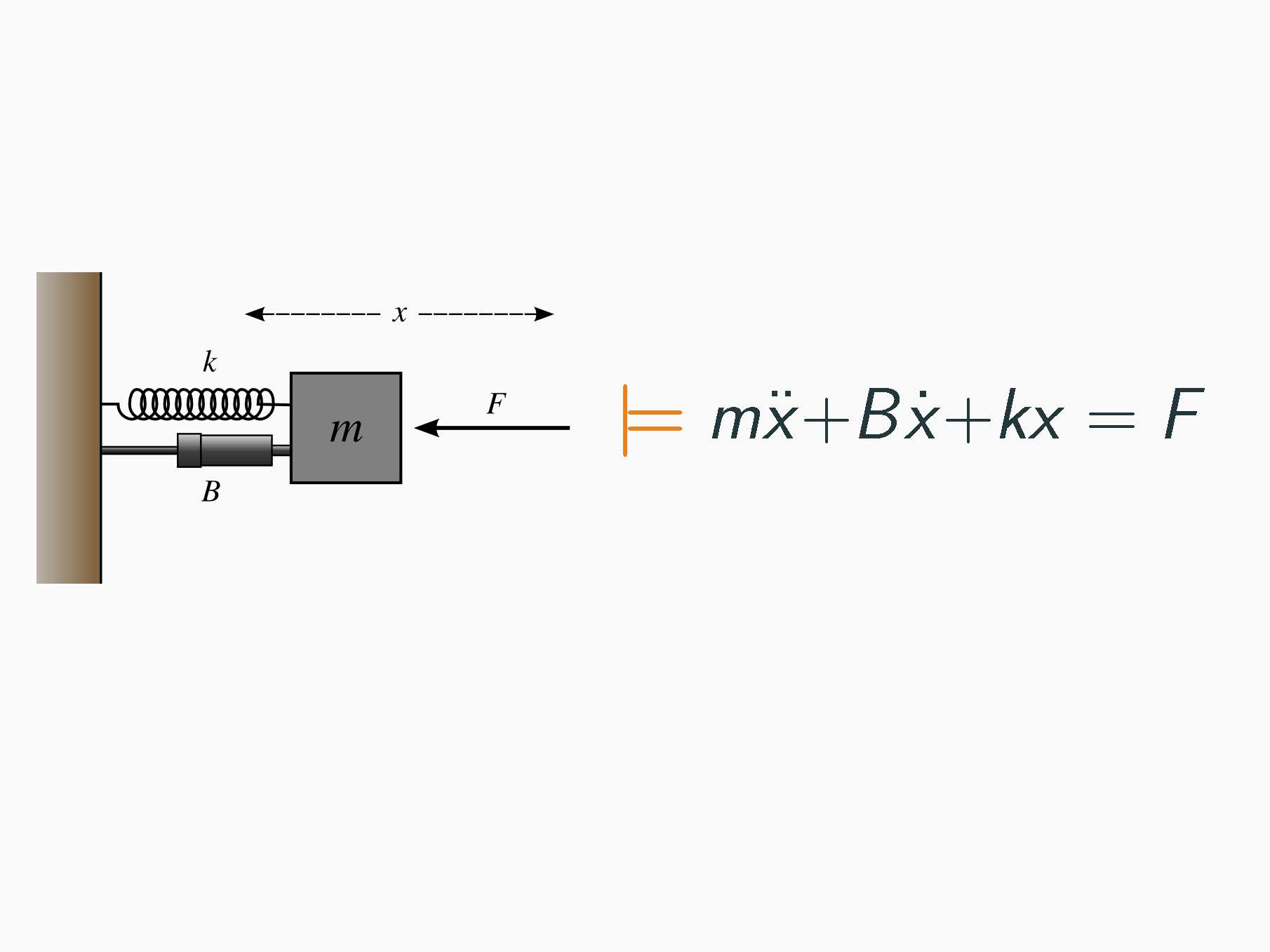 Algebraic Theory Of Differential And Difference Equations, Model Theory And Their Applications
The purpose of the summer school will be to introduce graduate students to effective methods in algebraic theories of differential and difference equations with emphasis on their model-theoretic foundations and to demonstrate recent applications of these techniques to studying dynamic models arising in sciences. While these topics comprise a coherent and rich subject, they appear in graduate coursework in at best a piecemeal way, and then only as components of classes for other aims. With this Summer Graduate School, students will learn both the theoretical basis of differential and difference algebra and how to use these methods to solve practical problems. Beyond the lectures, the graduate students will meet daily in problem sessions and will participate in one-on-one mentoring sessions with the lecturers and organizers.
Updated on Jan 11, 2023 02:38 PM PST -
Seminar ADJOINT Professional Development Panel - Work, Wellness & Autonomy
Updated on Jun 22, 2022 01:56 PM PDT -
Summer Graduate School Geometric Flows (Crete, Greece)
Organizers: Nicholas Alikakos (National and Kapodistrian University of Athens (University of Athens)), Panagiota Daskalopoulos (Columbia University)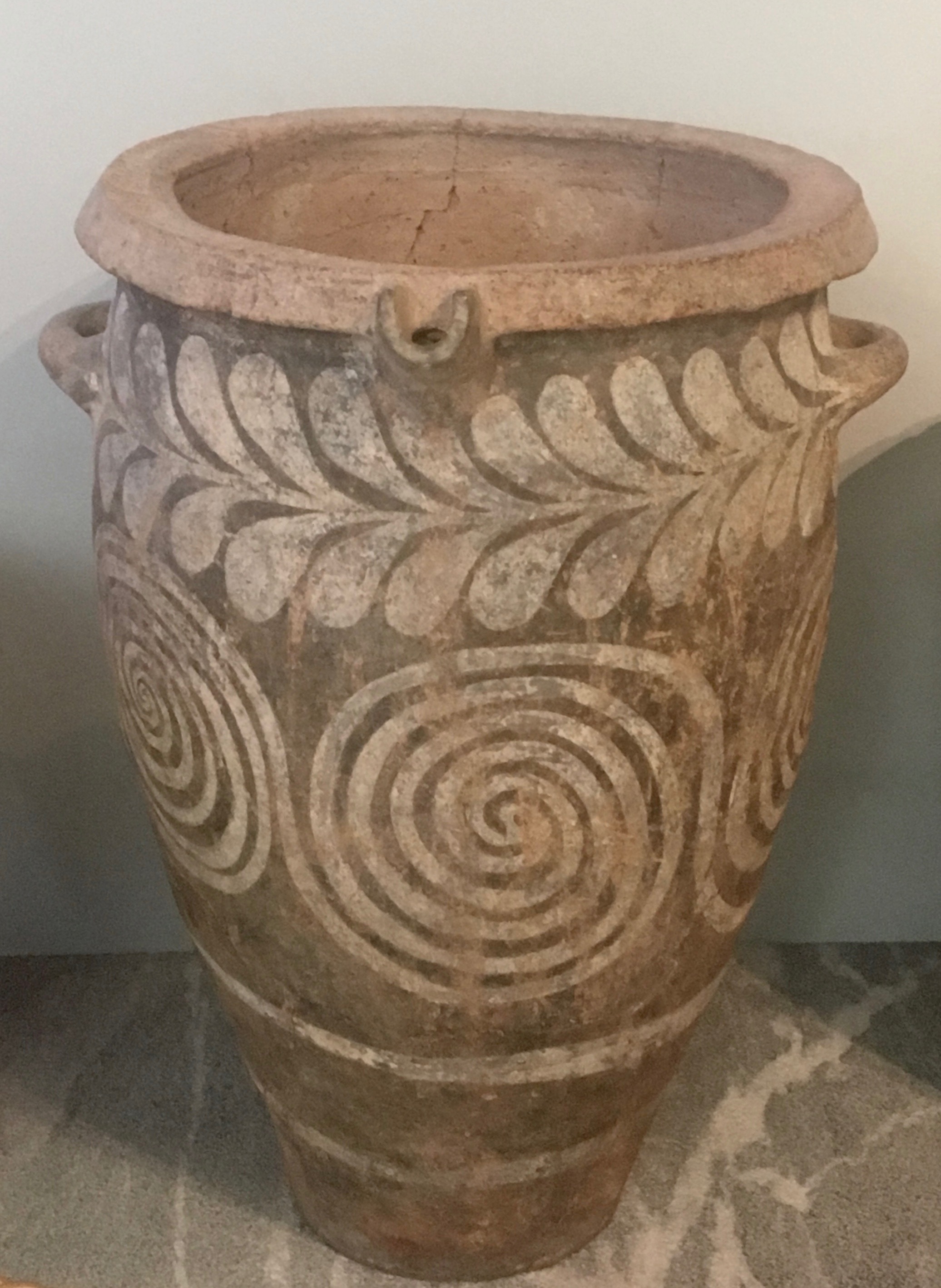 photo courtesy of Panagiota Daskalopoulos
[The image on this vase from Minoan Crete, dated on 1500-2000 BC, resembles an ancient solution to the Curve shortening flow - one of the most basic geometric flows. The vase is at Heraklion Archaeological Museum]
This summer graduate school is a collaboration between MSRI and the FORTH-IACM Institute in Crete. The purpose of the school is to introduce graduate students to some of the most important geometric evolution equations. Information about the location of the summer school can be found here.
This is an area of geometric analysis that lies at the interface of differential geometry and partial differential equations. The lectures will begin with an introduction to nonlinear diffusion equations and continue with classical results on the Ricci Flow, the Mean curvature flow and other fully non-linear extrinsic flows such as the Gauss curvature flow. The lectures will also include geometric applications such as isoperimetric inequalities, topological applications such as the Poincaré onjecture, as well as recent important developments related to the study of singularities and ancient solutions.
Updated on Sep 30, 2022 12:18 PM PDT -
Summer Graduate School New Directions in Representation Theory (AMSI and U. of Hawaii, Hilo)
Organizers: Angela Coughlin (Australian Mathematical Sciences Institute), Joseph Grotowski (University of Queensland), Tim Marchant (Australian Mathematical Sciences Institute), Ole Warnaar (University of Queensland), Geordie Williamson (University of Sydney)This school is offered in partnership with the Australian Mathematical Sciences Institute and the University of Hawaii, Hilo.
Representation Theory has undergone a revolution in recent years, with the development of what is now known as higher representation theory. In particular, the notion of categorification has led to the resolution of many problems previously considered to be intractable.
The school will begin by providing students with a brief but thorough introduction to what could be termed the “bread and butter of modern representation theory”, i.e., compact Lie groups and their representation theory; character theory; structure theory of algebraic groups.
We will then continue on to a number of more specialized topics. The final mix will depend on discussions with the prospective lecturers, but we envisage such topics as:
• modular representation theory of finite groups (blocks, defect groups, Broué’s conjecture);
• perverse sheaves and the geometric Satake correspondence;
• the representation theory of real Lie groups.
Updated on Aug 12, 2022 11:38 AM PDT -
MSRI-UP MSRI-UP 2022: Algebraic Methods in Mathematical Biology
Organizers: LEAD Federico Ardila (School of Mathematical Sciences, Queen Mary, University of London), Duane Cooper (Morehouse College), Maria Mercedes Franco, Rebecca Garcia (Colorado College), Candice Price (Smith College), Anne Shiu (Texas A & M University; Texas A&M University)The MSRI-UP summer program is designed to serve a diverse group of undergraduate students who would like to conduct research in the mathematical sciences.
In 2022, MSRI-UP will focus on Algebraic Methods in Mathematical Biology. The research program will be led by Dr. Anne Shiu, Associate Professor of Mathematics at Texas A&M University.
Updated on Oct 20, 2023 12:41 PM PDT -
Summer Graduate School Integral Equations and Applications
Organizers: Fioralba Cakoni (Rutgers University), Dorina Mitrea (Baylor University), Irina Mitrea (Temple University), Shari Moskow (Drexel University)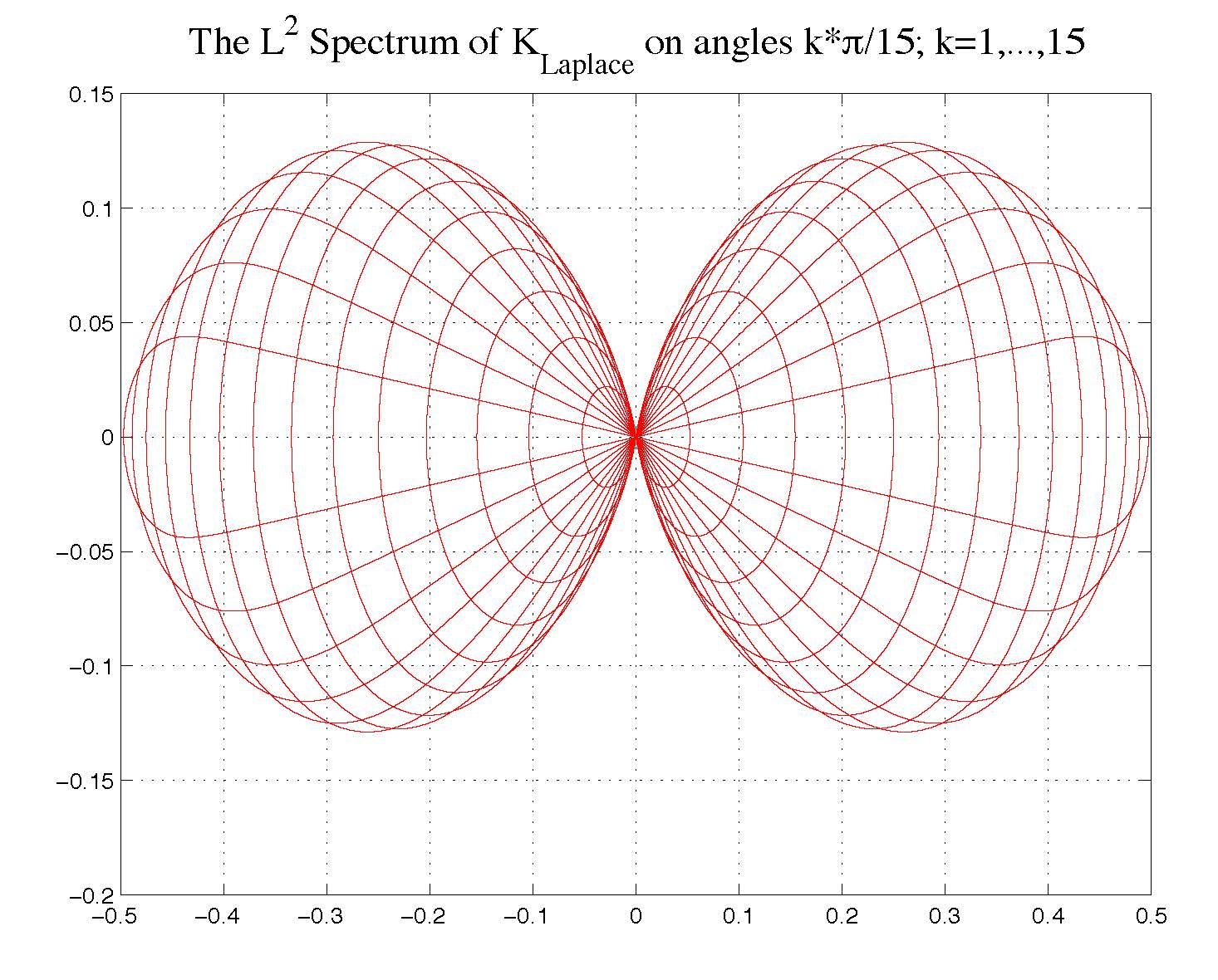 L 2 Spectra of K for apertures π 15 , · · · 14π 15 , π
The field of Integral Equations has a long and distinguished history, being the driving force behind many fundamental developments in various areas of mathematics including Harmonic Analysis, Partial Differential Equations, Potential Theory, Scattering Theory, Functional Analysis, Complex Analysis, Operator Theory, Mathematical Physics and Numerical Analysis.
This school will:
- introduce graduate students to the systematic study of integral equations;
- present some of the latest theoretical advancements in the field and open problems; and
- involve participants in a hands-on discovery lab focused on deriving results about integral operators in two dimensions relevant for both the theoretical and numerical treatment of Integral Equations in two dimensions. The curriculum of this program will be accessible and will have a broad appeal to graduate students from a variety of mathematical areas (both theoretical and applied).
Updated on Aug 11, 2022 09:23 AM PDT -
Workshop May 12, a Celebration for Women in Mathematics, year 2022
Organizers: Ini Adinya (University of Ibadan), Maria-Grazia Ascenzi (University of California Los Angeles), Hajer Bahouri (Laboratoire Jacques-Louis Lions; Centre National de la Recherche Scientifique (CNRS)), Hélène Barcelo (MSRI / Simons Laufer Mathematical Sciences Institute (SLMath)), Lenore Blum (University of California, Berkeley; Carnegie Mellon University), Donatella Danielli (Arizona State University), Shanna Dobson, Malena Espanol (Arizona State University), Vasiliki Evdoridou (The Open University), Olubunmi Fadipe-Joseph (University of Ilorin), Anna Fino (Florida International University), Adi Glucksam (Northwestern University), Eriko Hironaka (Florida State University), Céleste Hogan (Texas Tech University), Kyounghee Kim (Florida State University), Kuei-Nuan Lin (Pennsylvania State University), Liangbing Luo (Lehigh University), LEAD Ornella Mattei (San Francisco State University), Betul Orcan-Ekmekci (Rice University), Leticia Pardo Simon (University of Manchester), Julia Plavnik (Indiana University, Bloomington), Palina Salanevich (Universiteit Utrecht), Awais Shaukat (Government College University Lahore), Tara Taylor (St. Francis Xavier University)MSRI's 2022 Celebration of Women in Math event will be for graduate students, with a focus on "How to build a Career in Math". It will be a hybrid workshop, with online and in-person activities at satellite institutions.
The event will include a panel discussion, social activities, and breakout sessions on the following topics:
- Finding (having) mentors
- How to build a network and collaborations
- How to become an independent researcher
- How to balance teaching/research/admin/life
Registration is open.
Updated on May 26, 2022 02:41 PM PDT -
Workshop [Hybrid Workshop] Critical Issues in Mathematics Education 2022: Initiating, Sustaining, and Researching Mathematics Department Transformation of Introductory Courses for STEM Majors
Organizers: Naneh Apkarian (Arizona State University), David Bressoud (Macalester College), Pamela Burdman (Just Equations ), Jamylle Carter (Diablo Valley college), Ted Coe (Northwest Evaluation Association), Courtney Ginsberg (Math for America), Estrella Johnson (Virginia Polytechnic Institute and State University), W Gary Martin (Auburn University), Michael O'Sullivan (San Diego State University), LEAD Chris Rasmussen (San Diego State University), Daniel Reinholz (San Diego State University), Wendy Smith (University of Nebraska), David Webb (University of Colorado at Boulder)The world is changing, along with perceptions. Many call for the improvement of mathematics teaching and learning, for both citizenry and STEM preparation. To achieve sustainable change, though, the focus needs to extend from individuals to systems. It is not enough to change one classroom or one course. Transformation requires change at all levels: in teaching, programmatic practices, and institutions. This workshop will bring together teachers and researchers from universities, community colleges, and K-12 schools to explore the reasons for and processes by which change in university mathematics departments is initiated, promoted, and sustained and lessons learned from change efforts in K-12. It will review what we know about change at all levels and reflect on stories of failure and success.
Updated on Mar 14, 2022 12:02 PM PDT -
Workshop Blackwell Tapia Conference 2021
Organizers: David Banks (Duke University), Hélène Barcelo (MSRI / Simons Laufer Mathematical Sciences Institute (SLMath)), Lloyd Douglas, Robert Megginson (University of Michigan), Mariel Vazquez (University of California, Davis), Ulrica Wilson (Institute for Computational and Experimental Research in Mathematics (ICERM))MSRI and the Mathematical Science Institutes Diversity Initiative (MSIDI) are pleased to announce that the 2021 Blackwell-Tapia Conference (rescheduled from Fall 2020), will be held simultaneously at four locations nationwide. The conference will celebrate the 2020 Blackwell-Tapia prize winner, Tatiana Toro (University of Washington), who has recently been announced as the next Director of MSRI, effective August 2022.
ONLY REGISTRATIONS FOR VIRTUAL PARTICIPATION ARE BEING ACCEPTED AS OF NOVEMBER 8.
Choose from four host sites nationwide:
Mathematical Sciences Research Institute (MSRI): Berkeley, California
Institute for Pure and Applied Mathematics (IPAM): Los Angeles, California
Institute for Mathematical and Statistical Innovation (IMSI): Chicago, Illinois
Institute for Advanced Study (IAS): Princeton, New JerseyUpdated on Jul 07, 2026 08:28 AM PDT -
Summer Graduate School Foundations and Frontiers of Probabilistic Proofs (Virtual School)
Organizers: Alessandro Chiesa (École Polytechnique Fédérale de Lausanne (EPFL)), Tom Gur (University of Warwick)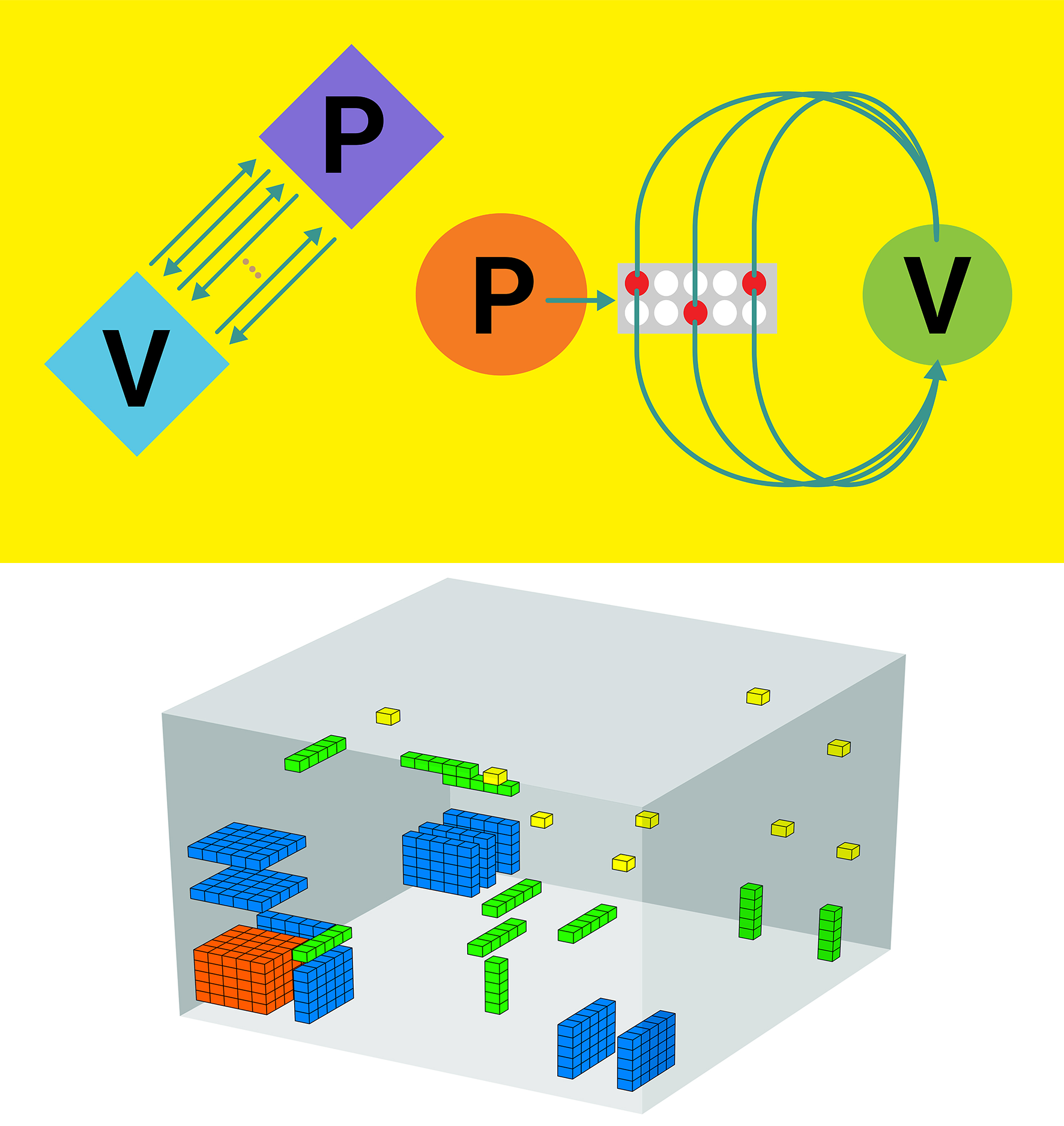 Several executions of a 3-dimensional sumcheck protocol with a random order of directions (thanks to Dev Ojha for creating the diagram)
Proofs are at the foundations of mathematics. Viewed through the lens of theoretical computer science, verifying the correctness of a mathematical proof is a fundamental computational task. Indeed, the P versus NP problem, which deals precisely with the complexity of proof verification, is one of the most important open problems in all of mathematics.
The complexity-theoretic study of proof verification has led to exciting reenvisionings of mathematical proofs. For example, probabilistically checkable proofs (PCPs) admit local-to-global structure that allows verifying a proof by reading only a minuscule portion of it. As another example, interactive proofs allow for verification via a conversation between a prover and a verifier, instead of the traditional static sequence of logical statements. The study of such proof systems has drawn upon deep mathematical tools to derive numerous applications to the theory of computation and beyond.
In recent years, such probabilistic proofs received much attention due to a new motivation, delegation of computation, which is the emphasis of this summer school. This paradigm admits ultra-fast protocols that allow one party to check the correctness of the computation performed by another, untrusted, party. These protocols have even been realized within recently-deployed technology, for example, as part of cryptographic constructions known as succinct non-interactive arguments of knowledge (SNARKs).
This summer school will provide an introduction to the field of probabilistic proofs and the beautiful mathematics behind it, as well as prepare students for conducting cutting-edge research in this area.
Updated on Oct 20, 2023 01:21 PM PDT
|
|
Past Educational Events |