

-
Workshop Modern Math Workshop 2026

The Simons Laufer Mathematical Sciences Institute (SLMath) will host the 2026 Modern Math Workshop (MMW) as part of the SACNAS Annual Conference. The Modern Math Workshop encourages undergraduates to pursue careers in the mathematical sciences, and builds research and networking opportunities among undergraduates, graduate students and recent PhDs in the mathematical sciences.
Updated on Sep 11, 2026 02:01 PM PDT -
Summer Graduate School Moduli of Varieties (SLMath)
Organizers: Kenneth Ascher, Dori Bejleri (University of Maryland), Kristin DeVleming (University of California, San Diego)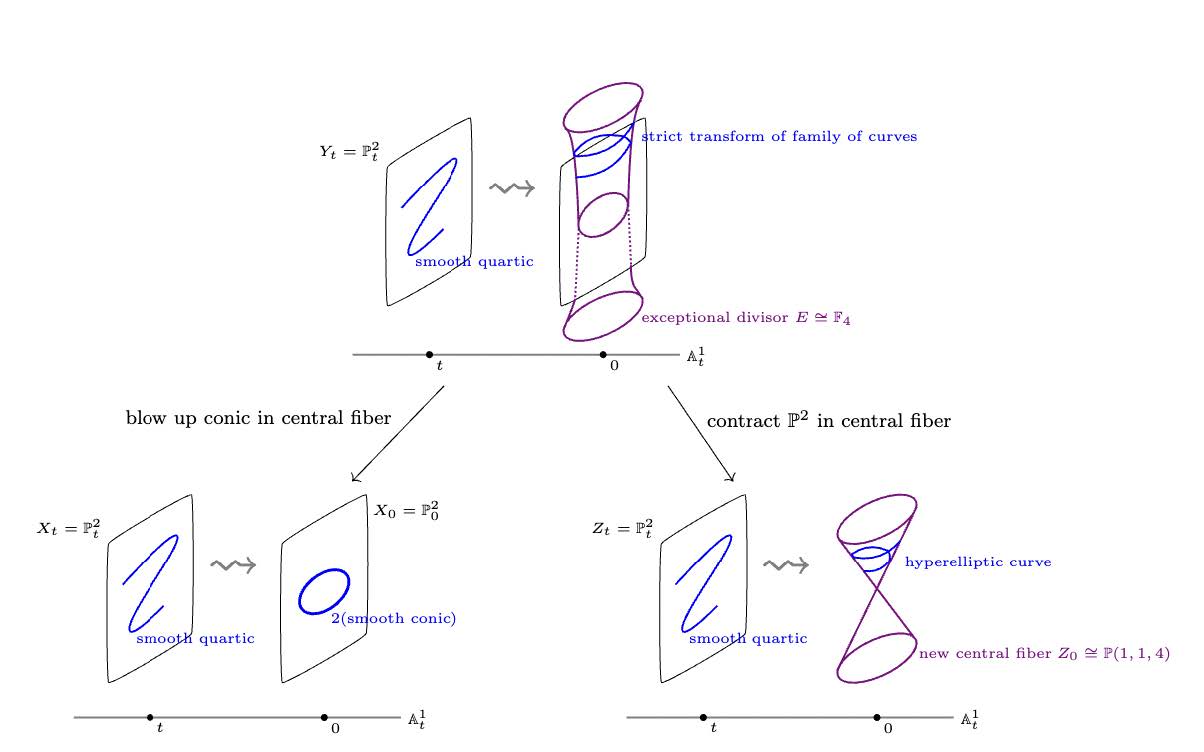 <p>A wall-crossing in a moduli problem</p>
One of the central problems in algebraic geometry is to classify so-called algebraic varieties: geometric shapes cut out by polynomial equations. Algebraic varieties are parametrized by certain moduli spaces (roughly: parameter spaces whose points correspond to these different varieties). The geometry of these moduli spaces encodes the ways of continuously deforming these shapes. Furthermore, classification questions for algebraic varieties often boil down to understanding the geometry of these moduli spaces. In the past few years, powerful new tools have been developed in moduli theory, especially for higher dimensional varieties – those which are of complex dimension at least two. The goal of this summer school is to provide an introduction to many of these recently emerging breakthroughs to enable graduate students to begin working in this area. The program will be motivated and often guided by examples and is intended to be accessible to a wide variety of students
Updated on Jul 23, 2026 01:27 PM PDT -
Summer Graduate School Singularities in Commutative Algebra Through Cohomological Methods (SLMath)
Organizers: Benjamin Briggs (Imperial College, London), Eloísa Grifo (University of Nebraska), Josh Pollitz (Syracuse University)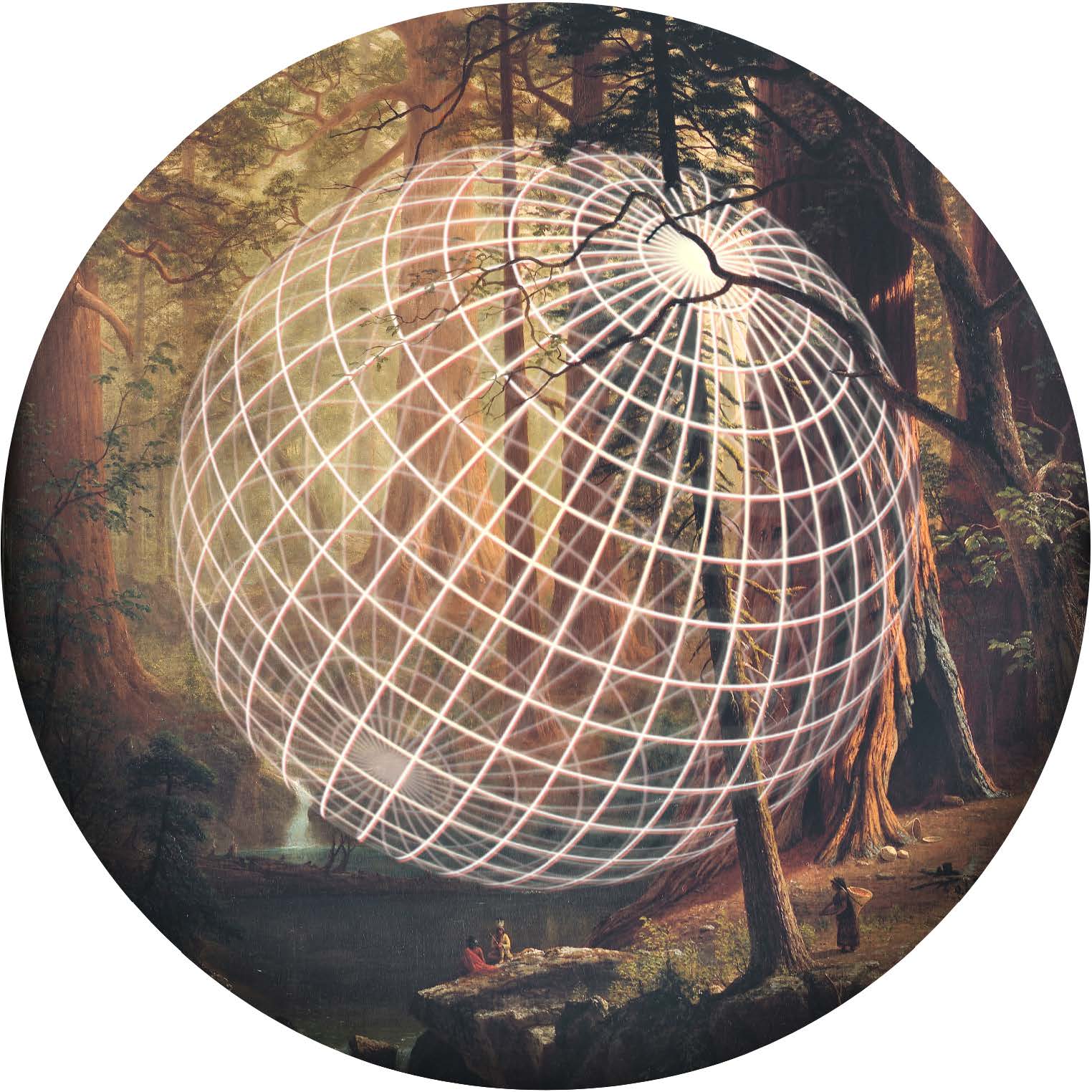 <p>Homotopy measures how spheres can be tangled in spaces; the logo shows a sphere tangled in a grove of California redwoods<br />The background painting is “Giant Redwood Trees of California” by Albert Bierstadt in 1874</p>
The goal of this school will be to introduce students to several powerful cohomological tools that were brought to commutative algebra by Avramov in the 80s and 90s: Lie algebra methods from homotopy theory, and support theoretic methods from the representation theory of finite groups. These tools have have seen a huge array of applications that continue to grow, with several major developments in recent years, opening new connections to algebraic topology, noncommutative algebraic geometry, and representation theory.
Updated on Jul 10, 2026 11:25 AM PDT -
Summer Graduate School Dynamical Systems for Machine Learning and AI (IBM Yorktown)
Organizers: Soumyadip Ghosh (IBM Thomas J. Watson Research Center), LEAD Yingdong Lu (IBM Thomas J. Watson Research Center), Tomasz Nowicki (IBM Thomas J. Watson Research Center)
This Summer Graduate School aims to introducing graduate students to some aspects of contemporary modeling and analysis of dynamical systems in their interactions with machine learning and artificial intelligence (AI) applications.
Updated on Jul 14, 2026 01:18 PM PDT -
Summer Graduate School John Tukey Summer Graduate School: Mathematics of Generative Models (SLMath)
Organizers: Jianfeng Lu (Duke University), Eric Vanden-Eijnden (New York University, Courant Institute) <p>Artificial image generation by flow-based generative models starting from noise</p>
The overarching goal of this summer school is to expose students to the latest developments in the mathematics of generative models. Our ultimate goal is to teach them how to conduct research in this exciting area in machine learning and use their knowledge to make contributions to applied mathematics using these new tools.
Updated on Jul 24, 2026 02:07 PM PDT -
Summer Graduate School SLMath-Oxford-OIST School: Analysis of Partial Differential Equations (Okinawa, Japan)
Organizers: Ugur Abdulla (Okinawa Institute of Science and Technology), Gui-Qiang Chen (University of Oxford)
This two week summer school, jointly organized by SLMath with OIST, will offer the following two mini-courses:
- Measure-theoretical analysis, divergence-measure fields, and nonlinear PDEs of divergence form
This course will present some recent developments in the theory of divergence-measure fields via measure-theoretic analysis and its applications to the analysis of nonlinear PDEs of conservative form – nonlinear conservation laws. - Perron’s method and Wiener-type criteria in the potential theory of elliptic and parabolic PDEs
This course will present some recent developments precisely characterizing the regularity of the point at ∞ for second order elliptic and parabolic PDEs and broadly extending the role of the Wiener test in classical analysis.
Updated on Dec 03, 2025 10:44 AM PST - Measure-theoretical analysis, divergence-measure fields, and nonlinear PDEs of divergence form
-
Summer Graduate School Random Growth Models, Phase Separation and Hamilton-Jacobi PDE (UC Berkeley)
Organizers: Alan Hammond (University of California, Berkeley), Fraydoun Rezakhanlou (University of California, Berkeley)Models of random growth and of the separation of phases occurring when one substance is suspended in another often evince universal features, in which scaling exponents are shared among a broad class of such models. A foothold for understanding such features is often offered by studying a few special models that are exactly solvable, which means that exact formulas of algebraic or integrable origin are available. Showing that a broader range of models also have the features is a task that may rely on a range of robust probabilistic or geometric tools. The summer school will offer an introduction to random growth and phase separation, with an emphasis on tools that offer the prospect of proving universality for a wider class of models.
Updated on Jul 17, 2026 10:16 AM PDT -
Summer Graduate School ICTP-INdAM-SLMath Summer Graduate School for Machine Learning (Trieste, Italy)
Organizers: Claudio Arezzo (Abdus Salam International Centre for Theoretical Physics), Jean Barbier (Abdus Salam International Centre for Theoretical Physics), Filippo Bracci (Università di Roma Tor Vergata), LEAD Domenico Marinucci (Università di Roma Tor Vergata), Cristina Trombetti (CSEF and Università degli Studi di Napoli Federico II)
The aim of this summer school is to provide an introduction to theoretical ideas that have been developed with the objective of understanding machine learning methods and their domain of applicability. The focus will be on proof technique and general mathematical tools. The lecturers are two worldwide experts in the area and the material is regularly taught in Mathematics and Statistics Departments of the top world Universities.
Updated on Jun 22, 2026 10:46 AM PDT -
MSRI-UP MSRI-UP 2026: Numerical Methods for Differential Equations
Organizers: LEAD Alexander Diaz-Lopez (Villanova University), Maria Mercedes Franco, Rebecca Garcia (Colorado College), Johnny Guzman (Brown University), Candice Price (Smith College), Robin Wilson (Loyola Marymount University)The MSRI-UP summer program is designed to serve a diverse group of undergraduate students who would like to conduct research in the mathematical sciences.
In 2026, MSRI-UP will focus on Numerical Methods for Differential Equations The research program will be led by Dr. Johnny Guzman of Brown University.
Updated on Apr 24, 2026 07:40 AM PDT -
Summer Graduate School Percolation and Lattice Models of Statistical Physics (Columbia University)
Organizers: Roland Bauerschmidt (New York University, Courant Institute), Tom Hutchcroft (California Institute of Technology)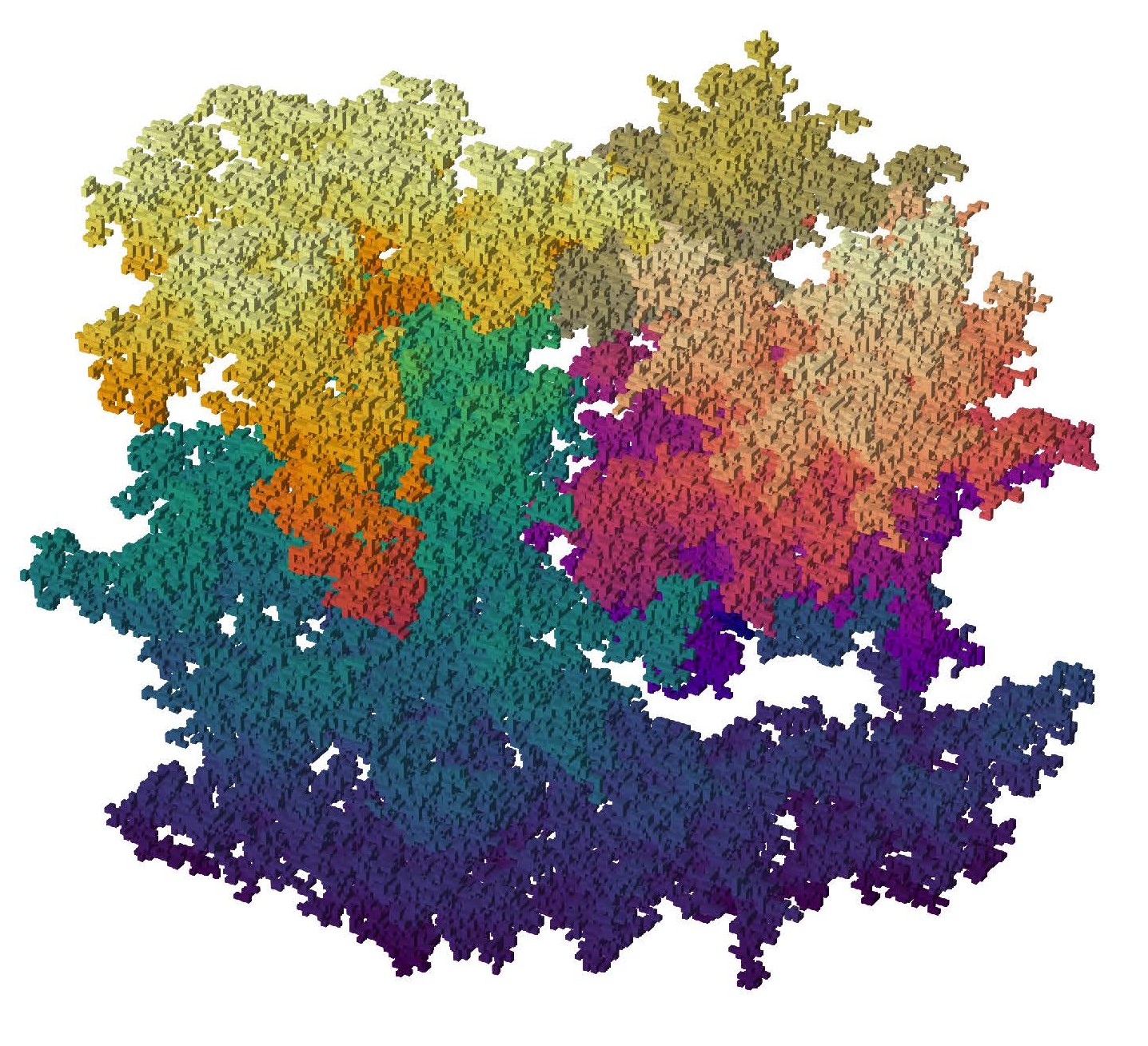 <p>The five largest clusters in critical site percolation on a large three-dimensional box</p>
Percolation and spin models such as the Ising model have a history that goes back over 100 years. The subject has taken a central role in probability theory over the last few decades, in particular through interactions with various other areas of mathematics. These include graph theory, theoretical
computer science, statistical physics, quantum field theory, complex analysis, partial differential equations, and geometric group theory. Through examples, the summer school aims to illustrate some of the successful techniques and ideas in the subject area.Updated on May 20, 2026 01:33 PM PDT -
Summer Graduate School Séminaire de Mathématiques Supérieures 2026: Universal Statistics in Number Theory (Montréal, Canada)
Organizers: Louis-Pierre Arguin (University of Oxford), Andrew Granville (Université de Montréal), Dimitris Koukoulopoulos (Université de Montréal), Matilde Lalin (Université de Montréal), Carlo Pagano (Concordia University), Elliott Paquette (McGill University), Frank Thorne (University of South Carolina)
One of the hottest topics in analytic number theory involves the use of statistics and probability in understanding different aspects of algebraic and analytic number theory, through various new lenses. This is reflected in some of the most exciting number theory research of the last few years (for example, of Bhargava, of Ellenberg and Venkatesh, of Alexander Smith, of Sawin and Wood, of Adam Harper, of Koukoulopoulos and Maynard, of Helfgott and Radziwill, of Pilatte,....). As a consequence the CRM will host a thematic semester Mar 2-July 3, 2026 on these topics involving some of the world leaders in the subject. Since this new area can roughly be split in two into Algebraic and Analytic, we will focus for two months on each, with the SMS school placed in the middle. The 2026 SMS will introduce junior mathematicians to important trends in number theory.
Updated on Oct 17, 2025 04:27 PM PDT -
Workshop Critical Issues in Mathematics Education 2026: Mathematics Literacy for 21st-Century Citizenship - Part II
Organizers: Robert Berry (Indiana University), Josue Cordones (Bronx Collaborative High School), Megan Franke, Maisie Gholson (University of Michigan), Courtney Ginsberg (Math for America), Mark Hoover (University of Michigan), Yvonne Lai (University of Nebraska), LEAD Maisha Moses (The Young People's Project), LEAD Benjamin Moynihan (The Algebra Project, Inc.), Aris Winger (Georgia Gwinnett College)Building on the vision Bob Moses set out in the 1993 Algebra Initiative Colloquium, the 2025 Critical Issues in Mathematics Education (CIME) Workshop celebrated the legacy of Moses’ call for a mathematics literacy that supports citizenship in the 21st century. A mathematics towards citizenship has proved elusive as a goal for mathematicians, mathematics educators, researchers, students, teachers, and leaders—even as efforts among different individuals, organizations, and communities labor for greater access to high-quality mathematics learning experiences. The 2026 CIME Workshop, Mathematics Literacy for 21st Century Citizenship - Part II, endeavors to design opportunities for learning, collaborating, and struggling towards a mathematics for lived citizenship, as a theme and organizing principle for communities across the Nation.
For Moses, the notion of lived citizenship is not simply a matter of gaining legal status but of demanding that the legal status be meaningful. Thus mathematics literacy for lived or participatory citizenship might be thought of to include contributing to your community, not just being part of a community, and beyond belonging, to actively participate in making your community better, in making life better for others.
The conception of mathematics for lived citizenship is an important foundation for the goals for the 2026 CIME Workshop, in order to envision the development of coordinated actions in the short and long term within the mathematics and mathematics education communities. To ground and catalyze these efforts, we invite participants to consider a mathematics for lived citizenship through three foundational ideas:
- Claiming mathematics -- establishing agency in and ownership of math.
- Building Agency -- claiming and leveraging mathematics knowledge to overcome present day, generational, community, and national challenges.
- Collaboration and collective effort -- using mathematics literacy to make systemic change.
Three questions will guide our work:
- How does the unfolding history of mathematics impact lived citizenship?
- How do we understand the relationship between mathematical flourishing and the evolution of vibrant democracy in the United States?
- In light of the above two questions, how do we reimagine our roles, responsibilities, and actions in the short and long term?
Updated on Apr 30, 2026 04:44 PM PDT -
Summer Graduate School Topological and Geometric Structures in Low Dimensions (SLMath)
Organizers: LEAD Kenneth Bromberg (University of Utah), Kathryn Mann (Cornell University)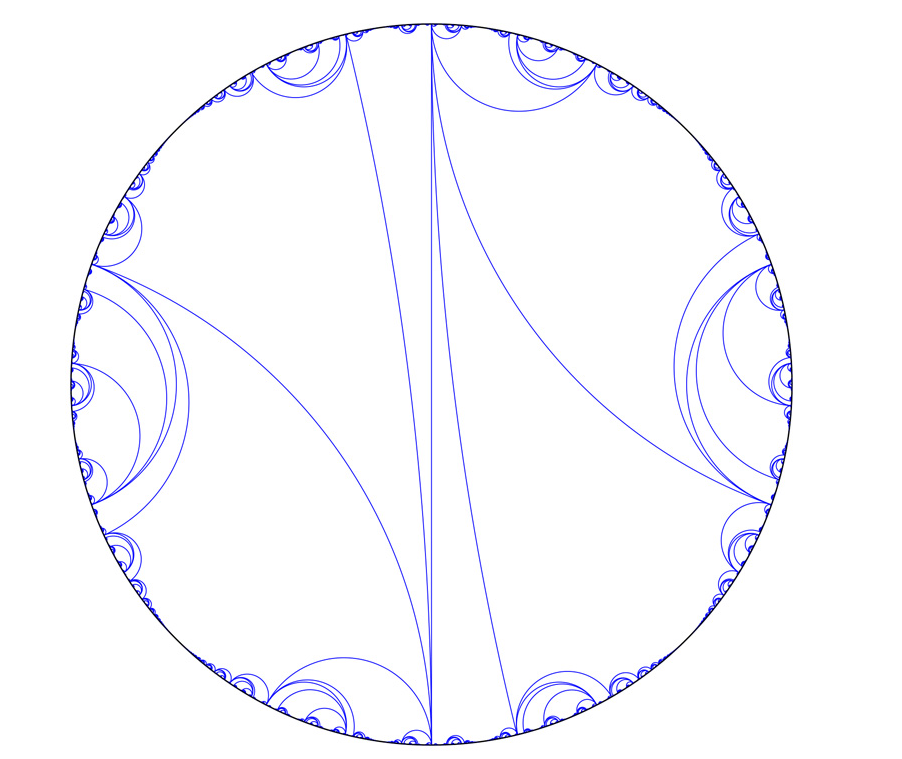 <p>Laminations arise naturally in hyperbolic geometry and (pseudo-) Anosov flows [Image by Jeffrey Brock]</p>
This school will serve as an introduction to the SLMath semester “Topological and Geometric Structures in Low-Dimensions”. The school consists of two mini-courses: one on Teichmüller Theory and Hyperbolic 3-Manifolds and the other on Anosov Flows on Geometric 3-Manifolds. Both topics lie at the interface of low-dimensional geometric topology (specifically, surfaces, foliations, and 3-manifolds) and low-dimensional dynamics. The first course will be targeted towards students who have completed the standard first year graduate courses in geometry, topology, and analysis while the second course will geared towards more advanced students who are closer to beginning research. However, we expect that all students will benefit from both courses.
Updated on Nov 03, 2025 12:23 PM PST -
Summer Graduate School Geometry and Dynamics in Higher Rank Lie Groups (UC Berkeley)
Organizers: Richard Canary (University of Michigan), Sara Maloni (University of Virginia), Wenyu Pan (University of Toronto; University of Toronto), Cagri Sert, LEAD Tengren Zhang (National University of Singapore)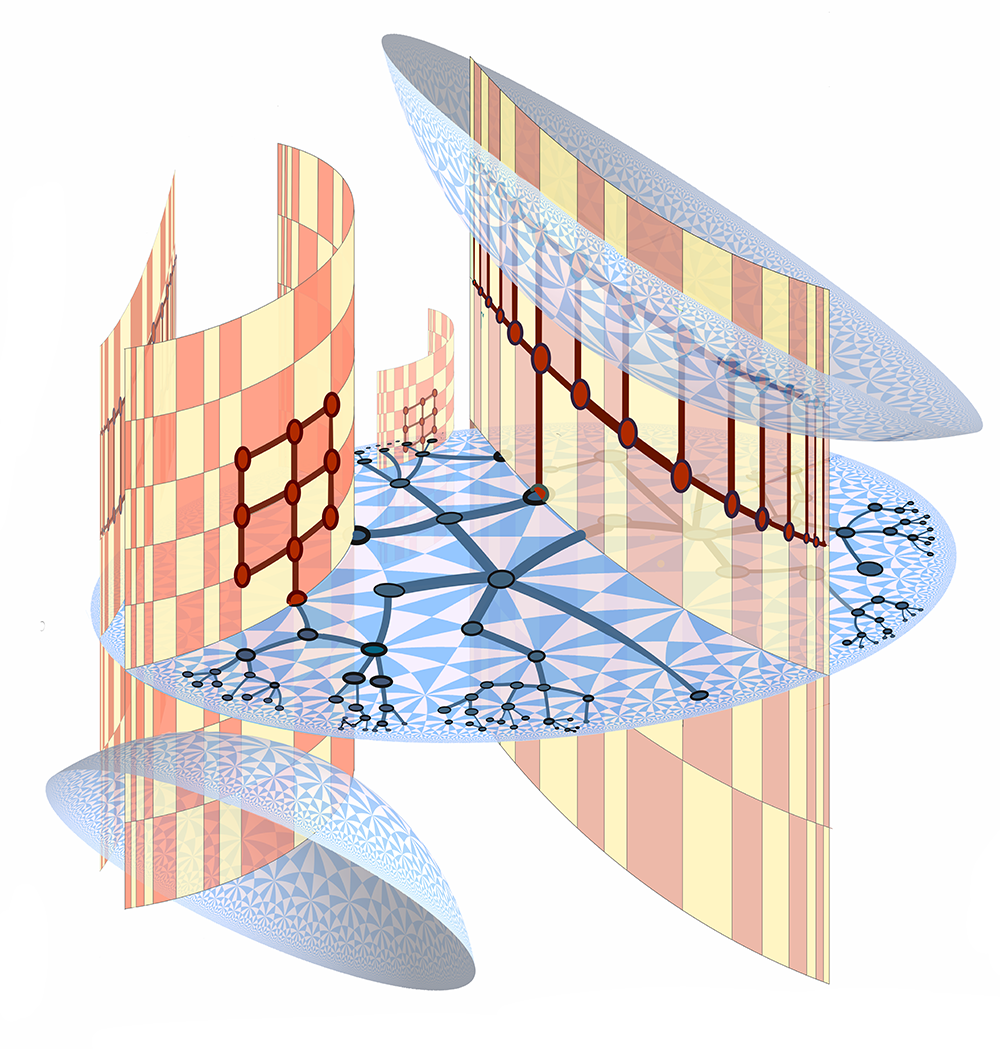 <p>Flats and hyperbolic planes in a higher rank symmetric space</p> Drawn by Steve Trettel.
Lie groups are central objects in modern mathematics; they arise as the automorphism groups of many homogeneous spaces, such as flag manifolds and Riemannian symmetric spaces. Often, one can construct manifolds locally modelled on these homogeneous spaces by taking quotients of their subsets by discrete subgroups of their automorphism groups. Studying such discrete subgroups of Lie groups is an active and growing area of mathematical research. The objective of this summer school is to introduce young researchers to a class of discrete subgroups of Lie groups, called Anosov subgroups.
Updated on Nov 03, 2025 01:16 PM PST -
Summer Graduate School Computer Assisted Proofs in Applied Mathematics (SLMath)
Organizers: LEAD Jonathan Jaquette (New Jersey Institute of Technology), Evelyn Sander (George Mason University)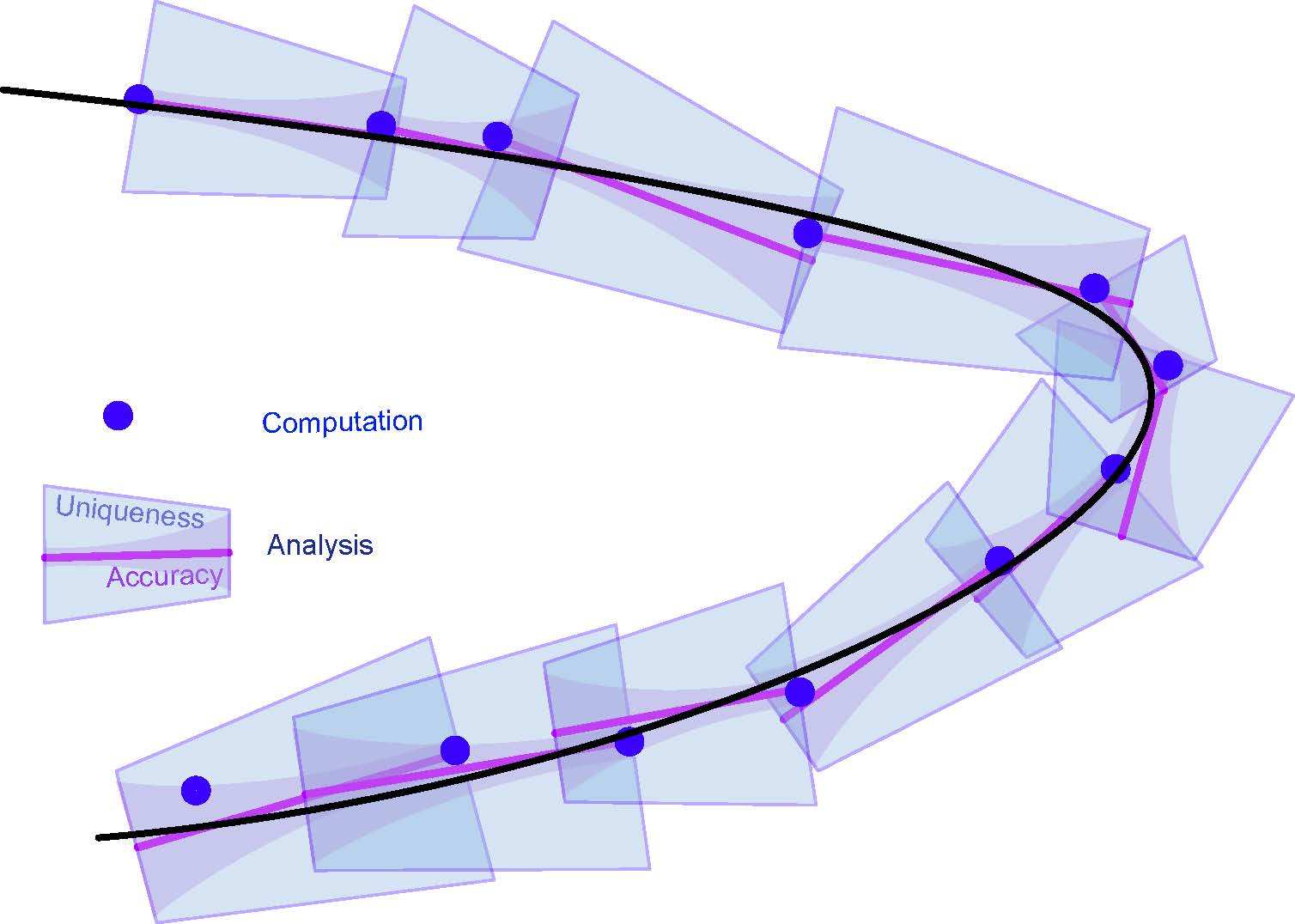
One of the core elements of applied mathematics is mathematical modeling consisting of nonlinear equations such as ODEs, and PDEs. A fundamental difficulty which arises is that most nonlinear models cannot be solved in closed form. Computer assisted proofs are at the forefront of modern mathematics and have led to many important recent mathematical advances. They provide a way of melding analytical techniques with numerical methods, in order to provide rigorous statements for mathematical models that could not be treated by either method alone. In this summer school, students will review standard computational and analytical techniques, learn to combine these techniques with more specialized methods of interval arithmetic, and apply these methods to establish rigorous results in otherwise intractable problems
Updated on Nov 03, 2025 01:45 PM PST -
Summer Graduate School Noncommutative Algebraic Geometry (Antwerp, Belgium)
Organizers: Pieter Belmans (University of Luxembourg), Lander Hermans (Universiteit Antwerp), Wendy Lowen (Universiteit Antwerpen), Arne Mertens (Universiteit Antwerp), Michel VAN DEN BERGH (Hasselt University), Špela Špenko (Université Libre de Bruxelles)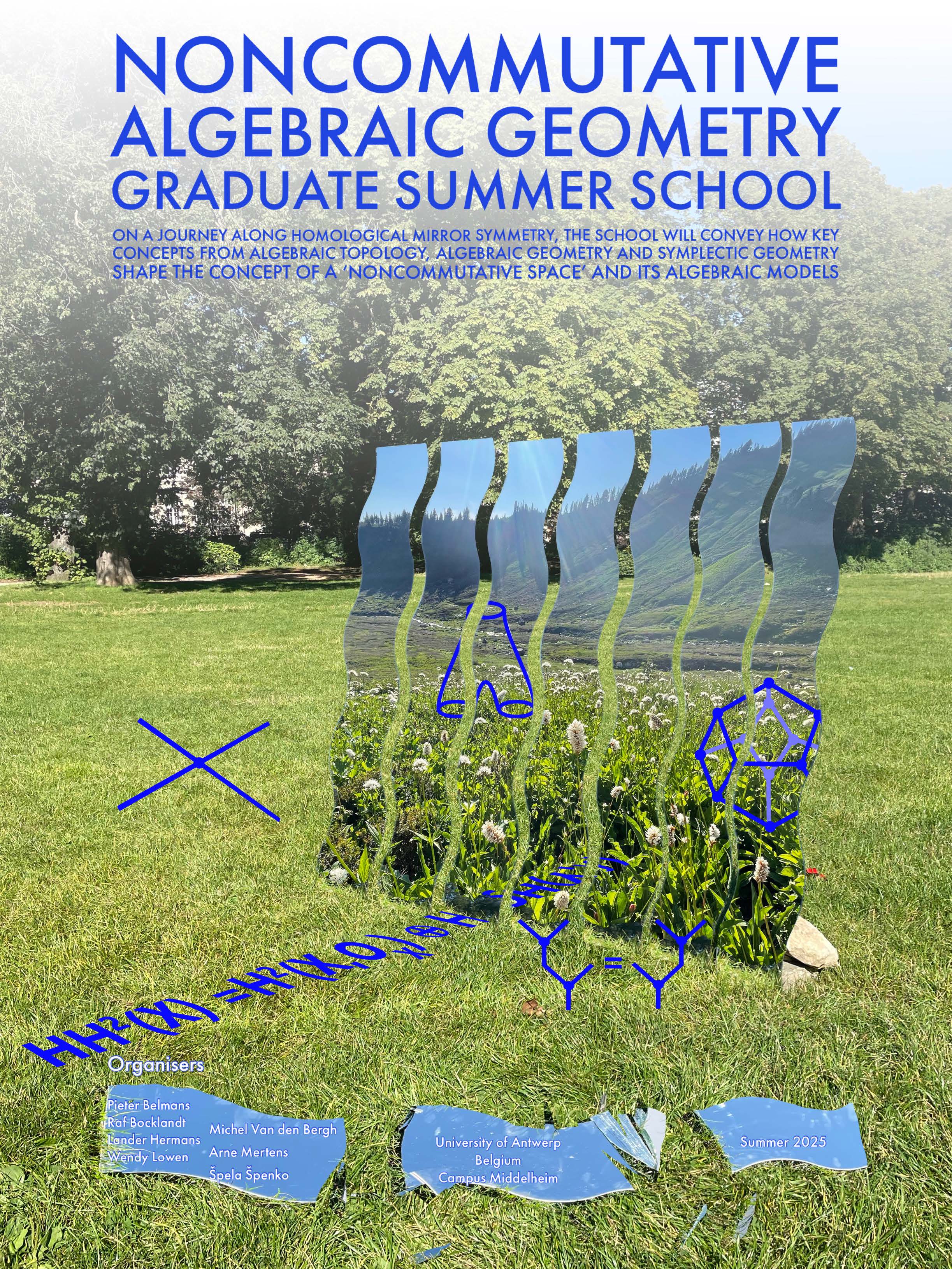
The school will consist of two courses: Homological Mirror Symmetry and Algebraic Models for Spaces. These courses will be planned and taught by organisers with the help of teaching assistants for the problem sessions. The school will be aimed at a wide range of graduate students, from students with a Bachelor degree to beginning PhD students. The lectures and problem sessions will be complemented by a poster session in week one and a total of four introductory research talks on Friday afternoons.
Updated on May 22, 2025 10:57 AM PDT -
Summer Graduate School New Perspectives on Discriminants and Applications (Leipzig, Germany)
Organizers: Eliana Duarte (Centro de Matemática da Universidade do Porto), Serkan Hosten (San Francisco State University), Simon Telen (Max-Planck-Institut)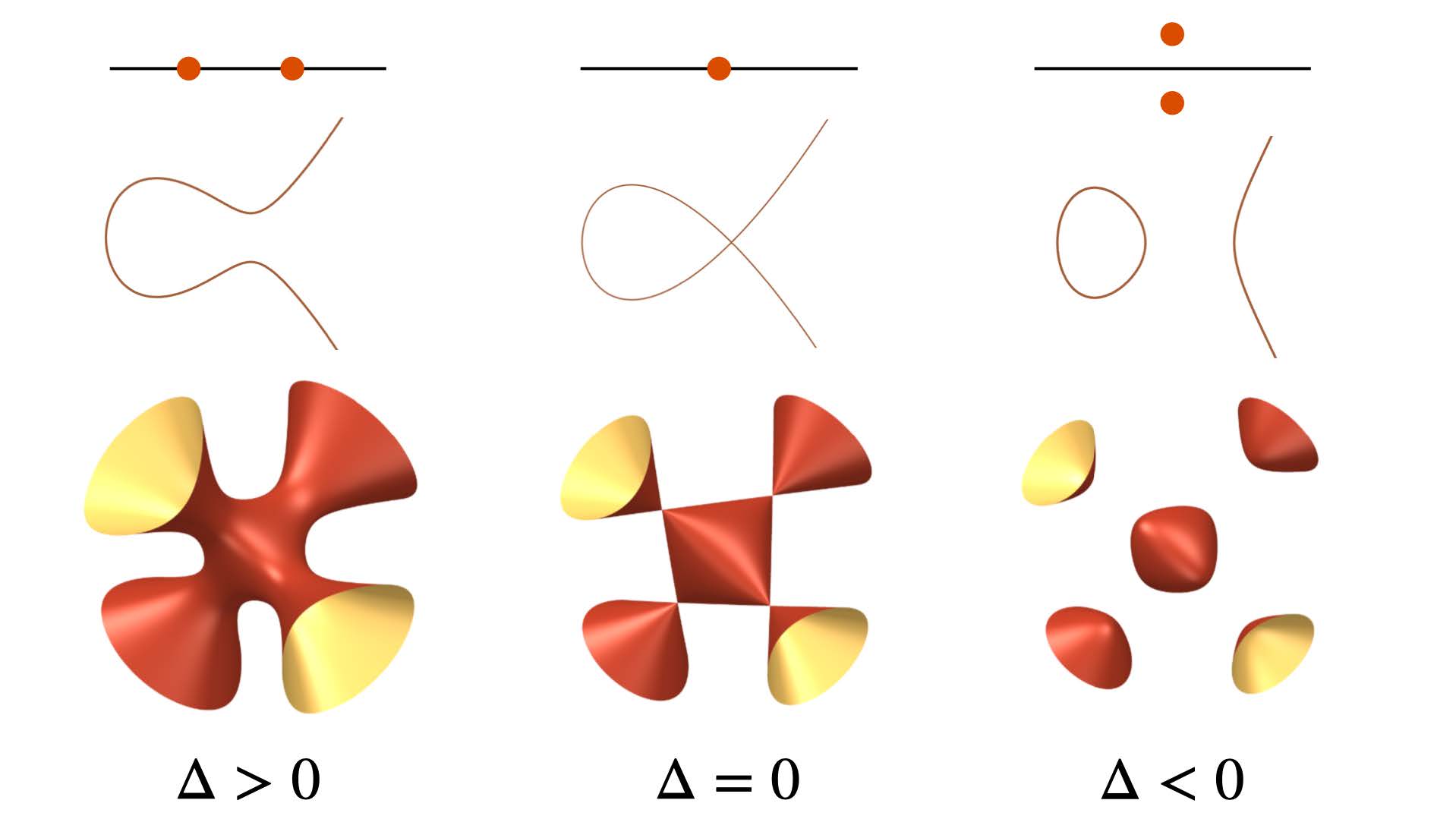 <p>The discriminant ∆ detects singular varieties. The picture shows three different scenarios: solutions of quadratic polynomials, cubic plane curves and cubic surfaces.</p>
This summer school will offer a hands-on introduction to discriminants, with a view towards modern applications. Starting from the basics of computational algebraic geometry and toric geometry, the school will gently introduce participants to the foundations of discriminants. A particular emphasis will be put on computing discriminants of polynomial systems using computer algebra software. Then, we will dive into three applications of discriminants: algebraic statistics, geometric modeling, and particle physics. Here, discriminants contribute to the study of maximum likelihood estimation, to finding practical parametrizations of geometric objects, and to computations of scattering amplitudes. We will explain recently discovered unexpected connections between these three applications. In addition to lectures, the summer school will have daily collaborative exercise sessions which will be guided by the teaching assistants and will include software demonstrations.
Updated on Jul 03, 2025 09:26 AM PDT -
Summer Graduate School Graphical Models in Algebraic Combinatorics (SLMath)
Organizers: Christian Gaetz (University of California, Berkeley), David Keating (University of Illinois at Urbana-Champaign; University of Illinois at Urbana-Champaign), Melissa Sherman-Bennett (University of California, Davis), LEAD Anna Weigandt (University of Minnesota; University of Minnesota, Twin Cities)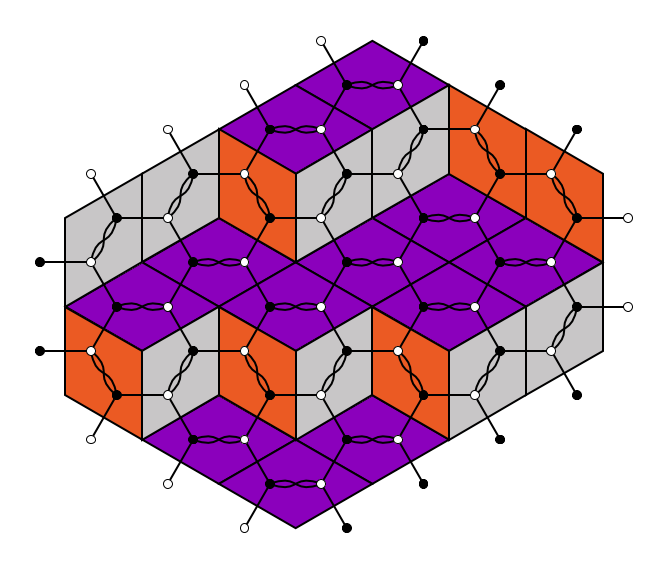 <p>A plane partition and an hourglass plabic graph</p>
This school will introduce students to a range of powerful combinatorial tools used to understand algebraic objects ranging from the homogeneous coordinate ring of the Grassmannian to symmetric functions. The summer school will center around two main lecture series "Webs and Plabic Graphs" and "Vertex Models and Applications". While the exact applications differ, both courses will center on graphical models for algebraic problems closely related to Grassmannian and its generalizations. This school will be accessible to a wide range of students. Students will leave the school with a solid grasp of the combinatorics of webs, plabic graphs, and the six-vertex model, an understanding of their algebraic applications, and a taste of current research directions.
Updated on Jul 02, 2025 10:42 AM PDT -
Summer Graduate School Mathematics of Sea Ice and Polar Ecosystems (Fairbanks, Alaska)
Organizers: Kenneth Golden (University of Utah), Jody Reimer (University of Utah)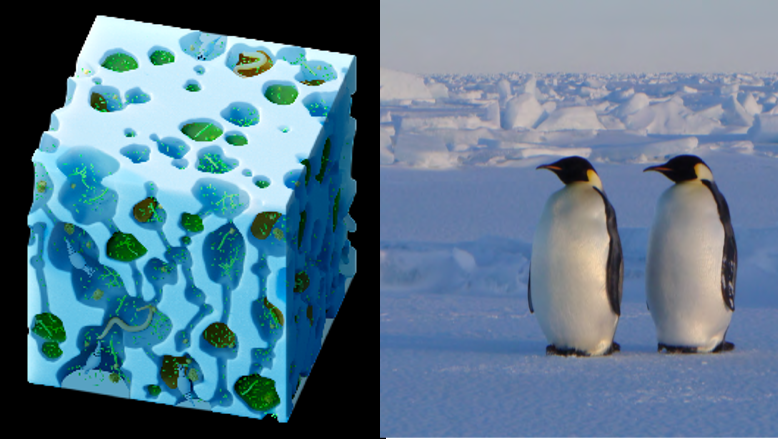 From micro to macro, sea ice supports life in the polar regions. Left: illustration of the porous sea ice microstructure, home to a microbial community of ice endemic organisms including bacteria and algae. Right: two penguins on Antarctic sea ice.
In this summer school, students will be introduced to mathematical and computational modeling of sea ice and polar ecosystems. As a material, sea ice is a multiscale composite structured on length scales ranging from tenths of millimeters to tens of kilometers. From tiny brine inclusions and surface melt ponds of increasing complexity, to ice floes of varying sizes in a seawater host, a principal challenge is how to find sea ice effective properties that are relevant to larger scale models, given data on smaller scale structures. Similarly, the sea ice ecosystem ranges from algae living in the brine inclusions to charismatic megafauna like penguins and polar bears, whose diets depend critically, down the line, on the tiny sea ice extremophiles. The dynamics of sea ice microbial communities are regulated by the physics of the ice microstructure, and, in turn, many of these microbes modify their environment by secreting extracellular polymeric substances. In addition to sea ice and its ecosystems, we will consider broader mathematical models including energy balance models, tipping points, and global circulation models.
Updated on Jun 10, 2025 09:42 AM PDT -
MSRI-UP MSRI-UP 2025: Quantitative Justice
Organizers: Alexander Diaz-Lopez (Villanova University), Maria Mercedes Franco, Rebecca Garcia (Colorado College), Omayra Ortega (Sonoma State University), Candice Price (Smith College), LEAD Robin Wilson (Loyola Marymount University)The MSRI-UP summer program is designed to serve a diverse group of undergraduate students who would like to conduct research in the mathematical sciences.
In 2025, MSRI-UP will focus on Quantitative Justice. The research program will be led by Dr. Omayra Y. Ortega, Associate Professor in the Department of Mathematics at Sonoma State University.
Updated on Dec 11, 2025 12:32 PM PST
|
|
Past Educational Events |