


Current all workshops
Upcoming all workshops
-
Motivic Homotopy Theory: Connections and Applications
Organizers: Adrien Dubouloz (Université de Poitiers), LEAD Dan Isaksen (Wayne State University), Sabrina Pauli (Technische Universitat Darmstadt)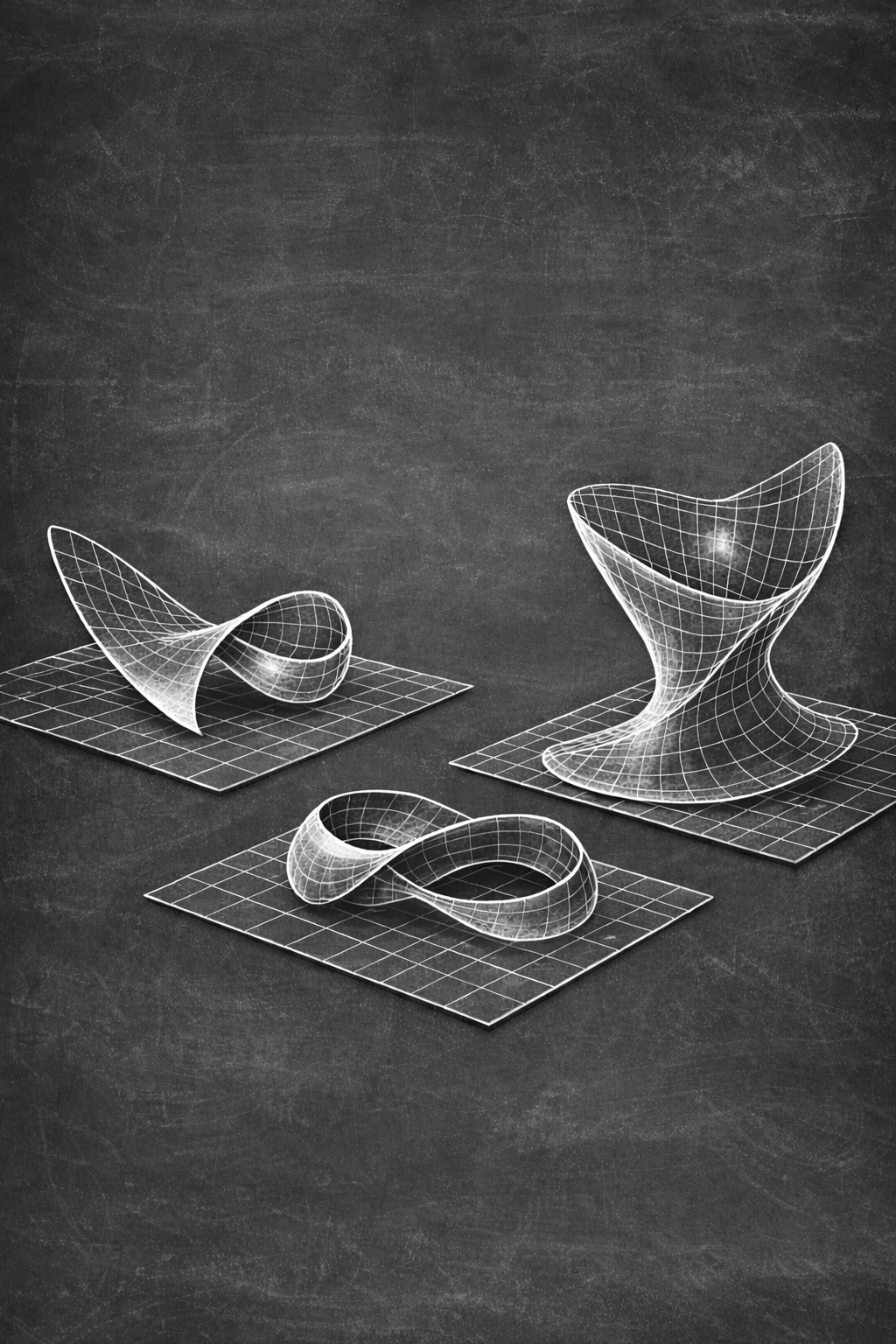
The workshop will bring together researchers at the forefront of ongoing work in motivic homotopy theory. Topics will include the application of motivic techniques to: geometry of affine algebraic varieties and algebraic vector bundles; computations in classical algebraic topology such as homotopy groups of spheres; and enumerative geometry. The workshop will also consider the internal foundational development of motivic homotopy theory itself.
Updated on Oct 08, 2026 12:41 PM PDT -
Modern Math Workshop 2026

The Simons Laufer Mathematical Sciences Institute (SLMath) will host the 2026 Modern Math Workshop (MMW) as part of the SACNAS Annual Conference. The Modern Math Workshop encourages undergraduates to pursue careers in the mathematical sciences, and builds research and networking opportunities among undergraduates, graduate students and recent PhDs in the mathematical sciences.
Updated on Sep 11, 2026 02:01 PM PDT -
Blackwell-Tapia Conference 2026
Updated on Sep 16, 2026 10:52 AM PDT -
Frontier of PDE Formalization and Analysis with AI
Organizers: Wuyang Chen (Simon Fraser University), Patrick Shafto (Rutgers University), Weiran Sun (Simon Fraser University)
The formalization of mathematics is undergoing a quiet revolution. Computational proof assistants like Lean now make it possible to build verified, machine-checkable libraries of mathematics at scale, and the frontier of partial differential equations (PDEs) stands as one of the most profound and underexplored territories in this landscape. At the same time, large language models and AI for mathematics (AI4Math) are beginning to reshape how researchers discover, conjecture, and verify mathematical results.
This workshop brings together three communities, PDE analysts, Lean/Mathlib developers, and AI/AI4Math researchers from both academia and industry, to chart a shared path forward. Our central aim is to produce a clear, community-endorsed roadmap (1-year, 3-year, and 5-year horizons) for the formalization and AI-assisted analysis of PDEs, spanning undergraduate and graduate textbook material through to active research frontiers. We will identify the PDE topics most ripe for formalization in Mathlib, the AI tools best positioned to accelerate that work, and the collaborative structures needed to sustain long-term progress. This workshop is supported by the AI for Math Fund.
Updated on Aug 17, 2026 04:24 PM PDT -
Revisiting Fundamental Problems Workshop: Old Problems in Irrationality
Organizers: LEAD Frank Calegari (University of Chicago), Yunqing Tang (University of California, Berkeley), Wadim Zudilin (Radboud University Nijmegen)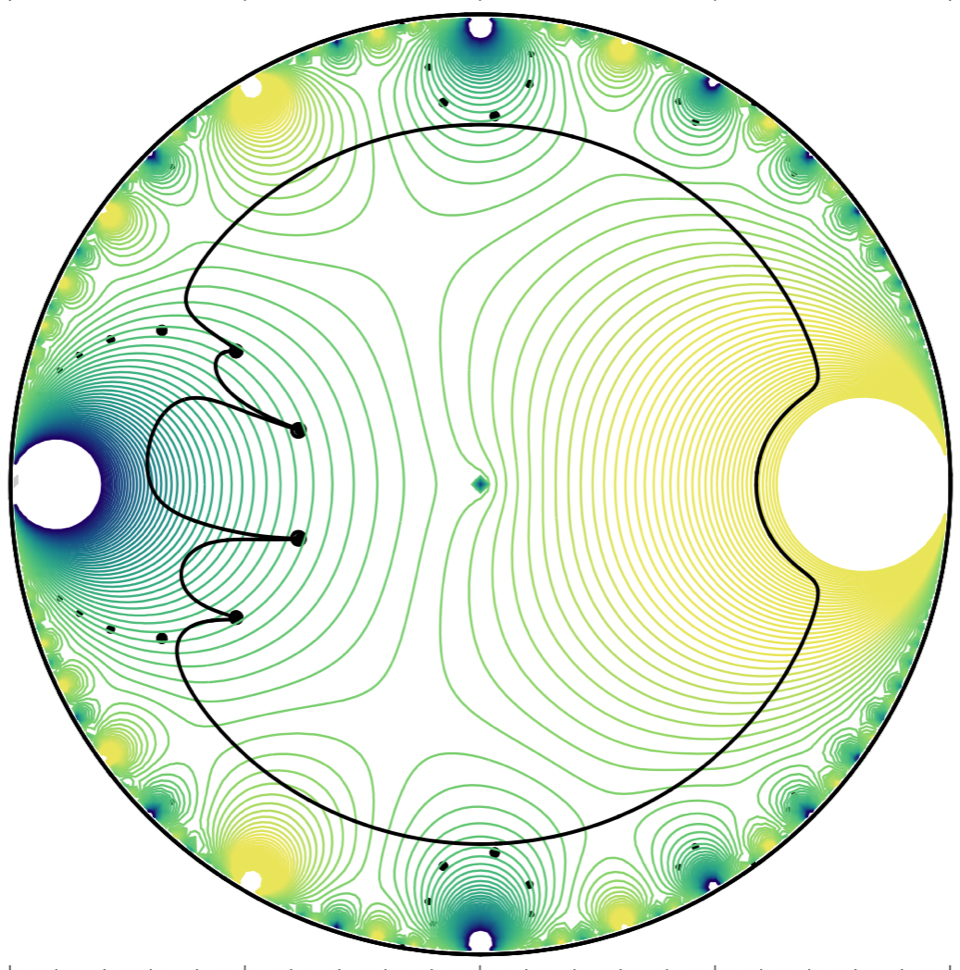 A contour used in [Calegari–Dimitrov–Tang, 2024] to prove L(2, χ−3) ∈/ Q.
In 1978, Apéry proved that ζ(3) was irrational. Almost 50 years later, we still don’t know if ζ(5) is irrational. Why not? The goal of this workshop is to bring together experts on explicit rational approximations and motivic differential equations to consider new approaches to these questions.
Updated on Jun 15, 2026 09:07 AM PDT -
Hot Topics Workshop: Geometric Sen Theory, the p-adic Simpson Correspondence, and Modularity
Organizers: Rebecca Bellovin (University of Connecticut), LEAD Sean Howe (University of Utah), David Savitt (Johns Hopkins University), Matthias Strauch (Indiana University, Bloomington) The perfectoid infinite level modular curve
This workshop will focus on geometric Sen theory, its connections to the p-adic Simpson correspondence, and applications to modularity. In addition to three mini-courses, the workshop will feature research talks on related recent developments in p-adic Hodge theory and p-adic geometry.
Updated on Sep 02, 2026 01:57 PM PDT -
Tensors and Their Applications: Foundations and Recent Advances (Columbia University)
Organizers: Josh Alman (Columbia University), Henry Yuen (Columbia University)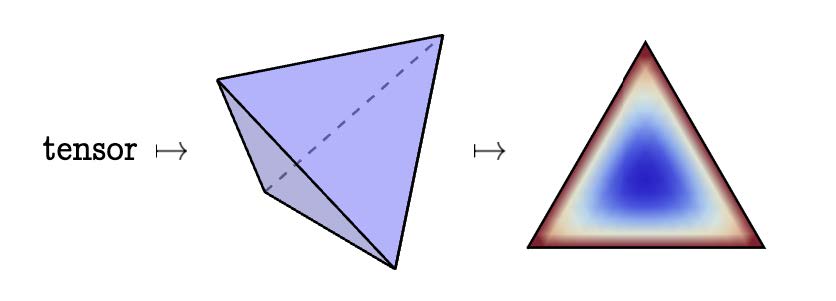 <p>Mapping tensors to their moment polytyopes to their asymptotic spectrum.</p>
Tensors play a central role in various areas of mathematics, physics and computer science: from constructing fast matrix multiplication algorithms in algebraic complexity theory to the study of entanglement in quantum information. While matrices (order-two tensors) are very well understood, tensors have a much more intricate structure, and much about them is still unknown, despite much interest. In this lecture series we will discuss foundations and recent advances in the theory of tensors and their applications across computer science and physics.
Updated on Aug 25, 2026 03:06 PM PDT -
MSRI-UP 2027: Applied Statistics: Health, Education, and Labor Market
Organizers: Alexander Diaz-Lopez (Villanova University), Maria Mercedes Franco (MSRI / Simons Laufer Mathematical Sciences Institute (SLMath)), Rebecca Garcia (Colorado College), Candice Price (Smith College), Robin Wilson (Loyola Marymount University)The MSRI-UP summer program is designed to serve a diverse group of undergraduate students who would like to conduct research in the mathematical sciences.
MSRI-UP 2027 will focus on statistical models applied to real-world data using the free statistical software R. Students should have completed the calculus sequence, and prior coursework in statistics and programming experience in R or a similar language are desired. Beyond these prerequisites, students should be willing to learn quickly, work in a team, and communicate results clearly. The first two weeks of the program will consist of crash-course training in regression, inference, and R. Research projects will be chosen from three areas: epidemiological statistics, education statistics, and labor economics. The summer projects will be directed by Dr. Minho Kim (Colorado College).
Updated on Sep 16, 2026 11:50 AM PDT -
Ricci Flow and Ricci Solitons (SLMath)
Organizers: LEAD Bennett Chow (University of California, San Diego), Yi Lai (University of California, Irvine), Ovidiu Munteanu (University of Connecticut)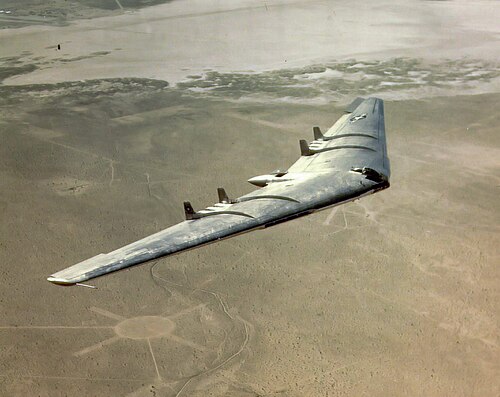 <p>A real-world Flying Wing. Lai proved Hamilton’s conjecture on the existence of Flying Wing Ricci solitons.</p>
Participants will learn the basic theory of Ricci flow and Ricci solitons—they will learn the fundamental equations and inequalities, how to do basic tensor calculations, how to control the potential function, how to obtain global curvature bounds, how to do bootstrap arguments, how to control the geometry at infinity, how to construct new Ricci solitons, the current cutting edge existence theory for Ricci solitons, including the existence and classification of flying wing solitons. Many arguments involve the maximum principle, integration by parts, and/or bootstrap arguments. In short, the student will learn the art of the a priori estimate. This is one of the main methods for understanding the geometry of Ricci solitons.
Updated on Aug 21, 2026 02:09 PM PDT -
Séminaire de Mathématiques Supérieures 2027: Growth, Asymptotics and Extremality in Geometry (Montréal, Canada)
Organizers: Viveka Erlandsson (University of Bristol), Maxime Fortier Bourque (Université de Montréal), Bram Petri (Institut de Mathématiques de Jussieu), Kasra Rafi (University of Toronto)The goal of our school is to make connections between different flavors of geometry: euclidean geometry, hyperbolic geometry, translation surfaces and graph theory. We will focus on growth, asymptotics and extremal problems.
Updated on Jul 16, 2026 09:40 AM PDT -
Min-Max Methods in Geometry (UC Berkeley)
Organizers: Otis Chodosh (Stanford University), Giada Franz (Centre National de la Recherche Scientifique (CNRS)), Daniel Ketover (Rutgers University), Yevgeny Liokumovich (University of Toronto)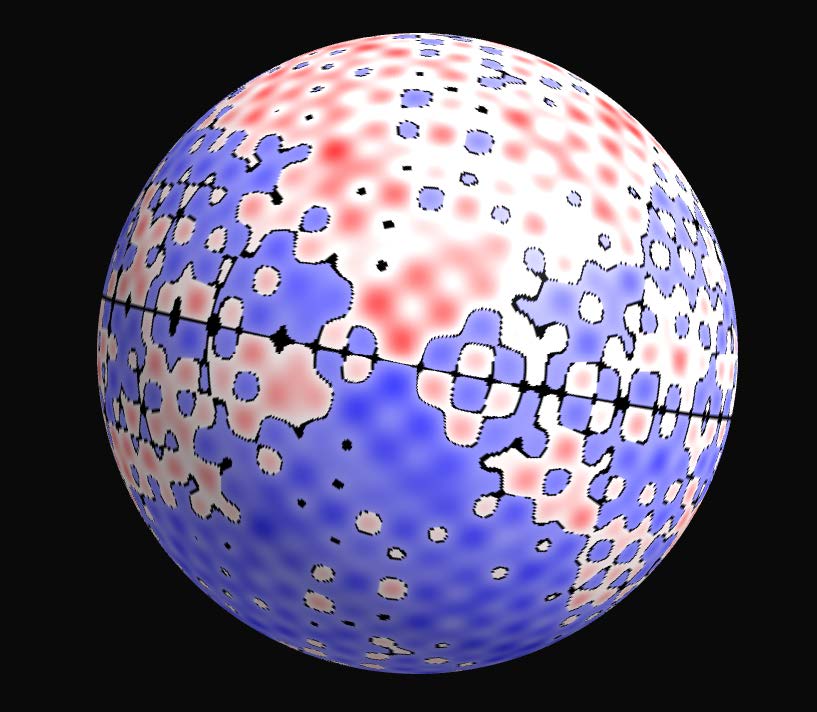
The course will introduce graduate students to the many modern methods to construct minimal surfaces from a variational or min-max principle as well as applications to problems in geometry and topology. Topics include Almgren-Pitts min max theory, Allen-Cahn construction and PDE methods, the proof of the Willmore conjecture, the resolution of Yau’s conjecture on the infinitude of minimal hypersurfaces in general Riemannnian manifolds and corresponding Weyl law and equidistribution results.
Updated on Aug 25, 2026 03:11 PM PDT -
SLMath-NITMB School on Mathematics of Ecological Systems (Chicago, IL)
Organizers: Antonio Auffinger (Northwestern University), Alan Hastings (University of California, Davis), Iacopo Paolo Longo (University of Exeter), Martin Rasmussen (Imperial College, London)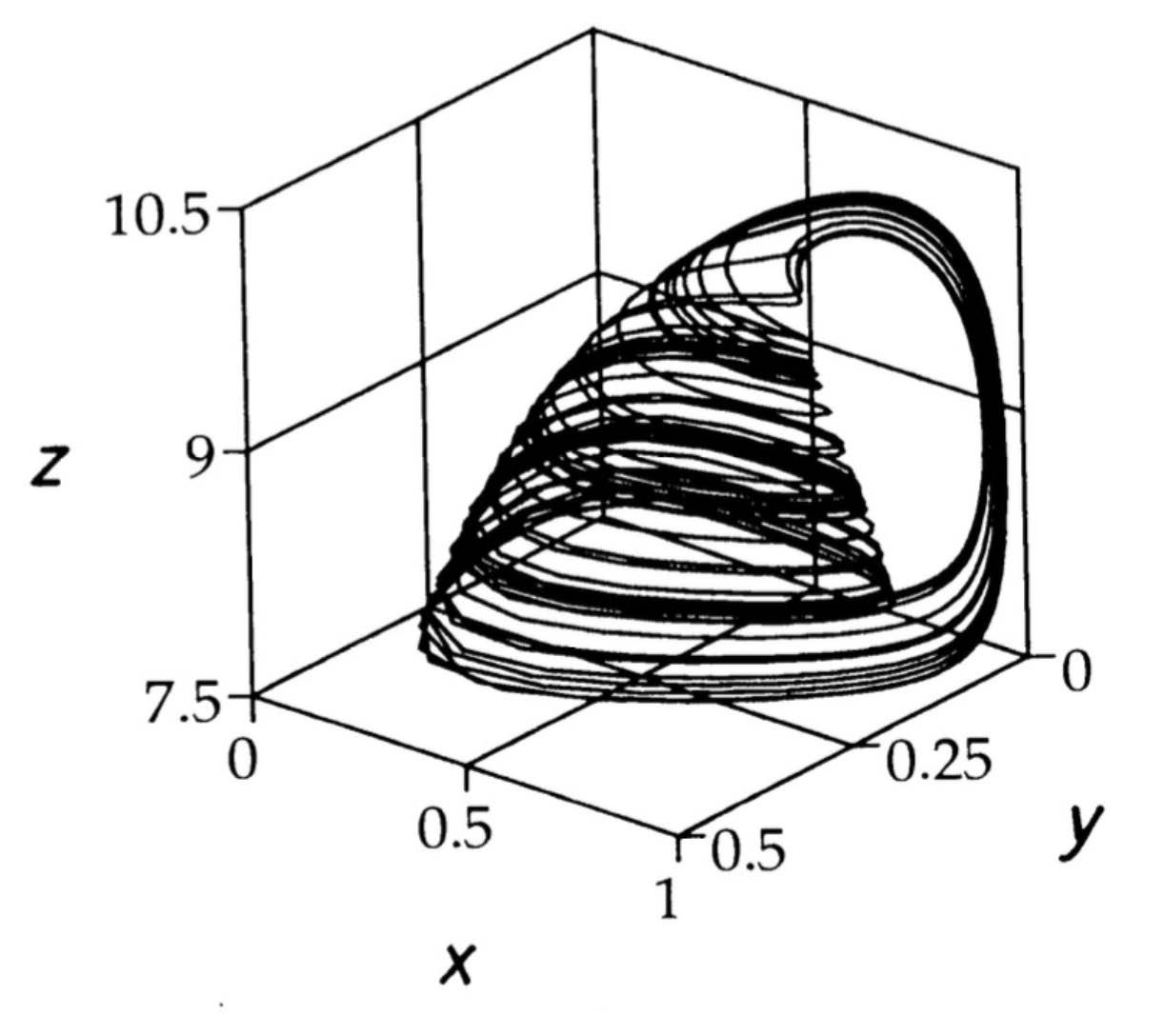
The aim of this summer school is to introduce students to landmark results in mathematical ecology while emphasizing the modern techniques and ideas developed to address these emerging challenges. The school will begin with a review of classical questions and results, together with a discussion of new problems arising from both novel data sources and changing environmental conditions. Particular emphasis will be placed on identifying ecological questions that are amenable to mathematical formulation.
The core of the school will focus on modern dynamical systems approaches. A sequence of lectures will introduce nonautonomous systems, including their attractors, stability theory, and bifurcation structure, with a strong emphasis on transient dynamics and tipping phenomena. This will be complemented by an introduction to ergodic theory and random dynamical systems, providing tools to model and analyse stochastic influences and variability. The final part of the school will return to open problems in ecology, highlighting how these modern mathematical frameworks can be used to address unresolved questions and to formulate new ones.
Updated on Jul 29, 2026 10:12 AM PDT -
Geometric Topology of Complex Surfaces (SLMath)
Organizers: Seraphina Eun Bi Lee (Harvard University), LEAD Matthew Stover (Temple University)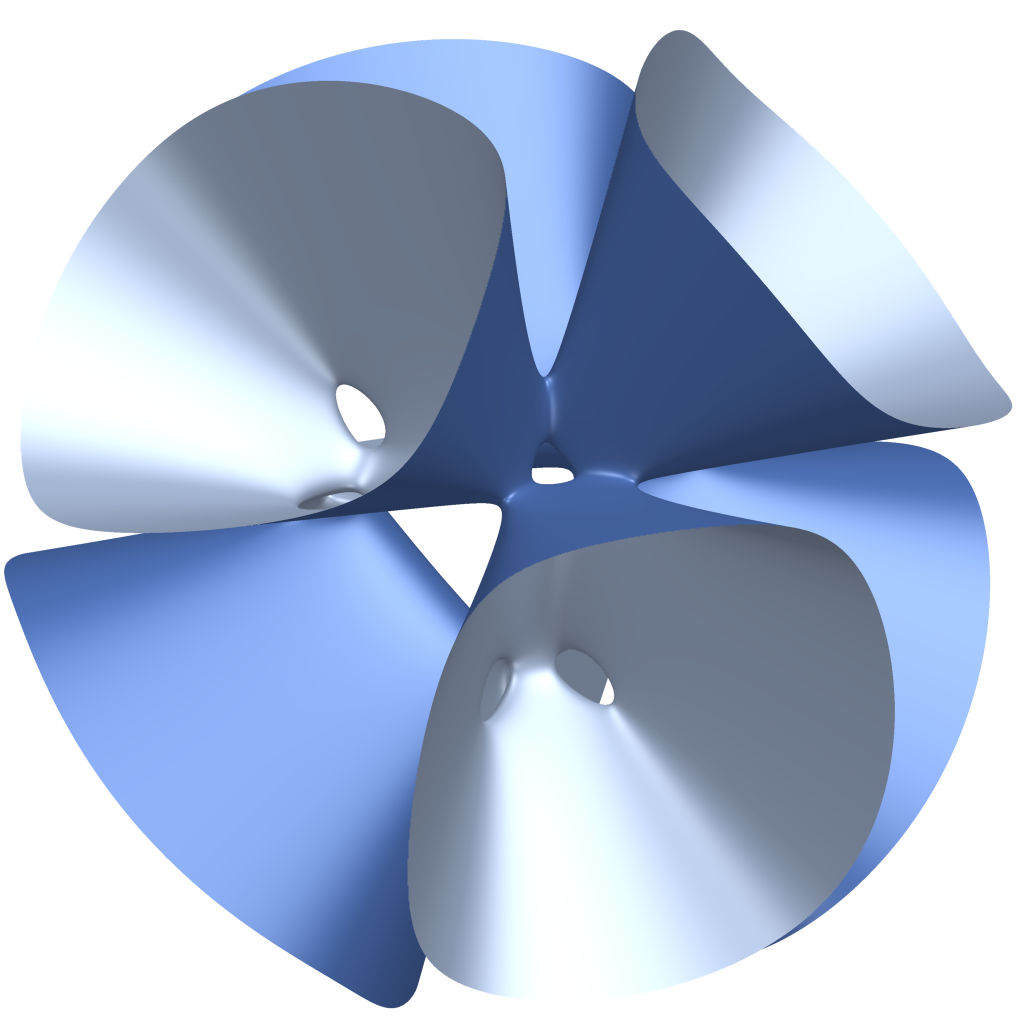 <p>A K3 surface</p>
The study of complex projective surfaces is yet to attain the level of realization and widespread prevalence as that of curves. The classification of surfaces is far from complete, and many basic problems remain open. This is particularly pronounced in geometric topology, where understanding of algebraic curves (i.e., Riemann surfaces) is essential knowledge but, for just one example, applications of surface theory to studying the geometric topology of four-dimensional manifolds are very limited at the present moment.
The purpose of this summer school is to close the background gap and connect young researchers with different backgrounds that are, perhaps unbeknownst to themselves, well-poised to fruitfully collaborate on important problems at the interface of geometric topology and surface geometry.
Updated on Jul 24, 2026 09:23 AM PDT -
Classification of Fusion Categories (SLMath)
Organizers: Cain Edie-Michell (University of New Hampshire), Julia Plavnik (Indiana University, Bloomington) <p>A simplification of the Hopf link in the quantum GL(N)-category</p>
The purpose of this summer school will be to introduce students to the world of tensor categories. We will approach this topic in a variety of ways. Beyond simply exploring the formal definitions, many examples will be introduced and studied, and the natural occurrences of tensor categories “in the wild” will be explored. One such example will be the Temperley-Lieb-Jones category, and the corresponding “quantum” knot invariants.
Updated on Aug 28, 2026 02:28 PM PDT -
2027 PIMS-CRM Summer School in Probability (Montréal, Canada)
Organizers: Louigi Addario-Berry (McGill University), Omer Angel (University of British Columbia), Benjamin Landon (University of Toronto), Mathav Murugan (University of British Columbia)The PIMS–CRM Summer Schools in Probability are a highlight of Canadian probability. Launched by PIMS in 2004, they take the form of two main 4-week courses by top researchers in probability theory and related fields, along with a number of keynote addresses and shorter mini-courses. The school is geared primarily at doctoral students and postdoctoral scholars, who are also given the opportunity to present their own research, should they desire. The schools have played a major role in the development of an exceptionally strong community of young probabilists in Canada, North America and overseas. This will be the 14th time this school has run.
Updated on Jul 28, 2026 10:58 AM PDT -
Modular Representation Theory and the Classification of Blocks (SLMath)
Organizers: Olivier Dudas (Université de Paris VII (Denis Diderot)), Radha Kessar (University of Manchester) Blocks, but not as you know them
The summer school will provide a comprehensive introduction to the structure and classification of blocks. Participants will explore the algebraic, homological, combinatorial, categorical, geometric, and computational perspectives that shape the area. Beginning with basic concepts such as defect groups, decomposition numbers, and Cartan matrices, the lectures will develop Morita and derived equivalences and higher representation-theoretic methods, before turning to finite reductive groups and geometric constructions arising from Deligne–Lusztig varieties. Hands-on computational sessions will complement this theoretical material, illustrating how character tables, decomposition matrices, and block invariants can be explored using Julia, and in particular its Chevie package for computations involving finite reductive groups.
Updated on Aug 05, 2026 03:42 PM PDT -
Resolutions of Singularities (Kashiwa, Chiba, Japan)
Organizers: Ana Bravo (Universidad Autónoma de Madrid), Steven Dale Cutkosky (University of Missouri)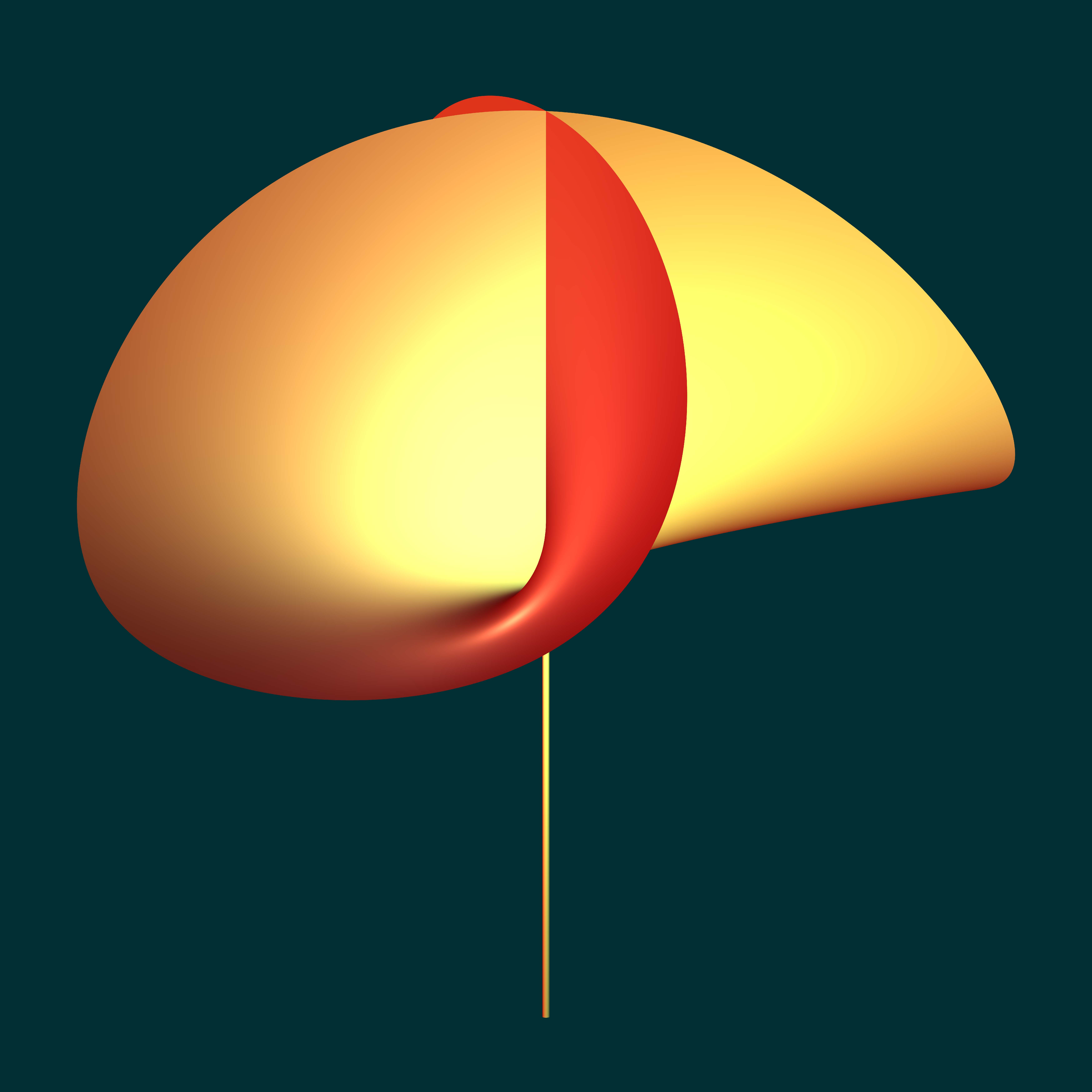 The Whitney Umbrella. Courtesy of Herwig Hauser, Fac. Math., University of Vienna, Austria
The school will introduce students to the fundamental problem of resolution of singularities of varieties and schemes. This is a subject that is relevant for all areas of algebraic geometry and commutative algebra. Students will learn algorithms to resolve singularities, and learn how to apply them in specific situations and understand how these techniques can be used in their research.
Updated on Sep 21, 2026 12:00 PM PDT -
Pathways Workshop: Algebraic Combinatorics & New Trends in Tropical Geometry
Organizers: Renzo Cavalieri (Colorado State University), Sylvie Corteel (Université de Paris VII (Denis Diderot); University of California, Berkeley), Olya Mandelshtam (University of Waterloo), LEAD Hannah Markwig (Eberhard-Karls-Universität Tübingen), Sarah Mason (Wake Forest University), Kris Shaw (University of Oslo)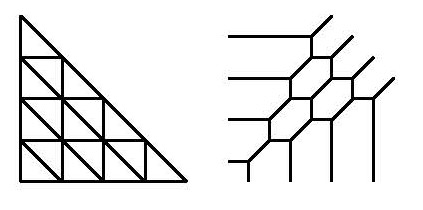
This workshop presents introductory talks and new trends in tropical geometry and algebraic combinatorics, including interactions between tropical geometry and enumerative, logarithmic, nonarchimedean, and real algebraic geometry, mirror symmetry and symplectic geometry, moduli spaces in tropical geometry, the geometry of matroids, integrable systems and dynamical combinatorics, combinatorial representation theory, geometry of polynomials, combinatorial varieties and connections to symmetric function theory and cluster algebras.
Updated on Jan 23, 2026 03:42 PM PST -
Introductory Workshop: Algebraic Combinatorics & New Trends in Tropical Geometry
Organizers: Philippe Di Francesco (University of Illinois at Urbana-Champaign), LEAD Ilia Itenberg (Institut de Mathématiques de Jussieu - Paris Rive Gauche), Svante Linusson (Royal Institute of Technology), Sam Payne (University of Michigan; University of Texas, Austin), LEAD Colleen Robichaux (University of California, Los Angeles), Kris Shaw (University of Oslo), Lauren Williams (Harvard University), Josephine Yu (Georgia Institute of Technology)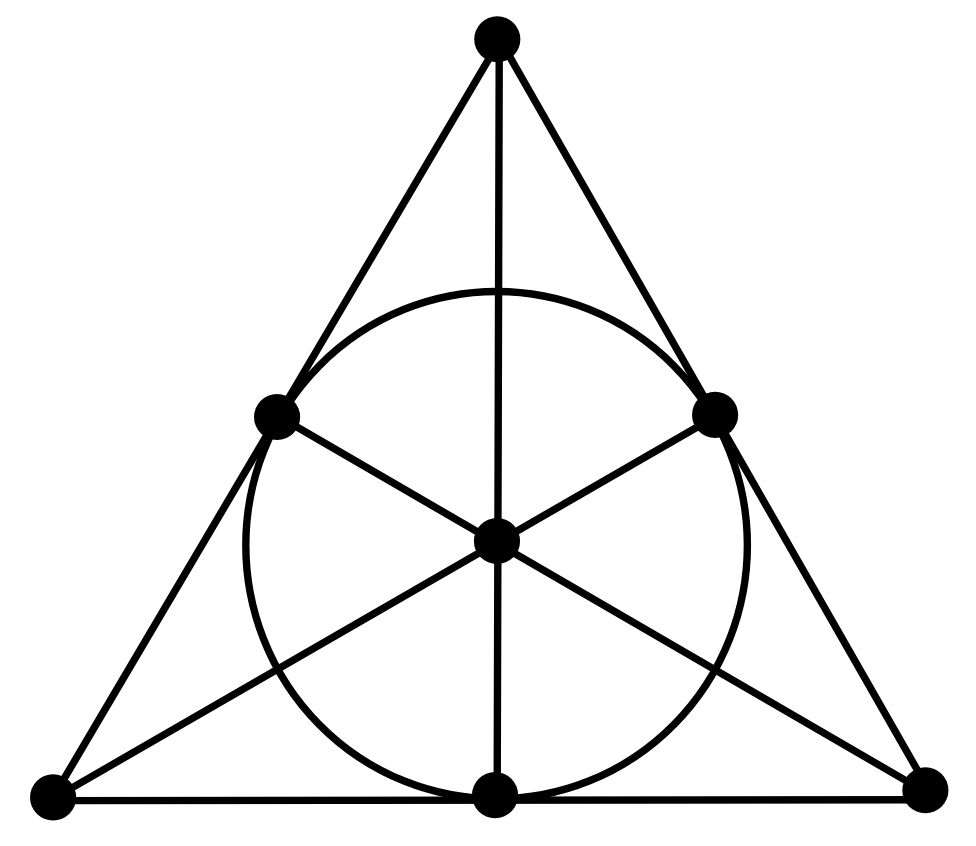 Fano plane
The workshop will include three minicourses on key topics in Algebraic Combinatorics & Tropical Geometry: combinatorial representation theory, combinatorial algebraic varieties and their connections to various polynomial bases, combinatorial and algebro-geometric facets of matroids, enumerative tropical geometry, real aspects of tropical geometry and connections with A1-homotopy theory.
The minicourses will be intended for a broad audience, with the goal of providing background and motivation in these topics.Updated on Jan 23, 2026 03:42 PM PST -
Recent Developments in Algebraic Combinatorics
Organizers: Sara Billey (University of Washington), LEAD Christian Gaetz (University of California, Berkeley), Melissa Sherman-Bennett (University of California, Davis), Cynthia Vinzant (University of Washington)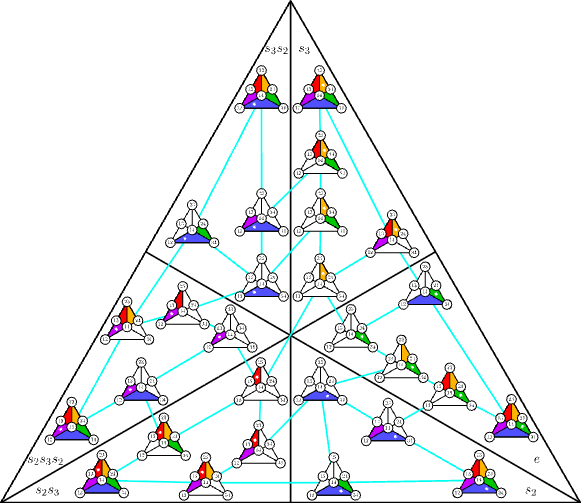 <p>This figure encodes the combinatorics of a triangulation of the permutahedron. Figure appears in Defant--Sherman-Bennett--<wbr />Williams <a data-saferedirecturl="https://www.google.com/url?q=https://arxiv.org/pdf/2509.11497&source=gmail&ust=1769544428157000&usg=AOvVaw1E-v0MZ1v_EyqlWLiqlPNw" href="https://arxiv.org/pdf/2509.11497" target="_blank">https://arxiv.org/<wbr />pdf/2509.11497</a>.</p>
This workshop will bring together researchers at the cutting edge of algebraic combinatorics. The topics will include integrable systems, dynamical combinatorics, combinatorial representation theory with connections to theoretical computer science, the geometry of polynomials, cluster algebras, combinatorial algebraic geometry, and symmetric functions.
Updated on Jan 27, 2026 01:21 PM PST -
Enumerative Aspects of Tropical Geometry
Organizers: Hulya Arguz (University of Georgia), LEAD Pierrick Bousseau (University of Georgia), M. Angelica Cueto (Ohio State University), Grigory Mikhalkin (Université de Genève)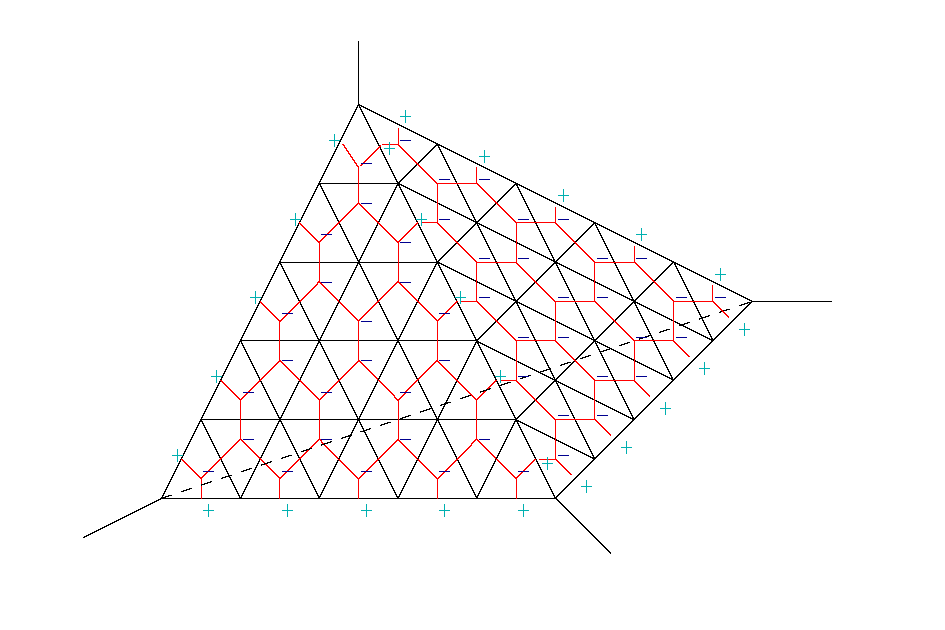 The discriminant locus in the base of a Lagrangian torus fibration on the quintic threefold.
This workshop will focus on enumerative aspects of tropical geometry and tropical moduli spaces. The meeting will bring together researchers from several different areas in real and complex geometry, symplectic geometry, mirror symmetry and non-Archimedean geometry.
Updated on May 01, 2026 03:22 PM PDT
Past all workshops
-
Workshop Geometric Representation Theory and 3d Mirror Symmetry
Organizers: Joel Kamnitzer (McGill University), Sam Raskin (Yale University), Peng Shan (Tsinghua University), LEAD Benjamin Webster (University of Waterloo; Perimeter Institute of Theoretical Physics) Image by Elliot Kienzle
This workshop will bring together theoretical physicists, representation theorists, algebraic geometers and symplectic geometers interested the connections between quantum field theory and geometric representation theory. The main topics to be discussed are mathematical aspects of 2d, 3d and 4d supersymmetric field theories, such as: topological twists and the resulting Higgs and Coulomb branches, relations to quantization and categorification, representations of vertex operator algebras, connections to enumerative geometry and quantum K-theory and elliptic cohomology, relations to knot homology and, finally, connections to the (relative) geometric Langlands program.
Updated on Aug 18, 2026 10:21 AM PDT -
Workshop Introductory Workshop: Representation Theory Under the Influence of Quantum Field Theory & Motivic Homotopy Theory
Organizers: David Ben-Zvi (University of Texas, Austin), Elden Elmanto (University of Toronto, Scarborough), Iva Halacheva (Northeastern University), LEAD Pavel Safronov (University of Edinburgh), Anand Sawant (Tata Institute of Fundamental Research), Peng Shan (Tsinghua University), Craig Westerland (University of Minnesota, Twin Cities), Maria Yakerson (Institut de Mathématiques de Jussieu) Under the light of suspended spheres, the QFT wizard dangles groups and their duals over a boiling cauldron of motives. (Drawn by Rok Gregoric)
The goal of this introductory workshop is to showcase some of the recent developments in motives and quantum field theory, with a focus on giving a high-level, but "outsider-friendly" introduction to both subjects. It will feature lectures introducing the modern formalism of sheaf theories, supersymmetric gauge theories, geometric representation theory and motivic spectra.
Updated on Aug 27, 2026 03:11 PM PDT -
Workshop Pathways Workshop: Representation Theory Under the Influence of Quantum Field Theory & Motivic Homotopy Theory
Organizers: Ana Balibanu (Louisiana State University), Asilata Bapat (Australian National University), Teena Gerhardt (Michigan State University), Iva Halacheva (Northeastern University), LEAD Padmavathi Srinivasan (Boston University), Kirsten Wickelgren (Duke University) <p>Calabi–Yau manifold. (Image attribution: Lunch on Wikipedia)</p>
This workshop is on recent developments in representation theory, quantum field theory, and motivic homotopy theory. Contemporary representation theory has been increasingly influenced by the mathematical development of supersymmetric gauge theories and mirror symmetry. Motivic homotopy theory—a version of homotopy theory for algebraic varieties and solutions to polynomial equations—has seen widespread modern applications. This three-day workshop aims to introduce researchers to these fields and their open problems, and to highlight recent progress. The workshop will include research lectures as well as activities to promote interaction and connections between the participants. This workshop is open to all mathematicians.
Updated on Sep 14, 2026 10:47 AM PDT -
Summer Graduate School Moduli of Varieties (SLMath)
Organizers: Kenneth Ascher (Princeton University), Dori Bejleri (University of Maryland), Kristin DeVleming (University of California, San Diego)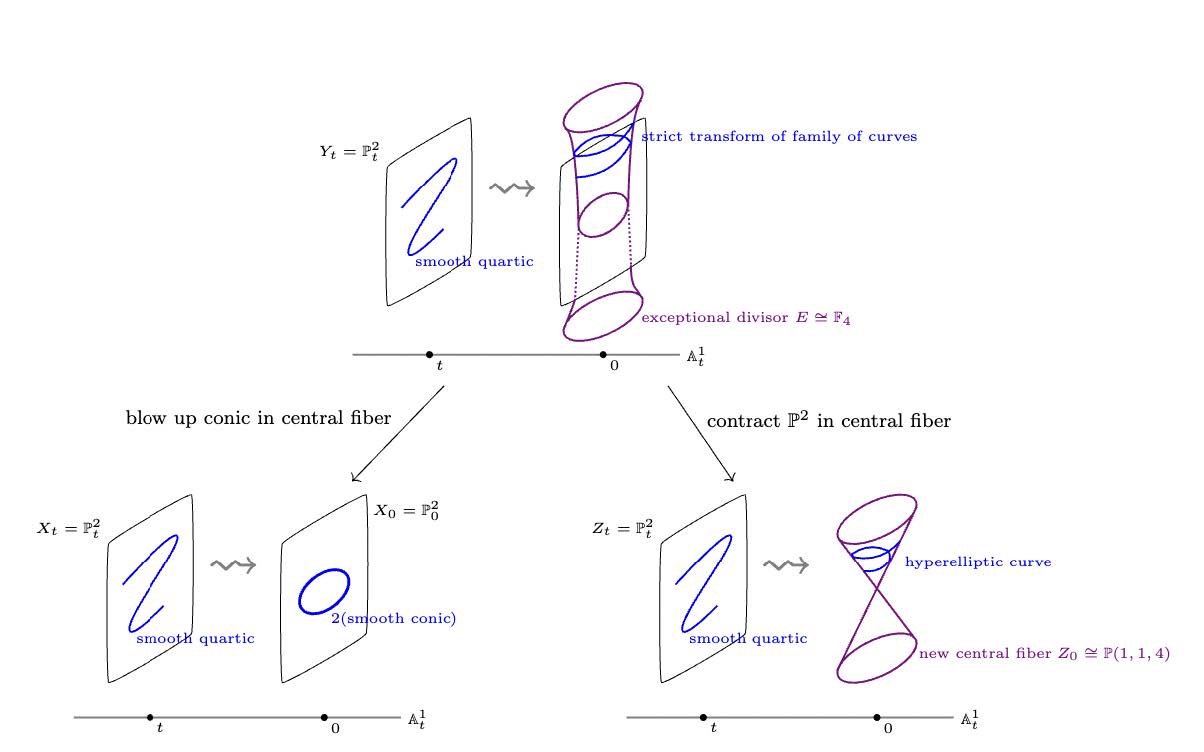 <p>A wall-crossing in a moduli problem</p>
One of the central problems in algebraic geometry is to classify so-called algebraic varieties: geometric shapes cut out by polynomial equations. Algebraic varieties are parametrized by certain moduli spaces (roughly: parameter spaces whose points correspond to these different varieties). The geometry of these moduli spaces encodes the ways of continuously deforming these shapes. Furthermore, classification questions for algebraic varieties often boil down to understanding the geometry of these moduli spaces. In the past few years, powerful new tools have been developed in moduli theory, especially for higher dimensional varieties – those which are of complex dimension at least two. The goal of this summer school is to provide an introduction to many of these recently emerging breakthroughs to enable graduate students to begin working in this area. The program will be motivated and often guided by examples and is intended to be accessible to a wide variety of students
Updated on Jul 23, 2026 01:27 PM PDT -
Summer Graduate School Dynamical Systems for Machine Learning and AI (IBM Yorktown)
Organizers: Soumyadip Ghosh (IBM Thomas J. Watson Research Center), LEAD Yingdong Lu (IBM Thomas J. Watson Research Center), Tomasz Nowicki (IBM Thomas J. Watson Research Center)
This Summer Graduate School aims to introducing graduate students to some aspects of contemporary modeling and analysis of dynamical systems in their interactions with machine learning and artificial intelligence (AI) applications.
Updated on Jul 14, 2026 01:18 PM PDT -
Summer Graduate School Singularities in Commutative Algebra Through Cohomological Methods (SLMath)
Organizers: Benjamin Briggs (Imperial College, London), Eloísa Grifo (University of Nebraska), Josh Pollitz (Syracuse University)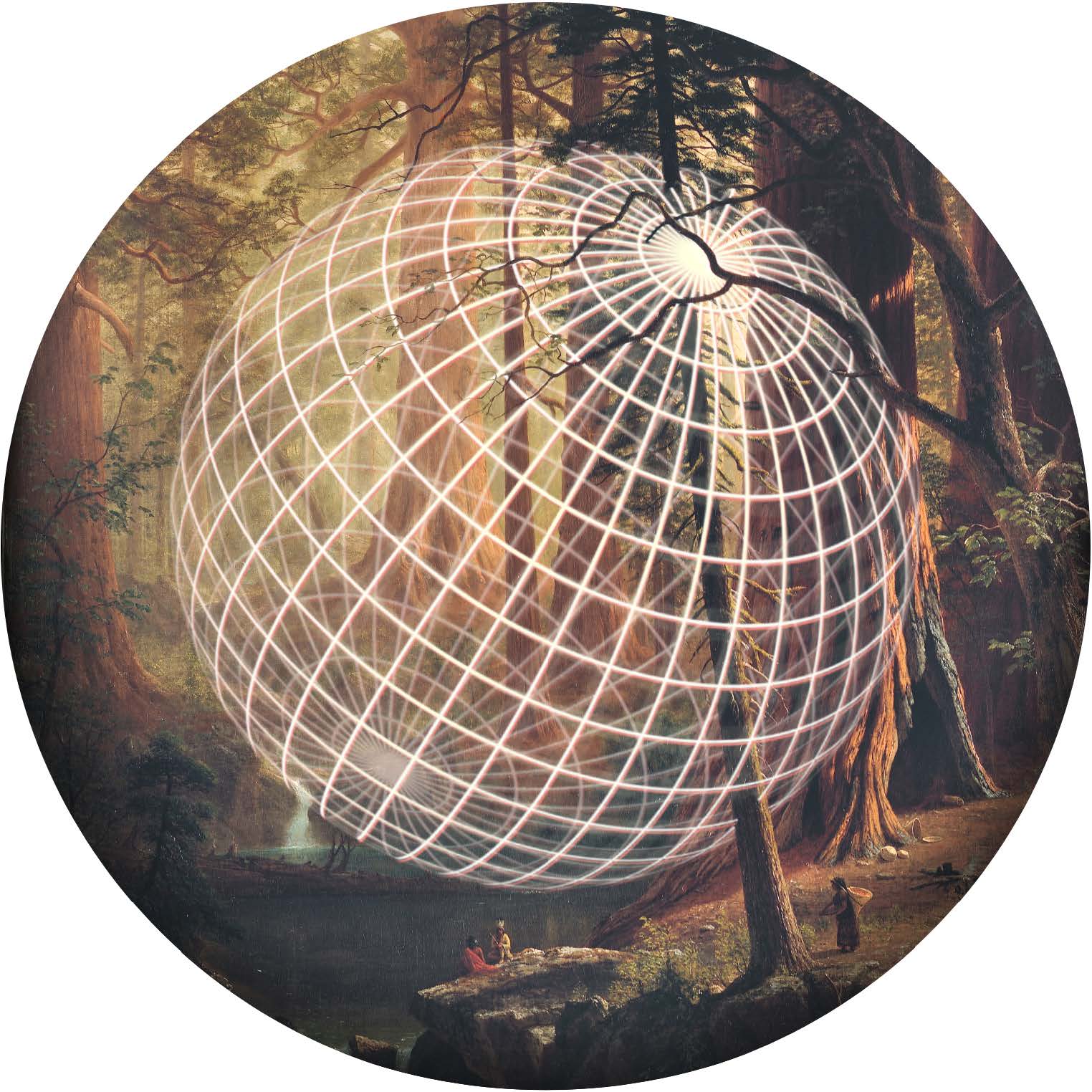 <p>Homotopy measures how spheres can be tangled in spaces; the logo shows a sphere tangled in a grove of California redwoods<br />The background painting is “Giant Redwood Trees of California” by Albert Bierstadt in 1874</p>
The goal of this school will be to introduce students to several powerful cohomological tools that were brought to commutative algebra by Avramov in the 80s and 90s: Lie algebra methods from homotopy theory, and support theoretic methods from the representation theory of finite groups. These tools have have seen a huge array of applications that continue to grow, with several major developments in recent years, opening new connections to algebraic topology, noncommutative algebraic geometry, and representation theory.
Updated on Jul 10, 2026 11:25 AM PDT -
Summer Graduate School SLMath-Oxford-OIST School: Analysis of Partial Differential Equations (Okinawa, Japan)
Organizers: Ugur Abdulla (Okinawa Institute of Science and Technology), Gui-Qiang Chen (University of Oxford)
This two week summer school, jointly organized by SLMath with OIST, will offer the following two mini-courses:
- Measure-theoretical analysis, divergence-measure fields, and nonlinear PDEs of divergence form
This course will present some recent developments in the theory of divergence-measure fields via measure-theoretic analysis and its applications to the analysis of nonlinear PDEs of conservative form – nonlinear conservation laws. - Perron’s method and Wiener-type criteria in the potential theory of elliptic and parabolic PDEs
This course will present some recent developments precisely characterizing the regularity of the point at ∞ for second order elliptic and parabolic PDEs and broadly extending the role of the Wiener test in classical analysis.
Updated on Dec 03, 2025 10:44 AM PST - Measure-theoretical analysis, divergence-measure fields, and nonlinear PDEs of divergence form
-
Summer Graduate School John Tukey Summer Graduate School: Mathematics of Generative Models (SLMath)
Organizers: Jianfeng Lu (Duke University), Eric Vanden-Eijnden (New York University, Courant Institute) <p>Artificial image generation by flow-based generative models starting from noise</p>
The overarching goal of this summer school is to expose students to the latest developments in the mathematics of generative models. Our ultimate goal is to teach them how to conduct research in this exciting area in machine learning and use their knowledge to make contributions to applied mathematics using these new tools.
Updated on Jul 24, 2026 02:07 PM PDT -
Summer Graduate School ICTP-INdAM-SLMath Summer Graduate School for Machine Learning (Trieste, Italy)
Organizers: Claudio Arezzo (Abdus Salam International Centre for Theoretical Physics), Jean Barbier (Abdus Salam International Centre for Theoretical Physics), Filippo Bracci (Università di Roma Tor Vergata), LEAD Domenico Marinucci (Università di Roma Tor Vergata), Cristina Trombetti (CSEF and Università degli Studi di Napoli Federico II)
The aim of this summer school is to provide an introduction to theoretical ideas that have been developed with the objective of understanding machine learning methods and their domain of applicability. The focus will be on proof technique and general mathematical tools. The lecturers are two worldwide experts in the area and the material is regularly taught in Mathematics and Statistics Departments of the top world Universities.
Updated on Jun 22, 2026 10:46 AM PDT -
Summer Graduate School Random Growth Models, Phase Separation and Hamilton-Jacobi PDE (UC Berkeley)
Organizers: Alan Hammond (University of California, Berkeley), Fraydoun Rezakhanlou (University of California, Berkeley)Models of random growth and of the separation of phases occurring when one substance is suspended in another often evince universal features, in which scaling exponents are shared among a broad class of such models. A foothold for understanding such features is often offered by studying a few special models that are exactly solvable, which means that exact formulas of algebraic or integrable origin are available. Showing that a broader range of models also have the features is a task that may rely on a range of robust probabilistic or geometric tools. The summer school will offer an introduction to random growth and phase separation, with an emphasis on tools that offer the prospect of proving universality for a wider class of models.
Updated on Jul 17, 2026 10:16 AM PDT -
MSRI-UP MSRI-UP 2026: Numerical Methods for Differential Equations
Organizers: LEAD Alexander Diaz-Lopez (Villanova University), Maria Mercedes Franco (MSRI / Simons Laufer Mathematical Sciences Institute (SLMath)), Rebecca Garcia (Colorado College), Johnny Guzman (Brown University), Candice Price (Smith College), Robin Wilson (Loyola Marymount University)The MSRI-UP summer program is designed to serve a diverse group of undergraduate students who would like to conduct research in the mathematical sciences.
In 2026, MSRI-UP will focus on Numerical Methods for Differential Equations The research program will be led by Dr. Johnny Guzman of Brown University.
Updated on Apr 24, 2026 07:40 AM PDT -
Summer Graduate School Percolation and Lattice Models of Statistical Physics (Columbia University)
Organizers: Roland Bauerschmidt (New York University, Courant Institute), Tom Hutchcroft (California Institute of Technology) <p>The five largest clusters in critical site percolation on a large three-dimensional box</p>
Percolation and spin models such as the Ising model have a history that goes back over 100 years. The subject has taken a central role in probability theory over the last few decades, in particular through interactions with various other areas of mathematics. These include graph theory, theoretical
computer science, statistical physics, quantum field theory, complex analysis, partial differential equations, and geometric group theory. Through examples, the summer school aims to illustrate some of the successful techniques and ideas in the subject area.Updated on May 20, 2026 01:33 PM PDT -
Summer Graduate School Geometric Measure Theory (SLMath)
Organizers: Camillo De Lellis (Institute for Advanced Study; GSSI), Gudo De Philippis (Università di Padova; Scuola Normale Superiore)
The school will consist of three interrelated courses, aimed to introduce the main concepts in Geometric Measure Theory.
(1) Sets and measure in the Euclidean space, Guido De Philippis (Courant Institute of Mathematical Sciences)
(2) Theory of currents, Annalisa Massaccesi (University of Padua)
(3) Allard regularity theory, Camillo De Lellis (Institute of Advanced Study)Updated on Jun 11, 2026 10:53 AM PDT -
Workshop M2@GT 2026: The Future of Macaulay2
Updated on May 27, 2026 09:29 AM PDT -
Summer Graduate School Séminaire de Mathématiques Supérieures 2026: Universal Statistics in Number Theory (Montréal, Canada)
Organizers: Louis-Pierre Arguin (University of Oxford), Andrew Granville (Université de Montréal), Dimitris Koukoulopoulos (Université de Montréal), Matilde Lalin (Université de Montréal), Carlo Pagano (Concordia University), Elliott Paquette (McGill University), Frank Thorne (University of South Carolina)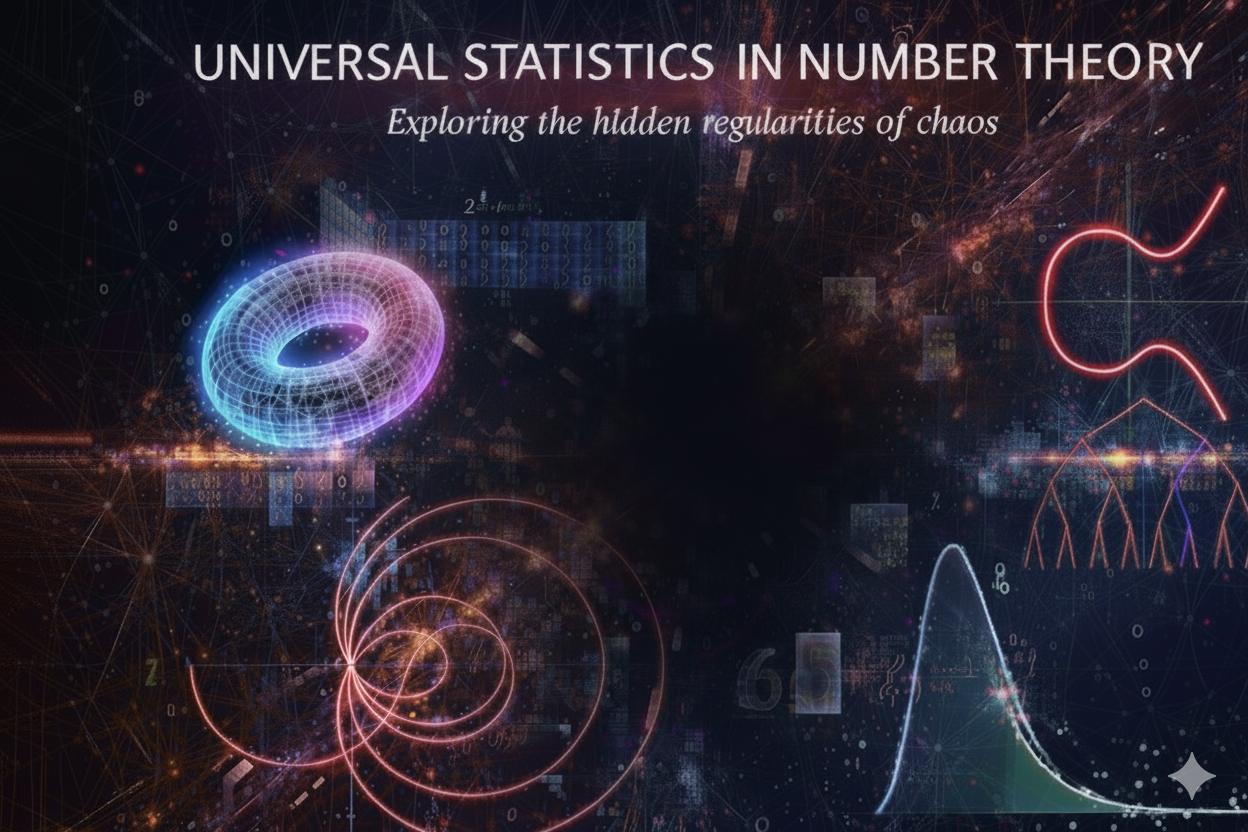
One of the hottest topics in analytic number theory involves the use of statistics and probability in understanding different aspects of algebraic and analytic number theory, through various new lenses. This is reflected in some of the most exciting number theory research of the last few years (for example, of Bhargava, of Ellenberg and Venkatesh, of Alexander Smith, of Sawin and Wood, of Adam Harper, of Koukoulopoulos and Maynard, of Helfgott and Radziwill, of Pilatte,....). As a consequence the CRM will host a thematic semester Mar 2-July 3, 2026 on these topics involving some of the world leaders in the subject. Since this new area can roughly be split in two into Algebraic and Analytic, we will focus for two months on each, with the SMS school placed in the middle. The 2026 SMS will introduce junior mathematicians to important trends in number theory.
Updated on Oct 17, 2025 04:27 PM PDT -
Workshop Critical Issues in Mathematics Education 2026: Mathematics Literacy for 21st-Century Citizenship - Part II
Organizers: Robert Berry (Indiana University), Josue Cordones (Bronx Collaborative High School), Megan Franke (University of California, Los Angeles), Maisie Gholson (University of Michigan), Courtney Ginsberg (Math for America), Mark Hoover (University of Michigan), Yvonne Lai (University of Nebraska), LEAD Maisha Moses (The Young People's Project), LEAD Benjamin Moynihan (The Algebra Project, Inc.), Aris Winger (Georgia Gwinnett College)Building on the vision Bob Moses set out in the 1993 Algebra Initiative Colloquium, the 2025 Critical Issues in Mathematics Education (CIME) Workshop celebrated the legacy of Moses’ call for a mathematics literacy that supports citizenship in the 21st century. A mathematics towards citizenship has proved elusive as a goal for mathematicians, mathematics educators, researchers, students, teachers, and leaders—even as efforts among different individuals, organizations, and communities labor for greater access to high-quality mathematics learning experiences. The 2026 CIME Workshop, Mathematics Literacy for 21st Century Citizenship - Part II, endeavors to design opportunities for learning, collaborating, and struggling towards a mathematics for lived citizenship, as a theme and organizing principle for communities across the Nation.
For Moses, the notion of lived citizenship is not simply a matter of gaining legal status but of demanding that the legal status be meaningful. Thus mathematics literacy for lived or participatory citizenship might be thought of to include contributing to your community, not just being part of a community, and beyond belonging, to actively participate in making your community better, in making life better for others.
The conception of mathematics for lived citizenship is an important foundation for the goals for the 2026 CIME Workshop, in order to envision the development of coordinated actions in the short and long term within the mathematics and mathematics education communities. To ground and catalyze these efforts, we invite participants to consider a mathematics for lived citizenship through three foundational ideas:
- Claiming mathematics -- establishing agency in and ownership of math.
- Building Agency -- claiming and leveraging mathematics knowledge to overcome present day, generational, community, and national challenges.
- Collaboration and collective effort -- using mathematics literacy to make systemic change.
Three questions will guide our work:
- How does the unfolding history of mathematics impact lived citizenship?
- How do we understand the relationship between mathematical flourishing and the evolution of vibrant democracy in the United States?
- In light of the above two questions, how do we reimagine our roles, responsibilities, and actions in the short and long term?
Updated on Apr 30, 2026 04:44 PM PDT -
Workshop Homogeneous Dynamics and Anosov Representations
Organizers: Simion Filip (University of Chicago), Ursula Hamenstädt (Rheinische Friedrich-Wilhelms-Universität Bonn), LEAD Fanny Kassel (Institut des Hautes Études Scientifiques (IHES)), Hee Oh (Yale University), Jean-François Quint (CNRS - Université de Montpellier) Limit set of an Anosov representation
This workshop will focus on recent advances on geometric and dynamical approaches to the study of discrete subgroups of higher rank Lie groups and their deformation spaces. The goal will be to present results and exchange ideas from different areas of mathematics, and we hope to create bonds between several different mathematical communities.
Updated on Apr 23, 2026 12:58 PM PDT -
Workshop Hot Topics: Geometric Langlands Conjecture
Organizers: Justin Campbell (Brandeis University), Charlotte Chan (University of Michigan), Lin Chen (Tsinghua University), Kevin Lin (University of Chicago), Sergey Lysenko (Université de Lorraine; Université de Lorraine), William Sawin (Princeton University)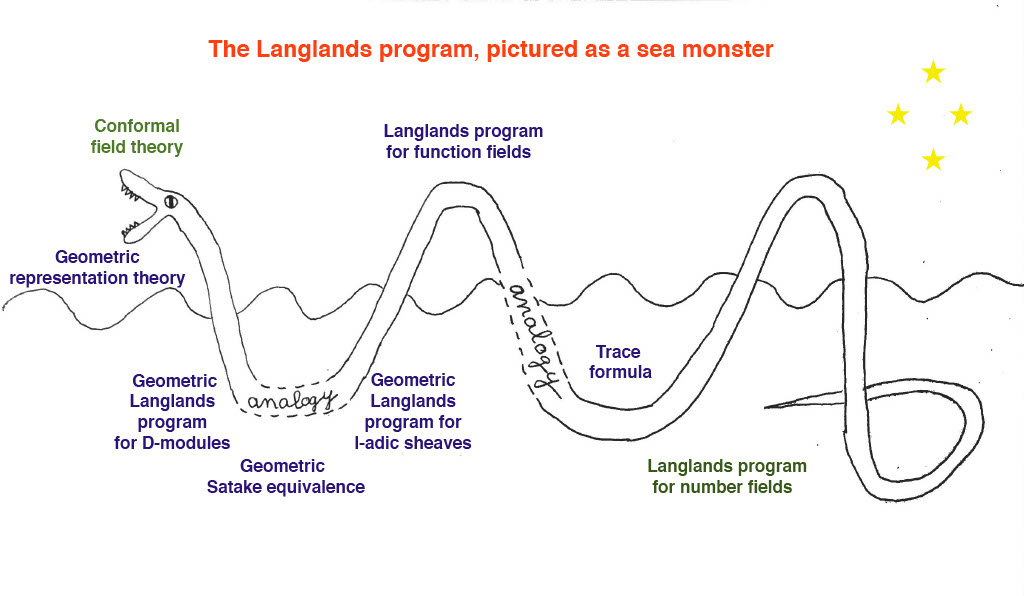 The Langlands program, pictured as a sea monster (Photo credit: V. Lafforgue)
This workshop will focus on the recent proof of the global unramified geometric Langlands conjecture as well as potential future developments in this field.
Updated on Apr 09, 2026 12:44 PM PDT -
Workshop Recent Progress in Topological and Geometric Structures in Low Dimensions
Organizers: Kenneth Bromberg (University of Utah), Sergio Fenley (Florida State University), Autumn Kent (University of Wisconsin-Madison), LEAD Kathryn Mann (Cornell University), Kasra Rafi (University of Toronto)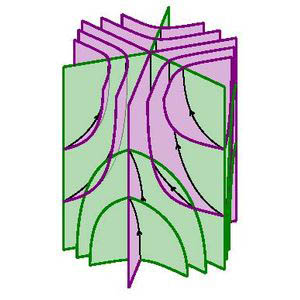 Foliations around a pseudo-Anosov singularity (Image credit: Chi Cheuk Tsang)
This workshop will bring together ideas from diverse areas of mathematics that meet in the setting of geometry and topology in low dimensions. This includes the study of flows, foliations, and fibrations of three-manifolds and the related study of geometry (e.g. hyperbolic or conformal structures) of the manifolds and of the leaves or fibers, and their mapping class groups. This is a rich and interconnected area and many adjacent topics will also be featured.
Updated on Mar 26, 2026 02:04 PM PDT -
Workshop Introductory Workshop: : Topological and Geometric Structures in Low Dimensions & Geometry and Dynamics for Discrete Subgroups of Higher Rank Lie Groups
Organizers: Federica Fanoni (Université de Fribourg), Steven Frankel (Washington University), LEAD Yair Minsky (Yale University), Amir Mohammadi (University of California, Berkeley), Andrés Sambarino (Université de Paris VII (Denis Diderot) et Université de Paris VI (Pierre et Marie Curie)), Barbara Schapira (Université de Picardie (Jules Verne)), Genevieve Walsh (Tufts University)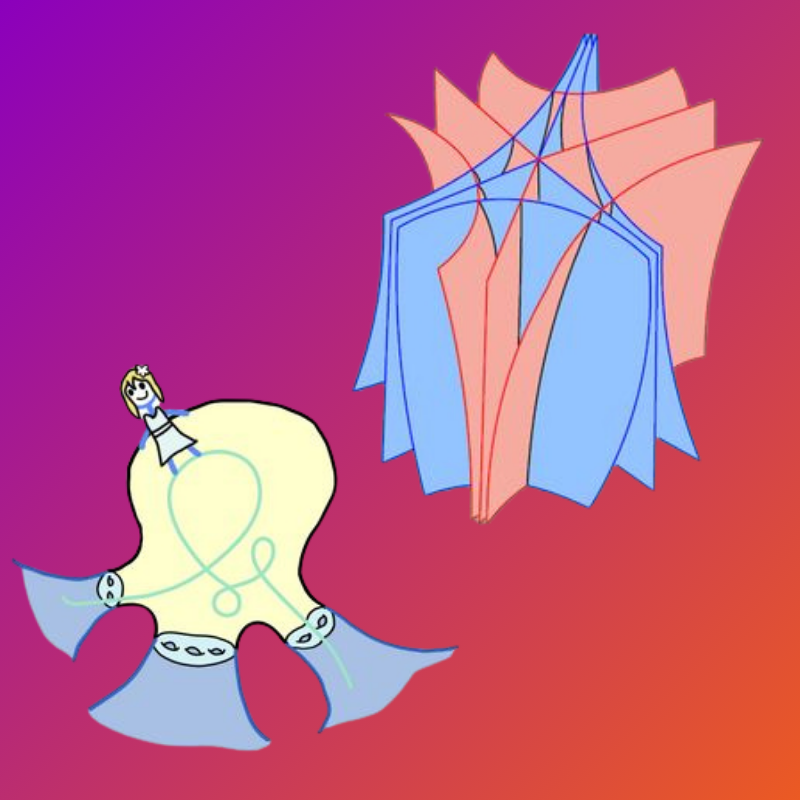
The joint introductory workshop for the programs in Geometry and Dynamics for Discrete Subgroups of Higher Rank Lie Groups and Topological and Geometric Structures in Low Dimensions will feature lectures introducing subjects of interest to both programs, including Teichmuller Theory, geometry in higher rank, foliations and flows, Anosov groups and thermodynamic formalism, mapping class groups, counting and equidistribution, and related topics. Minicourses will be targeted at early career researchers as well as specialists looking to find connections between the different subjects.
Updated on Feb 09, 2026 10:40 AM PST -
Workshop Pathways Workshop: Topological and Geometric Structures in Low Dimensions & Geometry and Dynamics for Discrete Subgroups of Higher Rank Lie Groups
Organizers: Martin Bridgeman (Boston College), Lei Chen (University of Chicago; University of Maryland), Beibei Liu (Ohio State University), Maria Beatrice Pozzetti (Università di Bologna), Rachel Roberts, Jing Tao (University of Oklahoma)
This workshop features a series of invited talks by experts across the fields of low-dimensional topology, homogeneous dynamics, and the geometry of symmetric spaces. Spanning all career stages, the event aims to foster a collaborative and supportive environment, particularly for early-career mathematicians, encouraging engagement, learning, and exploration in a welcoming academic setting.
Updated on Jan 23, 2026 05:04 PM PST -
Workshop Revisiting Fundamental Problems Workshop: Infinite-Dimensional Division Algebras - Algebraicity and Freeness
Organizers: Agata Atkarskaia (Guangdong Technion - Israel Institute of Technology), Jason Bell (University of Waterloo), LEAD Be'eri Greenfeld (University of California, San Diego), Susan Sierra (University of Edinburgh), LEAD James Zhang (University of Washington) Tribute to Hamilton's graffiti of the Quaternion Division Algebra, County Dublin, Ireland. Photo: Professor Peter Gallagher, Director Dublin Institute for Advanced Studies Dunsink Observatory (courtesy DIAS)
Infinite-dimensional division algebras are essential in noncommutative algebra and noncommutative algebraic geometry, yet they have remained cryptic and largely unclassified. This workshop will address three key classical open problems concerning them: the Kurosh Problem, the Free Subalgebra Problem and Artin's Conjecture. We will review decades of progress on these wide-open problems and emphasize novel techniques and emerging theories and concepts that show promise in facilitating breakthroughs.
Updated on Dec 04, 2025 01:49 PM PST -
Workshop Recent Trends in Stochastic Partial Differential Equations
Organizers: Sandra Cerrai (University of Maryland), LEAD Ilya Chevyrev (International School for Advanced Studies (SISSA/ISAS)), Yu Deng (University of Chicago)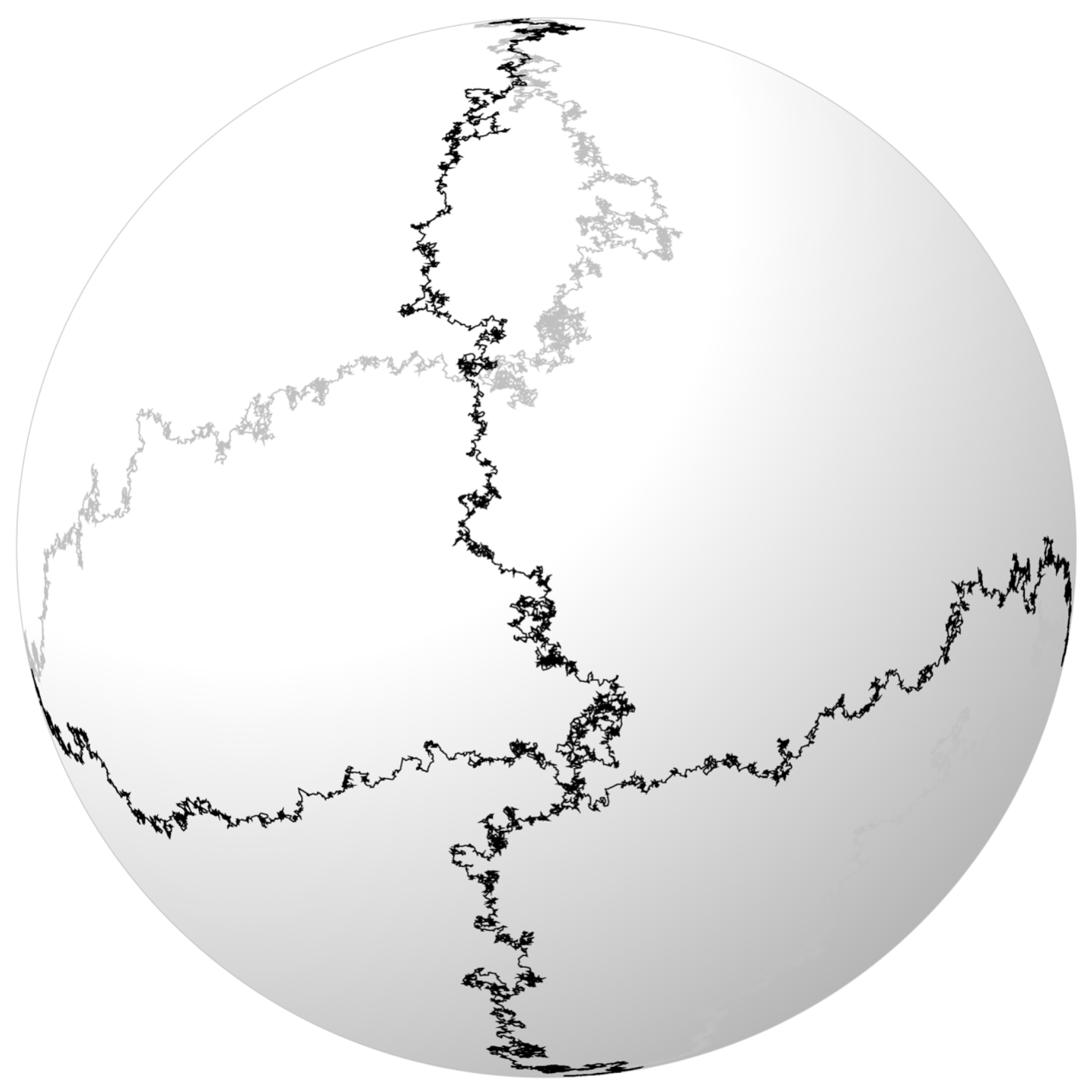 The motion of a random string.
The workshop aims to bring together researchers working on different facets of stochastic PDEs. The field of stochastic PDEs has seen many new techniques recently appear to tackle different problems, including renormalization, large scale and long-time behaviours, stochastic fluid dynamics, and homogenization. The goal of the workshop is to facilitate discussions and allow different communities to engage with one another one.
Updated on Nov 24, 2025 03:38 PM PST -
Workshop Kinetic Theory: Novel Statistical, Stochastic and Analytical Methods
Organizers: Irene M. Gamba (University of Texas, Austin), LEAD Weiran Sun (Simon Fraser University)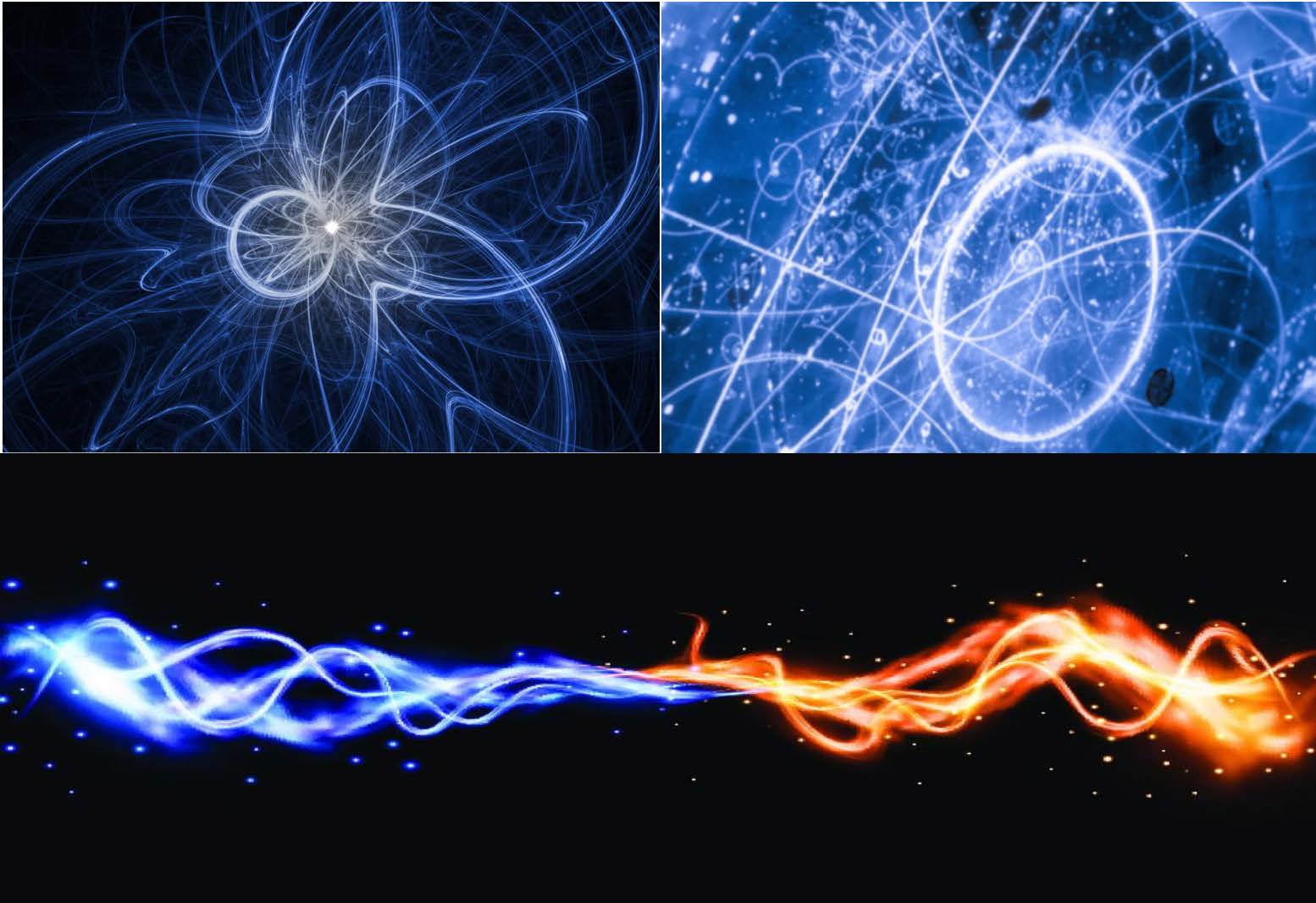 Top: Neutrino interactions and neutrino-atom interactions. Bottom: Collision of two "waves"
This workshop will explore the latest advances in kinetic theory and stochastic particle dynamics in mean field regimes, covering both classical themes and emerging areas. Topics will include the derivation of kinetic type equations from particle and plasma systems, state-of-the-art numerical methods, studies of multiscale phenomena, and the applications of kinetic equations in physics, chemistry, computer sciences appearing in life sciences, social sciences, and machine learning. This workshop will offer an exciting opportunity to connect researchers from all stages and sub-areas and spark new ideas.
Updated on Oct 24, 2025 10:44 AM PDT -
Workshop Lean for PDEs, an ICARM & SLMath collaboration
Organizers: Jeremy Avigad (Institute for Computer-Aided Reasoning in Mathematics (ICARM); Carnegie Mellon University), Matthew Ballard (Institute for Computer-Aided Reasoning in Mathematics (ICARM)), Tatiana Toro (MSRI / Simons Laufer Mathematical Sciences Institute (SLMath); University of Washington)
Computational proof assistants let us build global, digital libraries of mathematics where every theorem is fully verified by a computer. In this workshop, you'll get to explore this exciting new technology and the ideas behind it, with a special focus on formalizing partial differential equations (PDEs). The Lean mathematical library, Mathlib, is a community-driven effort to build a unified library of mathematics formalized in the Lean proof assistant. The main goal of this workshop is to help you start tangible projects that will contribute to the PDE section of the Mathlib library.
Updated on Sep 15, 2025 12:12 PM PDT -
Workshop Introductory Workshop: Kinetic Theory & Stochastic Partial Differential Equations
Organizers: Davar Khoshnevisan (University of Utah), Qin Li (University of Wisconsin-Madison), LEAD Konstantin Matetski (Michigan State University), Andrea Nahmod (University of Massachusetts, Amherst), Chiara Saffirio (Universität Basel), Xiangchan Zhu (Chinese Academy of Sciences)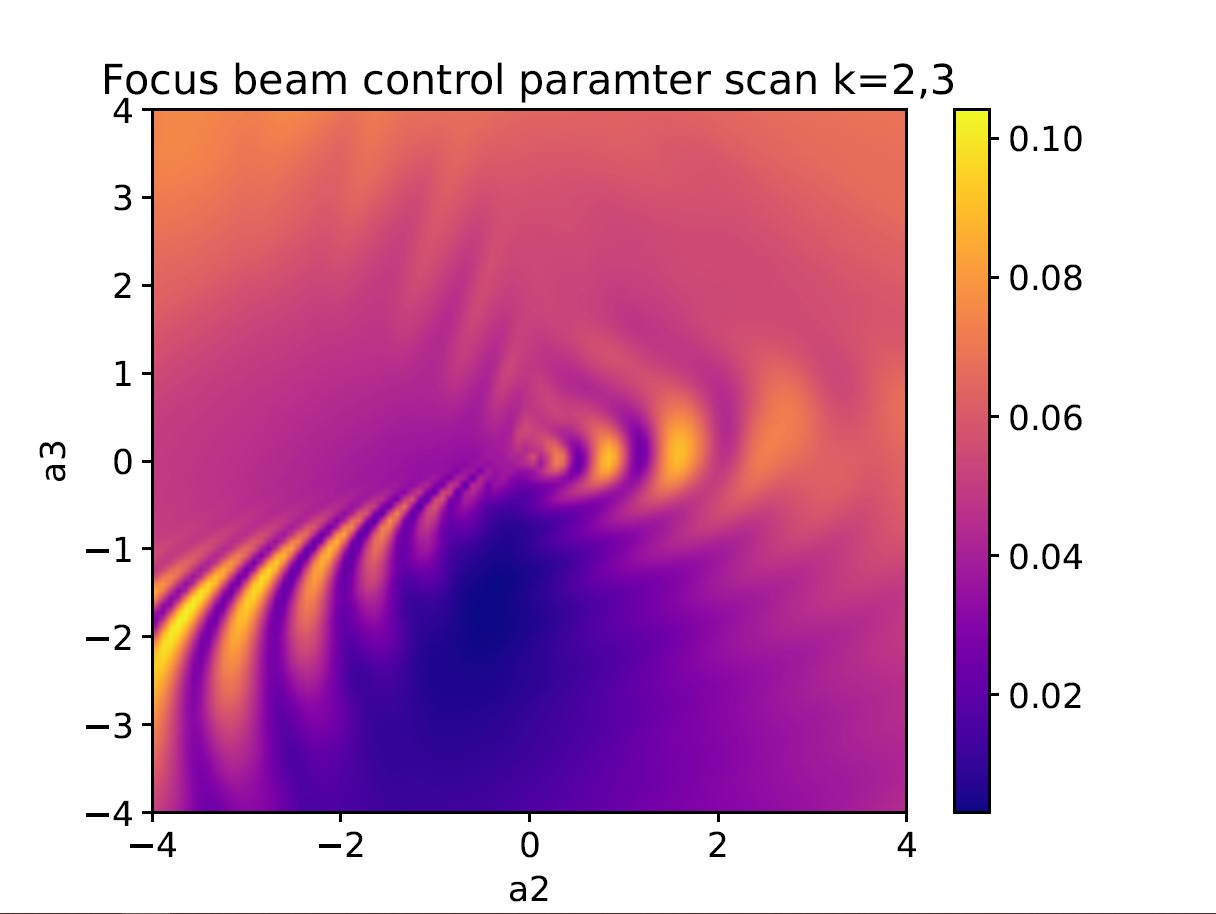 Parameter scan for deploying external electric field to control two-stream instability for Vlasov-Poisson.
The goal of the workshop is to introduce non-experts to two active research areas: kinetic theory and stochastic partial differential equations. Kinetic theory studies the properties of interacting particle systems modeling various processes in non-equilibrium statistical mechanics. Stochastic partial differential equations describe dynamics subjected to random noises. The methods from the two areas complement each other in studies of the phenomena arising in physics, economics, life sciences, etc.
Updated on Aug 28, 2025 10:56 AM PDT -
Workshop Pathways Workshop: Kinetic Theory & Stochastic Partial Differential Equations
Organizers: LEAD Raluca Balan (University of Ottawa), François Golse (Centre de Mathématiques Laurent Schwartz, École Polytechnique), Qin Li (University of Wisconsin-Madison), Xiaoming Song (Drexel University; Drexel University), Rongchan Zhu (Beijing Institute of Technology)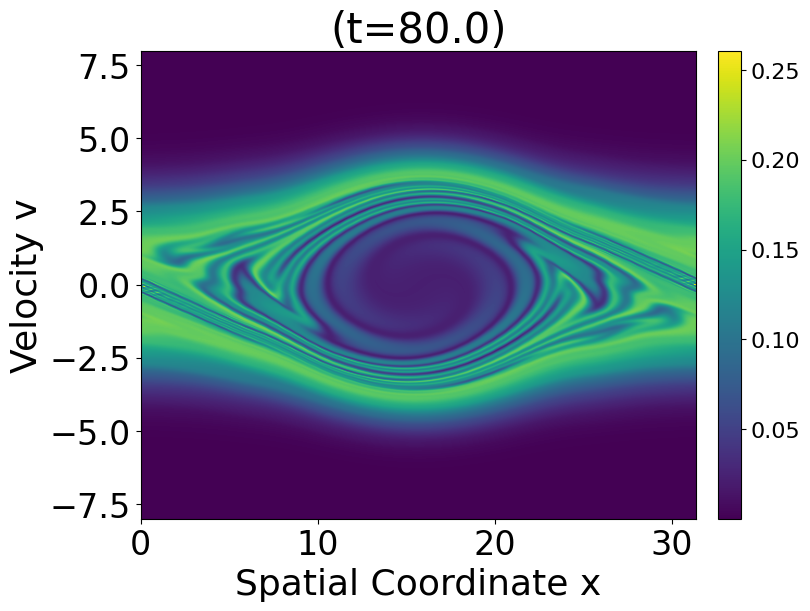
The Pathways workshop will bring together leading experts working at the intersection of kinetic theory and stochastic partial differential equations (SPDEs).
Updated on Aug 22, 2025 11:48 AM PDT -
Summer Graduate School Topological and Geometric Structures in Low Dimensions (SLMath)
Organizers: LEAD Kenneth Bromberg (University of Utah), Kathryn Mann (Cornell University)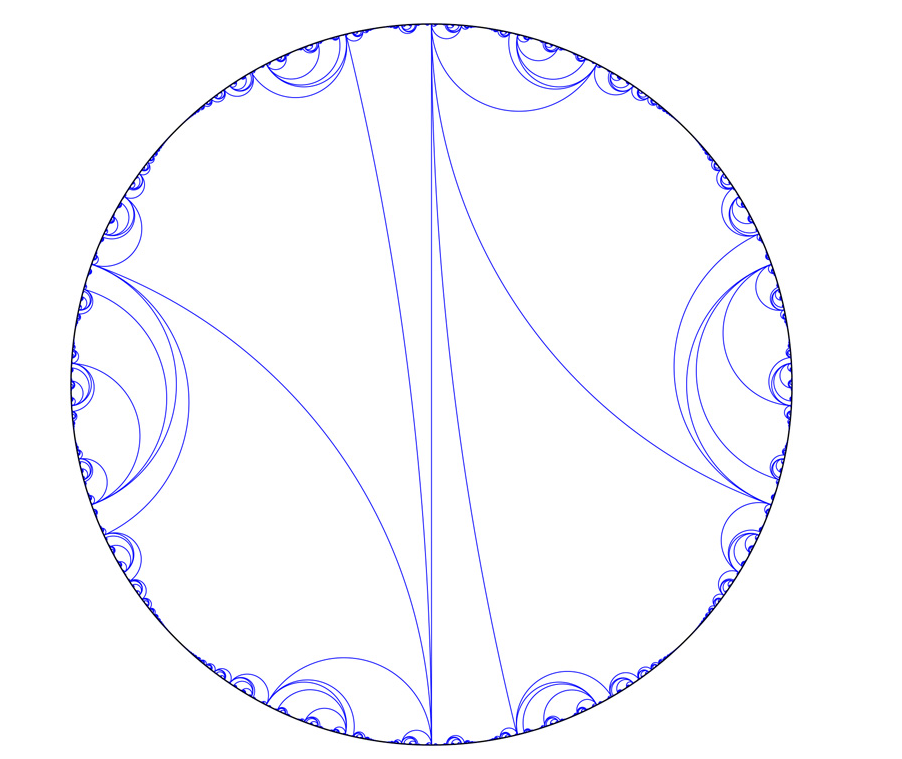 <p>Laminations arise naturally in hyperbolic geometry and (pseudo-) Anosov flows [Image by Jeffrey Brock]</p>
This school will serve as an introduction to the SLMath semester “Topological and Geometric Structures in Low-Dimensions”. The school consists of two mini-courses: one on Teichmüller Theory and Hyperbolic 3-Manifolds and the other on Anosov Flows on Geometric 3-Manifolds. Both topics lie at the interface of low-dimensional geometric topology (specifically, surfaces, foliations, and 3-manifolds) and low-dimensional dynamics. The first course will be targeted towards students who have completed the standard first year graduate courses in geometry, topology, and analysis while the second course will geared towards more advanced students who are closer to beginning research. However, we expect that all students will benefit from both courses.
Updated on Nov 03, 2025 12:23 PM PST -
Summer Graduate School Geometry and Dynamics in Higher Rank Lie Groups (UC Berkeley)
Organizers: Richard Canary (University of Michigan), Sara Maloni (University of Virginia), Wenyu Pan (University of Toronto; University of Toronto), Cagri Sert (University of Zurich), LEAD Tengren Zhang (National University of Singapore)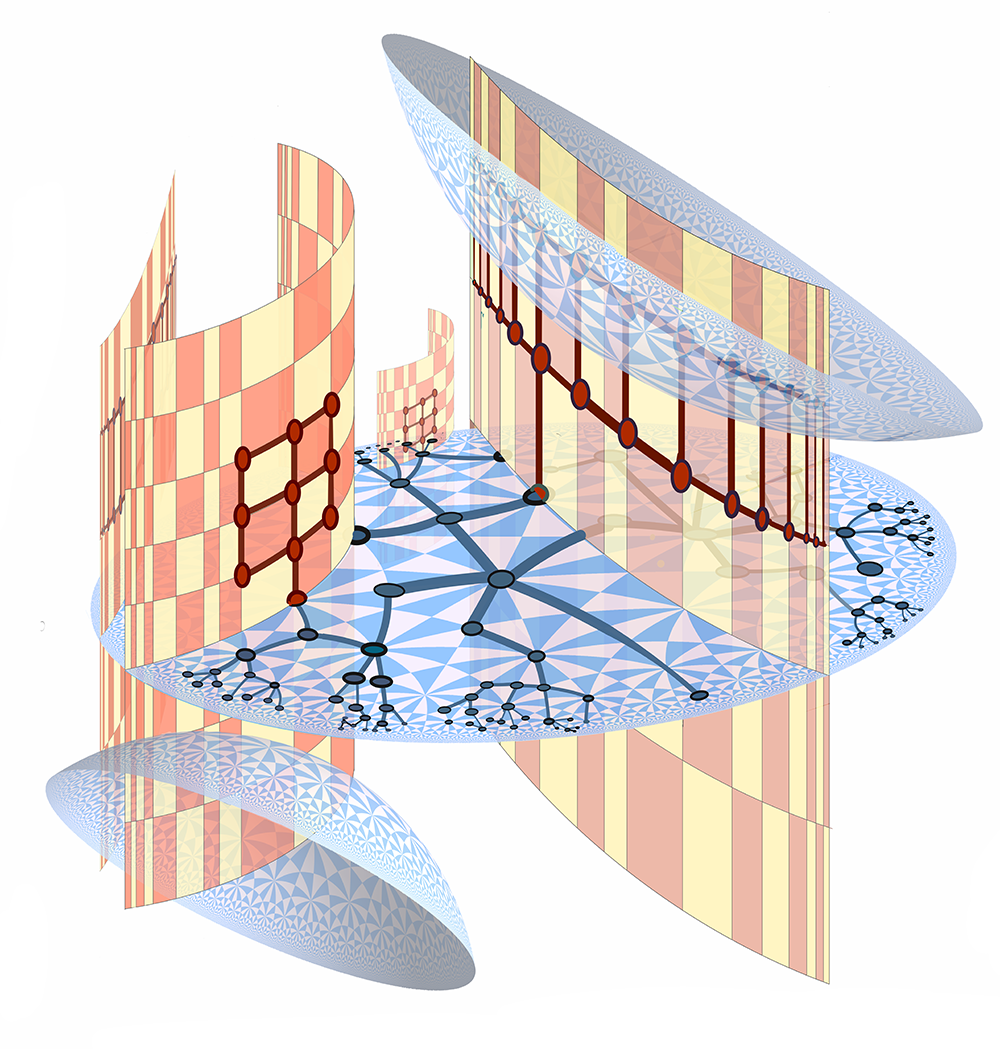 <p>Flats and hyperbolic planes in a higher rank symmetric space</p> Drawn by Steve Trettel.
Lie groups are central objects in modern mathematics; they arise as the automorphism groups of many homogeneous spaces, such as flag manifolds and Riemannian symmetric spaces. Often, one can construct manifolds locally modelled on these homogeneous spaces by taking quotients of their subsets by discrete subgroups of their automorphism groups. Studying such discrete subgroups of Lie groups is an active and growing area of mathematical research. The objective of this summer school is to introduce young researchers to a class of discrete subgroups of Lie groups, called Anosov subgroups.
Updated on Nov 03, 2025 01:16 PM PST -
Summer Graduate School Computer Assisted Proofs in Applied Mathematics (SLMath)
Organizers: LEAD Jonathan Jaquette (New Jersey Institute of Technology), Evelyn Sander (George Mason University)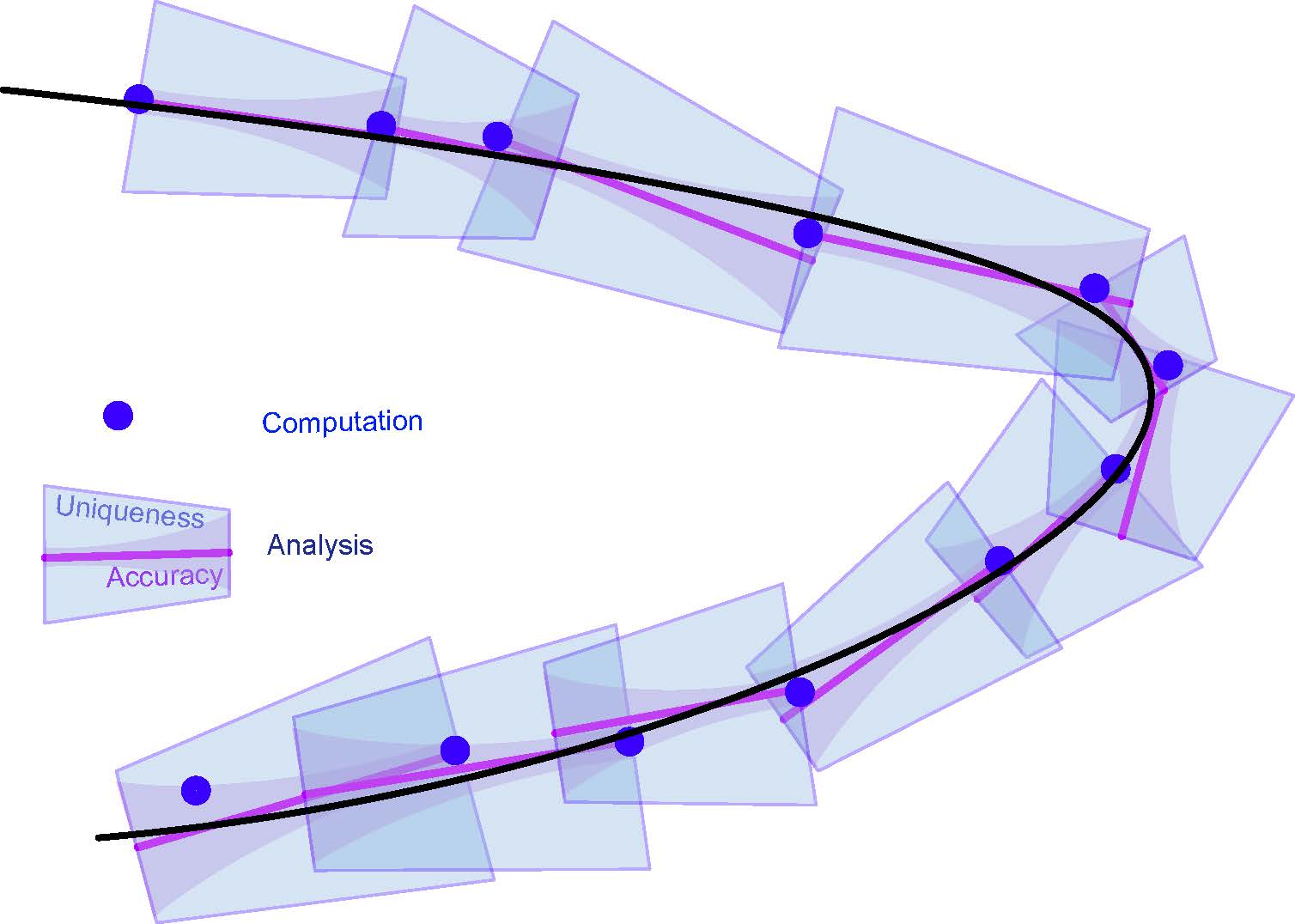
One of the core elements of applied mathematics is mathematical modeling consisting of nonlinear equations such as ODEs, and PDEs. A fundamental difficulty which arises is that most nonlinear models cannot be solved in closed form. Computer assisted proofs are at the forefront of modern mathematics and have led to many important recent mathematical advances. They provide a way of melding analytical techniques with numerical methods, in order to provide rigorous statements for mathematical models that could not be treated by either method alone. In this summer school, students will review standard computational and analytical techniques, learn to combine these techniques with more specialized methods of interval arithmetic, and apply these methods to establish rigorous results in otherwise intractable problems
Updated on Nov 03, 2025 01:45 PM PST